Enterprise-scale coffee programs
Established brands, retailers, and distributors can discuss projects involving 50,000, 100,000, or 300,000+ cans, planned against available capacity, packaging, production timing, and delivery requirements.
Manufacture ready-to-drink THC coffee for established brands, retailers, distributors, and growing beverage companies. Start with an available coffee, bring an existing formula, or develop something new.
Plan production around a commercial first run of approximately 1,200 cans per product, larger multi-pallet orders, recurring programs, or enterprise-scale manufacturing. The final scope depends on the formula, packaging, schedule, and available capacity.
Published and maintained by Next Level Leaf · Updated August 22, 2026
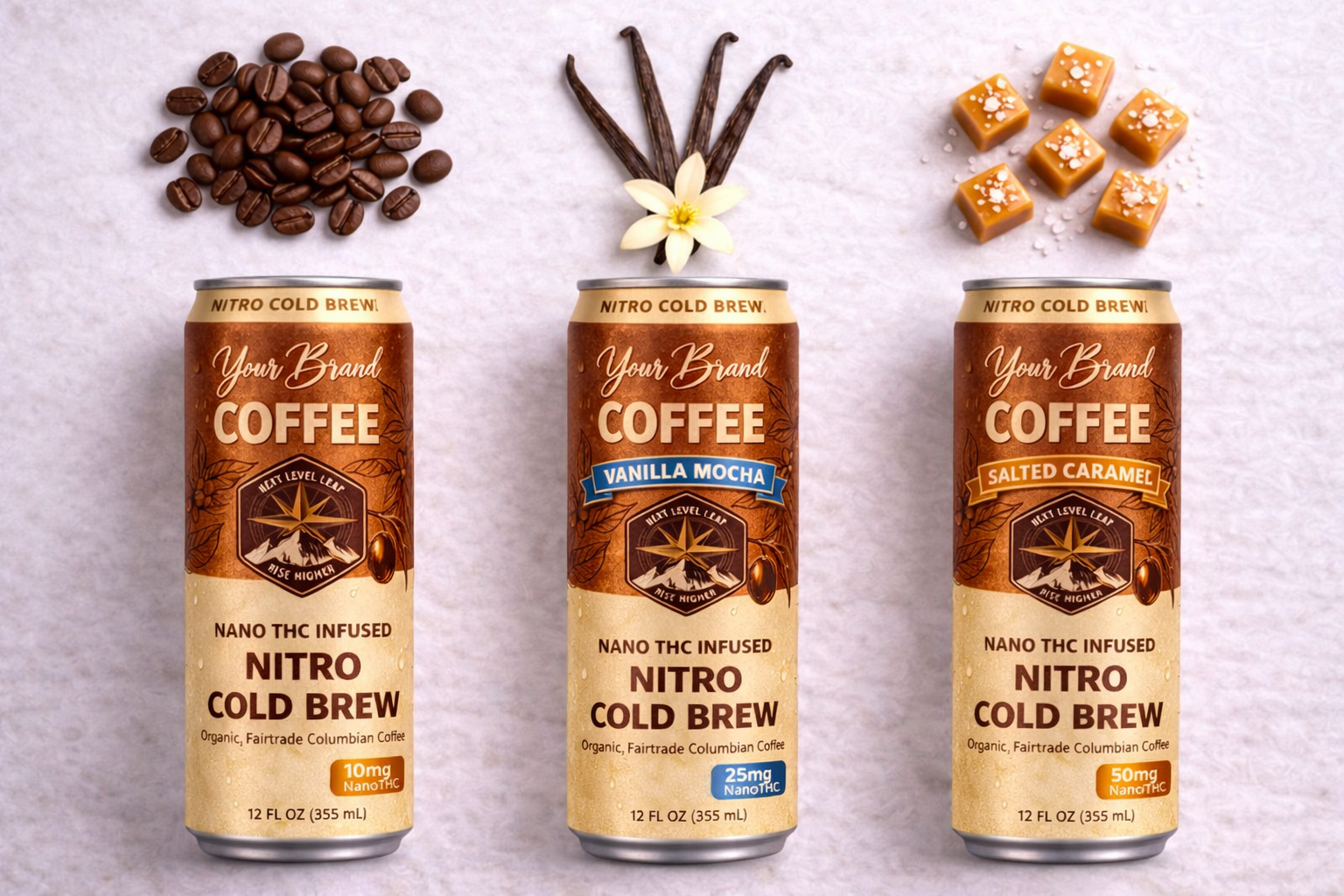
Next Level Leaf helps established brands, retailers, distributors, and growing companies manufacture ready-to-drink THC coffee and nitro cold brew. Start with Black Nitro Cold Brew, Vanilla Mocha or Salted Caramel, adapt an available coffee, bring an existing recipe, or develop a new drink. Production can range from a common 1,200-can commercial run to larger recurring and enterprise programs. A selective 360-can prototype may be considered for a qualified project.
Discuss larger multi-pallet orders, recurring manufacturing, and retail or distributor programs.
A typical initial commercial run equals 50 cases of 24 cans per approved flavor and dose.
Choose Black Nitro Cold Brew, Vanilla Mocha or Salted Caramel when one fits your brand.
A 360-can run may be available when the approved formula, packaging, and schedule support it.
Choose the order size that fits your distribution needs, customer demand, approved product, and production schedule.
Established brands, retailers, and distributors can discuss projects involving 50,000, 100,000, or 300,000+ cans, planned against available capacity, packaging, production timing, and delivery requirements.
A common commercial entry point is approximately 1,200 cans, or 50 cases of 24, for each approved flavor-and-dose combination. Larger multi-pallet orders can be planned when the project requires them.
A smaller 15-case run may be considered for a qualified project after the formula is ready and when ingredients, packaging, production fit, and the testing objective support it.
All order quantities and delivery timelines are confirmed against the approved coffee formula, packaging, available manufacturing capacity, and agreed production schedule.
A THC coffee manufacturer takes your idea or approved recipe and turns it into finished cans. It is more than adding THC to coffee. The drink has to taste good, deliver a consistent dose, run through the canning line, hold up in the package and be practical to make again.
Choose the coffee, flavor, sweetness, THC dose and any additional ingredients, then make sure the recipe works in a full production run.
Confirm the cans, labels or printed cans, carriers and cases before the production date.
Test the finished coffee, connect the results to the correct batch and lot code, and arrange freight to your delivery location.
Before production, you should know exactly what is being made, how many cans you are ordering, what the packaging will look like, what testing is included, where the cases are going and what the full project is expected to cost.
You do not need a finished recipe before you contact us. You can start with a coffee that is already ready for production, make changes to an existing coffee, develop a new drink or bring us a recipe you already own.
| Option | What you start with | When it makes sense | What happens before production |
|---|---|---|---|
| White label | Black Nitro Cold Brew, Vanilla Mocha or Salted Caramel with few or no recipe changes. | You like an available coffee and want the fastest, simplest way to launch. | Choose the coffee, THC dose and package. Finish the artwork, testing plan, quantity and shipping details. |
| Private label | One of our existing coffees with changes for your brand. | You want to change the flavor, sweetness, dose or selected ingredients without starting from scratch. | We review the requested changes, make samples when needed and confirm the final recipe before production. |
| Custom | A new coffee, flavor or blend of ingredients. | Your idea cannot be made by changing one of the available coffees. | We review the idea, make samples, collect your feedback and prepare the approved recipe for a full production run. |
| Your existing recipe | A recipe or finished product that your brand already owns. | You are moving production or need a manufacturer that can make more volume. | We review the recipe, ingredients, production records, samples, testing and package to confirm that we can make it. |
Read White Label THC Coffee, Private Label THC Coffee, or our white-label versus custom coffee guide if you want more help choosing between these options.
You do not have to start with a blank page. These coffee options already have an established recipe and production process:
A bold, coffee-forward option for brands that want the cold brew and nitro experience to lead.
A familiar coffeehouse flavor that brings together coffee, vanilla and chocolate notes.
A sweeter, dessert-style coffee with a flavor customers can understand as soon as they see the can.
Ready to produce does not mean every detail is automatic. We still need to confirm the THC dose, other ingredients, can and label, testing plan and the states where you plan to sell the coffee.
Still cold brew and nitro cold brew are not the same finished drink. Nitro uses nitrogen to change the texture and the way the coffee pours. That choice affects both production and packaging.
| Decision | Still cold brew | Nitro cold brew |
|---|---|---|
| What the customer gets | A regular ready-to-drink cold brew without the nitrogen pour. | A creamier texture and the familiar cascading look when the coffee is poured. |
| What leads the product | The coffee, flavor and convenience of a ready-to-drink can. | The coffee plus the texture and premium feel of nitro. |
| How it is made | The brewing, filling and package are set up for still coffee. | The production process and package must work with nitrogen and create the intended pour and texture. |
| Best next resource | Review How THC Coffee Is Made. | Review the Nitro Cold Brew THC Coffee guide. |
The THC has to mix evenly throughout the coffee so that each can has the intended dose. We also have to consider taste. The emulsion, THC amount and other ingredients can affect bitterness, color, cloudiness and the overall coffee flavor. A water-soluble or nano THC emulsion may be used when it works with the recipe and the type of experience you want to create.
CBD, CBG, CBN and other cannabinoids may also be possible. Functional ingredients can be considered as well, but every added ingredient can change the taste, texture, cost, stability or testing needs. A focused product is often easier for customers to understand and easier to make well.
For the technical side, review Nano THC in Coffee and Best Cannabinoids for Coffee.
A typical first production run is approximately 1,200 cans for each finished product. That equals 50 cases of 24 cans. A finished product means one flavor and one THC dose. A different flavor or dose usually needs its own batch, ingredients, labels, production records and testing.
A prototype run makes finished, packaged cans after the recipe is ready. It can be useful for buyer samples or a limited market test, but the cost per can is usually higher. A 1,200-can run generally gives you a better cost per can and enough inventory to learn how the product sells. The Infused Coffee MOQ guide explains these choices in more detail.
The price per can is important, but it is not the whole budget. The total cost depends on the coffee, ingredients, amount of THC, packaging, testing, number of products and freight.
Starting with one coffee, one flavor and one dose is usually the simplest way to launch. A 12-ounce slim can with a pressure-sensitive label can also help keep the first order easier to manage while you learn what customers want.
Use the THC Coffee Pricing guide to plan the full budget and compare quotes that may include different materials and services.
The can and label have to protect the coffee, display the needed product information and work through production, shipping and retail. A common first package is a 12-ounce slim can with a pressure-sensitive BOPP label. The label is printed separately and applied to the can during production.
Once the final recipe, deposit, artwork, ingredients and packaging are ready, production may be scheduled in about three weeks. A new custom drink, a recipe that needs more work before it can be made in a full batch, or custom-printed cans can add time. The project quote should explain the expected schedule.
The COA for the raw THC ingredient does not replace testing the finished coffee. The final canned drink should be tested under the plan approved for the project. This may include potency and other tests needed for quality or the states where the coffee will be sold.
A batch-specific COA connects the test results to the finished production run. Keep the COA, lot code, final recipe, label version and other batch records together. Retailers and distributors may ask for them, and they also give you a clean record for the next run.
Many ready-to-drink coffee programs are planned for an approximate 12-month shelf life. The final shelf life depends on the coffee, ingredients, recipe, canning process, package and storage. Review THC Coffee Shelf Life before making promises to retailers or distributors.
Decide where you plan to sell the product before the recipe and label are final. THC beverage rules, dose limits, testing, registration, label details and allowed sales channels can differ by state.
A 1,200-can run is about 50 cases. Freight is usually quoted separately because the cost depends on the delivery address and how the shipment must be unloaded. Let us know whether the delivery location has a loading dock, forklift or pallet jack, or whether it needs liftgate or appointment service.
Do not wait until the last few cases are gone to reorder. Track how many cases you sell each week and allow enough time for coffee, THC, labels or printed cans, production, testing and freight. Established brands can also plan larger multi-pallet shipments, recurring production dates, additional retail placements, and enterprise programs around their demand forecasts.
Brands building wholesale coverage can continue with THC Coffee Distribution.
Share the coffee, flavor, dose, ingredients and packaging you have in mind. We can help you decide the simplest way to turn that idea into finished cans.
Request a THC Coffee QuoteThese guides can help you choose the right coffee, estimate the first run, understand pricing and prepare for production.
Tell us the coffee, flavor, dose, packaging, expected order quantity, and production schedule you need. We can discuss an initial commercial run, a larger retail program, or recurring enterprise production.