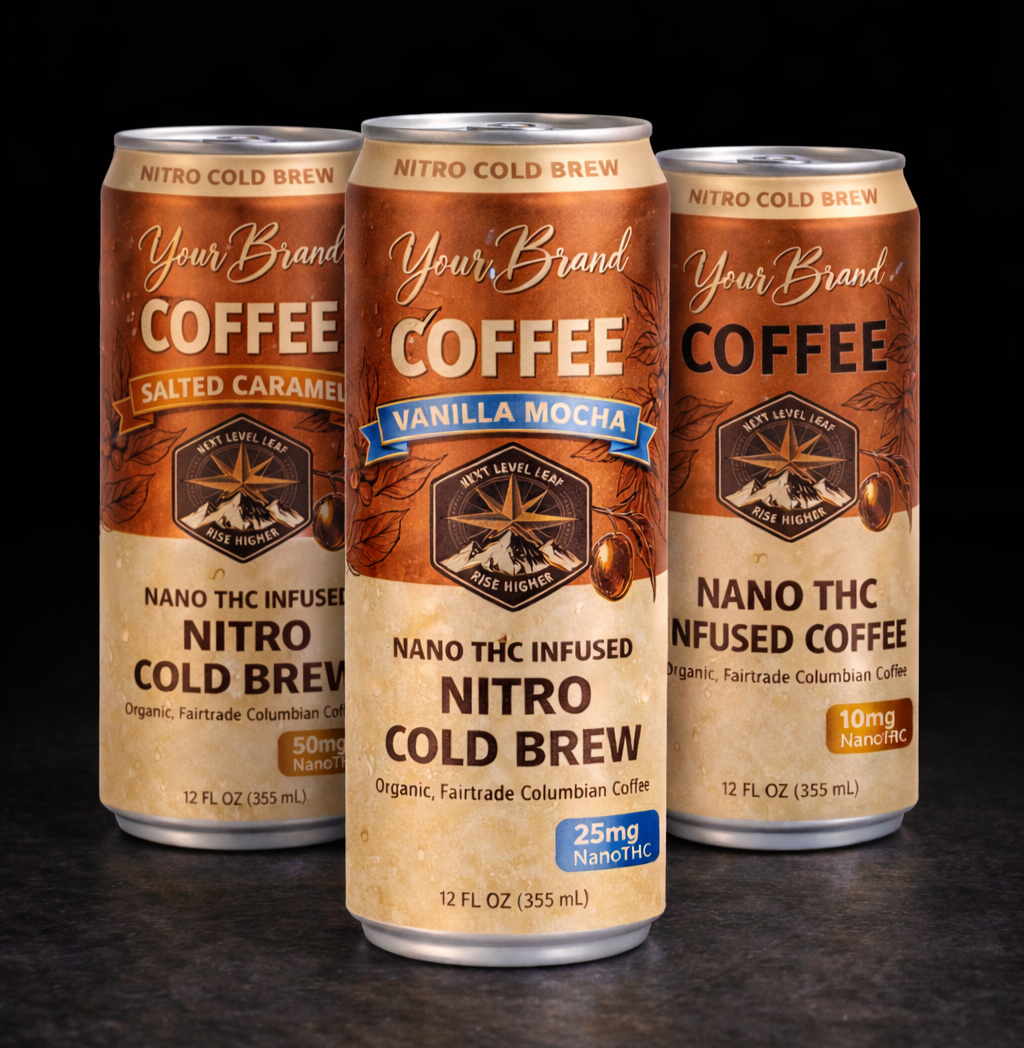
Infused coffee production quantities at a glance
Choose the production scope that matches approved formulation, expected demand, available capacity, packaging, sales channel, and delivery needs.
Established brands and enterprise programs
Discuss approved programs of 50,000, 100,000, or 300,000 or more cans, including recurring multi-pallet orders, when formula approval, materials, available capacity, scheduling, and delivery requirements support that volume.
Commercial manufacturing
A common commercial starting point is approximately 1,200 cans per approved product, equivalent to about 50 cases of 24, subject to packaging, ingredients, formulation, and manufacturing scope.
Selective qualified prototype
Approximately 360 cans, or about 15 cases of 24, may be considered selectively after formula approval for qualified projects when packaging, available capacity, and project objectives support a limited run.
Quantities are not guaranteed and are confirmed only after the approved formulation, packaging, manufacturing capacity, timing, testing, and delivery requirements are reviewed.
How flavors, strengths, and SKUs affect the total order
The approximately 1,200-can commercial quantity generally applies to each approved finished product, not automatically to the entire order. Different flavors, formulas, approved cannabinoid strengths, or packaging may require separate production records, labels, testing, and manufacturing runs.
| Approved production plan | Approximate cans | Approximate cases |
|---|
| One approved commercial coffee product | 1,200 cans | 50 cases of 24 |
| Two approved coffee products or flavors | 2,400 cans total | 100 cases of 24 |
| Three approved coffee products or flavors | 3,600 cans total | 150 cases of 24 |
| Selective qualified prototype | 360 cans | 15 cases of 24 |
| Larger established-brand production | 50,000, 100,000, or 300,000 or more cans | Confirmed by approved package and delivery plan |
For example, Black Nitro Cold Brew and Vanilla Mocha generally represent two separate products. A different approved dose, formula, or package can also create a separate SKU. Salted Caramel or another approved coffee direction may require its own production scope.
Packaging can have its own minimums
Pressure-sensitive labels may be practical for approved commercial runs, while custom-printed cans or specialized packaging can have separate supplier minimums, artwork requirements, and production lead times. Final packaging options are confirmed during project review.
Cases, freight, and receiving requirements matter
Fifty cases, multiple pallets, or larger recurring shipments require different storage, delivery, and receiving plans. Confirm the delivery address, loading dock or liftgate needs, freight appointments, case configuration, and projected replenishment schedule.
What MOQ actually means in a beverage launch
MOQ stands for minimum order quantity. For an approved infused coffee product, a common commercial starting point is approximately 1,200 cans, or 50 cases of 24. The final number depends on formulation, packaging, ingredients, manufacturing capacity, and the overall project requirements.
That number is influenced by several things:
- production line realities
- ingredient purchasing
- packaging requirements
- freight efficiency
- whether the product is more standardized or more custom
In other words, MOQ is not just a random threshold. It exists because beverage production has real-world setup and efficiency constraints.
Why MOQ matters so much for infused coffee founders
Order quantity affects production cost, packaging, freight, inventory, available working capital, and sales-channel planning. A founder preparing a first run, a retailer planning store inventory, and an established brand scheduling recurring production may need different approved quantities.
MOQ affects your startup exposure
A higher MOQ usually means more upfront capital tied up in product and a larger inventory commitment. That may make sense for some brands, but not for everyone at the beginning.
MOQ affects unit economics
Lower MOQs can be more accessible, but they often come with higher per-unit costs. Larger runs can improve efficiency, but they also increase inventory and capital commitment. Businesses have to balance both sides of that equation.
MOQ affects how intelligently you can test
One of the biggest benefits of a more practical MOQ is that it can allow a brand to test the category, packaging, and response without overcommitting too early.
The best MOQ is not automatically the smallest one. It is the one that best matches your brand stage, launch plan, and risk tolerance.
How to think about your first infused coffee production run
Use the approximately 1,200-can commercial baseline as a starting point, then compare the approved formula, number of products, sales channel, packaging, delivery needs, and working capital required for your business.
Start with the role of the first run
Your first run is usually for validation, credibility, and market entry. It is not always meant to represent your fully scaled future business.
Work backward from your launch plan
Ask yourself where the product is going, how it will be sold, and how quickly you expect to move inventory. MOQ should connect to a real go-to-market plan, not just a desire to “start big.”
Keep the concept tight
It is easier to make an MOQ work when the concept is focused. A strong coffee-first product with clear positioning is often better than a scattered concept trying to do too much at once.
Why coffee brands often justify higher MOQs
Some established brands, retailers, and distributors may need larger approved production quantities to support existing sales channels, inventory requirements, or recurring replenishment. The right order size should be based on actual demand, available manufacturing capacity, packaging, freight, delivery timing, and the approved project plan; repeat sales or customer retention cannot be assumed.
Common MOQ mistakes founders make
Choosing a number without a strategy
MOQ should fit your launch plan. It should not be treated like a trivia number disconnected from how the brand will actually enter the market.
Assuming lower is always better
A lower MOQ may feel safer, but sometimes it creates weaker unit economics or a less efficient path. There is a balance between caution and practicality. Make sure you have considered unit economics that improve as scale goes up.
Ignoring packaging and freight implications
MOQ is tied to more than product volume. Packaging decisions and freight realities can materially affect how sensible a specific order size really is.
Building too broad a first run
Too many SKUs or too many concept layers can make an MOQ harder to manage well. Founders often do better with one strong lead concept first.
What to do next after understanding MOQ
Once MOQ is clearer, the next questions are usually about overall launch strategy and cost.
- Use the cost article to understand the broader startup variables
- Use the launch article to understand the overall path from concept to finished inventory
- Use the main infused coffee page to keep the big-picture coffee-first strategy in view
Match the production quantity to the buyer journey
Established beverage brands
Start with projected sales, approved formula, existing distribution, order frequency, inventory goals, packaging availability, and realistic delivery schedules. Discuss larger or recurring production when the complete manufacturing plan supports it.
Retailers, distributors, and wholesalers
Estimate store count, sales territory, packaging needs, case requirements, replenishment timing, freight, and whether the product will be white-label or private-label.
Founders planning a commercial launch
Choose an approved first product, confirm whether approximately 1,200 cans per SKU fits the actual launch plan, and budget for packaging, finished-product testing, freight, storage, and future reorders.