


Established brands and larger programs
Discuss 50,000, 100,000, or 300,000+ can planning scenarios, subject to formula, packaging, available capacity, scheduling, and delivery requirements.
Plan THC coffee pricing around your actual product, sales channel, and production scope—from an approximately 1,200-can-per-SKU commercial launch to larger programs for established beverage brands, retailers, and distributors.
Useful quotes account for coffee format, approved product specifications, packaging, testing, freight, landed cost, and the volume required to support both the current order and future production.
Updated August 22, 2026 · Reviewed by Next Level Leaf
THC coffee pricing is project-specific. Coffee format, approved formulation, packaging, testing, production quantity, freight, and sales-channel requirements shape the final quote. A typical commercial program starts around 1,200 cans per SKU, while larger qualified brands can discuss recurring and enterprise-scale production subject to manufacturing requirements and available capacity.
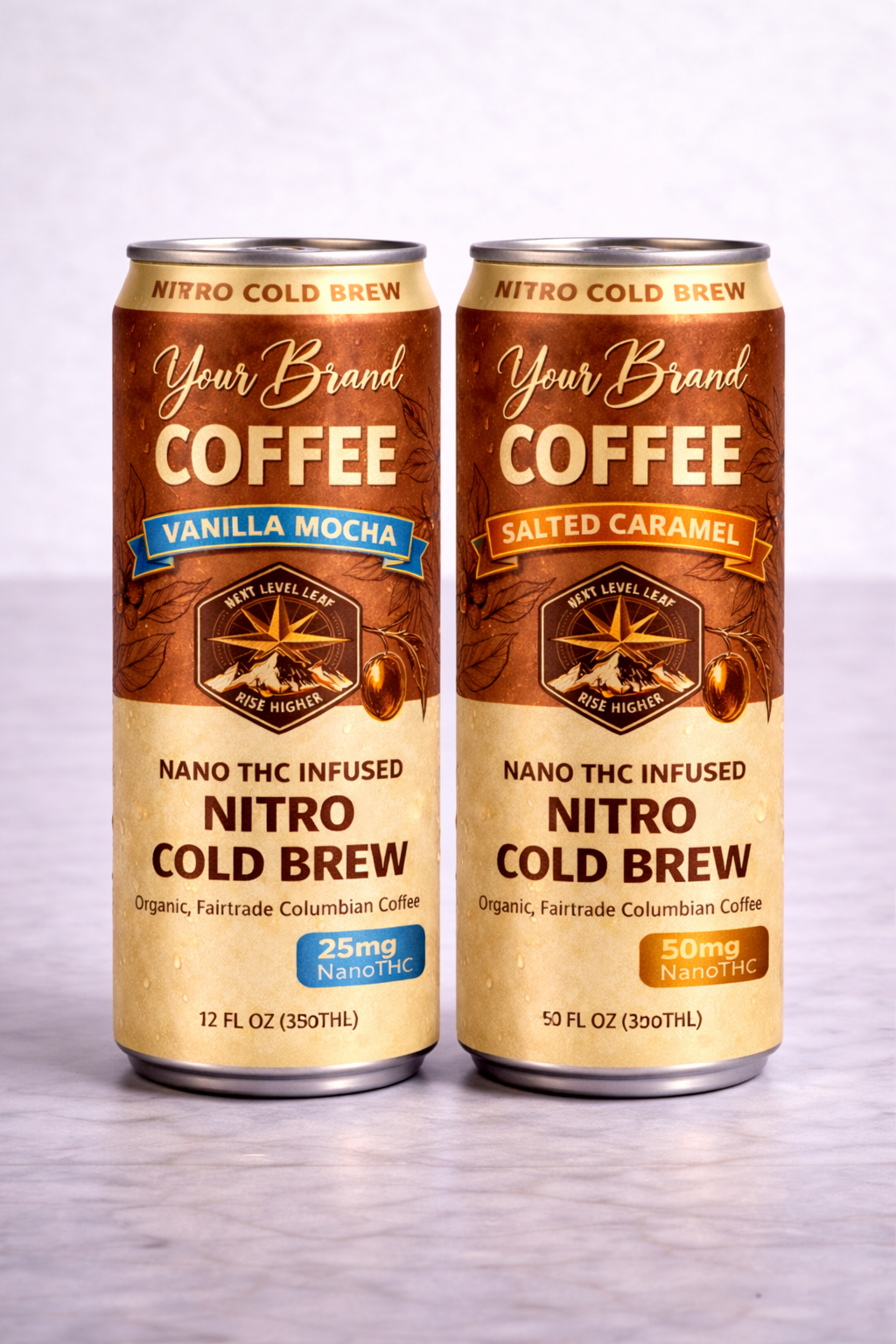
A useful THC coffee quote connects the finished beverage to the actual business plan. Coffee base, approved formulation, packaging, production setup, testing, freight, and the intended sales channel all affect the program. A black nitro cold brew and a flavored ready-to-drink coffee can have different requirements even when the can size is the same.
Next Level Leaf supports founders evaluating a first commercial launch and established beverage brands, retailers, and distributors planning larger production programs. The right question is not simply “What does a can cost?” It is “What product, volume, packaging, and delivery plan does this business actually require?”
Evaluate the coffee format, approved cannabinoid specification, flavor direction, production setup, testing, label requirements, and case configuration together.
Compare landed cost, delivery requirements, intended retail position, channel economics, order volume, and the likelihood of recurring production.
Pricing is shaped by decisions that interact with one another. An attractive initial production assumption may stop being useful if the finished format, packaging, testing, or delivery plan is incomplete.
A standard commercial starting point is approximately 1,200 cans per SKU, equal to 50 cases of 24. Each approved flavor or formula is generally evaluated as its own SKU, so a three-flavor commercial launch could be planned around approximately 3,600 cans total, subject to the approved scope.
A selective qualified project may be considered for approximately 360 cans per SKU, or 15 cases of 24, when a prototype is appropriate. This is an exception for validation, not the standard commercial offer. Setup, packaging, testing, and freight can behave differently at smaller quantities.
Discuss 50,000, 100,000, or 300,000+ can planning scenarios, subject to formula, packaging, available capacity, scheduling, and delivery requirements.
Begin with an approved commercial program, 50 cases of 24, and a clearly defined product, packaging, delivery, and reorder strategy.
A limited qualified prototype, 15 cases of 24, may be considered where the approved concept and production schedule support it.
Planning principle: Larger quantities may improve purchasing, setup, packaging, or freight efficiency, but pricing is never guaranteed from volume alone. Every program depends on the approved product, production requirements, available capacity, and delivery plan.
Compare programs using the same product definition and commercial assumptions. A lower headline production number is not a better result if packaging, freight, testing, delivery requirements, or the number of SKUs are different.
| Planning stage | What to confirm | What the buyer learns |
|---|---|---|
| Selective prototype | Approved formula, approximately 360 cans per SKU, packaging, testing, and qualification. | Whether a limited concept-validation run fits the actual project. |
| Commercial launch | Approximately 1,200 cans per SKU, number of flavors, delivery destination, and intended sales channel. | How the launch scope connects production volume to sell-through and inventory planning. |
| Multi-SKU program | Quantity for each approved product, coordinated packaging, flavor requirements, and case counts. | Whether the overall order matches the channel and avoids overextending the initial launch. |
| Enterprise or recurring production | Formula, packaging, available capacity, scheduling, delivery requirements, and repeat-order expectations. | How larger-volume production can be scoped without assuming unverified capacity or pricing. |
Manufacturing cost is only one part of the commercial equation. Work backward from the intended shelf position and include packaging, freight, landed cost, channel requirements, promotional needs, and the operating room required for future production.
This page explains the commercial planning framework while keeping project-specific manufacturing terms private. Actual pricing belongs in a project-specific quote after the relevant product and delivery details are confirmed.
Confirm coffee format, flavor, approved formulation, packaging, and the number of individual SKUs.
Account for the quoted production scope, packaging, testing, freight, and applicable delivery requirements.
Evaluate realistic shelf positioning, retailer or distributor requirements, sell-through assumptions, and reorder planning.
Landed cost = approved production scope + applicable packaging + testing or documentation requirements + freight and project-specific delivery charges. Ask which items are included, which are quoted separately, and which depend on final artwork, production scheduling, or the receiving location.
A delivery that requires a liftgate, appointment, limited-access service, or a specific pallet configuration can have different logistics requirements from a standard commercial dock. These details should be part of quote planning rather than discovered after the production decision.
Premium positioning works best when the product format, coffee experience, packaging, documentation, and channel fit support the story. Black Nitro Cold Brew, Vanilla Mocha, and Salted Caramel illustrate different approved flavor directions a buyer may explore based on project fit.
A strong premium strategy does not guarantee a particular price, margin, sell-through, or production outcome. It helps a buyer decide whether the finished concept matches the customer, sales channel, packaging, and reorder expectations.
Start with the Infused Coffee hub, evaluate nitro cold brew, and review the THC coffee manufacturing approach.
Compare launch cost planning, infused coffee MOQ, and launch execution.
Explore white-label THC coffee, private-label programs, and the project-specific quote process.
Connect pricing decisions to product strategy, production requirements, distribution, and the next step in your buying process.
Share your product format, number of SKUs, approximate volume, packaging preferences, delivery location, and timeline. We’ll help scope a project-specific commercial launch or larger production program.