

Full-panel testing
Cannabis-infused beverages we recommend are expected to be produced and tested to high standards, with full-panel testing as part of a responsible safety approach.
Safe products, clean ingredients, and responsible labeling matter. This page explains how we think about beverage quality, testing, and labeling awareness for infused beverage brands.
This is not legal advice, and we are not attorneys. The goal here is to show the standards we prioritize, explain why label review matters, and point brands toward useful resources as they move toward launch.
Our compliance philosophy starts with product safety, clean formulation standards, traceability, and responsible labeling. We prioritize beverages that are produced to high standards, fully tested where applicable, supported by corresponding COAs, and tied to batch-level documentation that helps brands operate more responsibly.
Product Standards
We believe infused beverages should feel like real beverage products, not shortcuts. That means clean formulation standards and ingredient decisions that support trust.
We advocate for organic and natural ingredient approaches whenever practical. We do not use artificial colorings, artificial flavorings, or high-fructose corn syrup unless those choices are specifically requested for a project.
Safe products are important to us. We want the products we recommend to be approached with the same level of care we would expect for our own families, friends, and the public.
Testing and Traceability
Testing and batch traceability are two of the most important things to consider.
Cannabis-infused beverages we recommend are expected to be produced and tested to high standards, with full-panel testing as part of a responsible safety approach.
Full-panel Certificates of Analysis should be available to support batch-level transparency and help brands, buyers, and consumers understand what is in the product.
Batch numbers printed on the can or packaging help connect the physical product to the corresponding test record and improve traceability.
Whether the product is being positioned for hemp, medical, or adult-use markets, safety documentation and product standards should be treated seriously.
Labeling Awareness
Labeling is one of the highest-risk parts of launch because the rules can change by market, product type, packaging format, and jurisdiction.
Beverage labels can sit at the intersection of food law, cannabinoid law, market-specific rules, warning language, testing disclosures, and marketing restrictions.
We can help brands think through operational and practical label considerations, but we do not provide legal advice or guarantee that a label is compliant in any jurisdiction.
If you are taking a product to market, label review by qualified counsel is a smart step before commercial use and again whenever you expand into new states or update the product.
This page is provided for informational and operational awareness only. Next Level Leaf is not a law firm and does not provide legal advice, legal review, or jurisdiction-specific compliance approval.
You are responsible for ensuring that your product, packaging, claims, labeling, distribution, and marketing comply with all applicable federal, state, and local laws in every jurisdiction where your product is manufactured, shipped, marketed, or sold.
Before commercial use, brands should have labels reviewed by qualified legal counsel with experience in cannabis, hemp, food, beverage, and labeling compliance.
Practical Checklist
This is not a legal checklist. It is a practical awareness list of the kinds of items brands often need to evaluate.
If you are evaluating this for your brand, start with the process page and then explore beverage manufacturing here.
Proactive Example
This example shows how some brands approach labeling when aiming for a higher standard of transparency, safety, and multi-state readiness.
This is a hypothetical example based on publicly available guidance and industry practices. It is not legal advice and must be reviewed by qualified legal counsel before use.
Reference Visual
A real-world style example can help founders see how potency, symbols, and warning elements often need to work together visually.
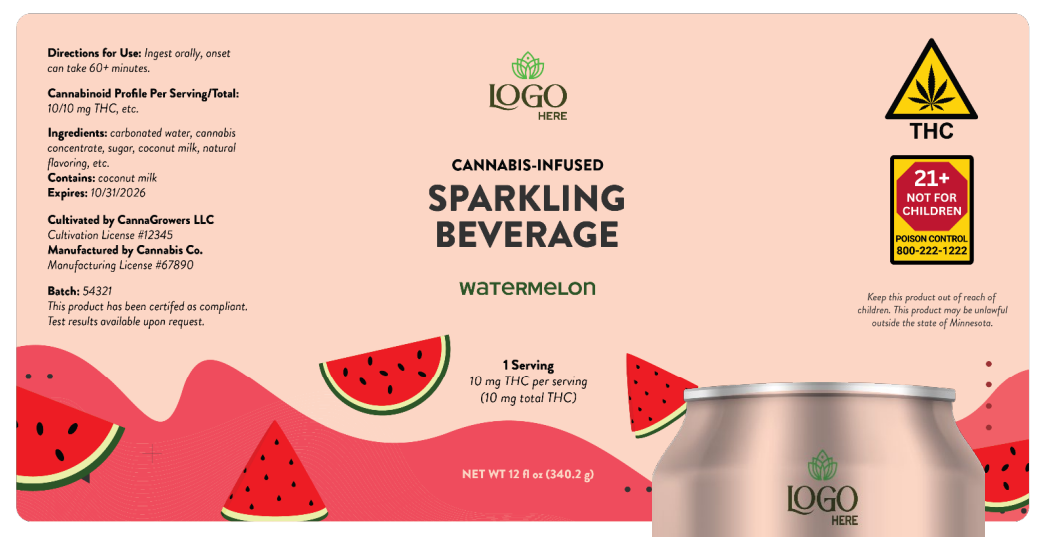
Example screenshot from the Minnesota Office of Cannabis Management Packaging and Labeling Guide, used here for educational reference. View the full guide.
Many founders understand the idea of “needing a compliant label” but have never seen how all the required and risk-sensitive elements actually fit together on a can, carton, or multipack.
That is why reference examples can be useful. They help translate abstract compliance language into real packaging decisions that affect design, readability, and launch readiness.
Advanced Considerations
These are the kinds of packaging and labeling details that often surface later than they should.
In some regulated frameworks, required symbols, statements, and other information must appear on the outermost visible retail layer of the product. If the package has only one layer, that outer surface is effectively the marketing layer.
Practically, that means important information should not be hidden under peel-away panels, secondary stickers, or outer packaging that creates ambiguity about what the consumer must see first.
If beverages are sold in multipacks, the outer packaging should not create confusion about what is inside. Serious brands think carefully about how potency, servings, and unit-count information are communicated at both the outer-pack and individual-unit level.
This is one of the easiest places for an early-stage brand to create avoidable label problems when moving from concept to retail.
Common Mistakes
Many compliance problems are created less by what a brand includes and more by how the packaging is presented.
Packaging that uses candy-style cues, cartoons, toy-like imagery, or other child-directed signals can create serious problems.
Packaging should not resemble popular non-cannabis products in a way that creates confusion or mimicry risk.
Critical information should not be obscured by stickers, layered packaging, peel-away elements, or poor contrast and unreadable typography.
Labels and packaging should avoid disease, cure, treatment, or other high-risk medical-style claims unless specifically permitted and supported.
Medical-Grade Thinking
Some brands intentionally design labels to a higher internal standard than the minimum required in a single market.
A label that is easier for a consumer, retailer, regulator, or attorney to understand is usually a better label. It also tends to support trust, improve internal discipline, and reduce costly redesigns later.
That does not replace legal review, but it does reflect a more serious operator mindset.
Official and Industry Resources
These are public resources that can help brands understand the broader regulatory environment. Review the latest guidance directly from the source.
FDA’s public overview of cannabis-derived products, including its current position on THC and CBD in foods and dietary supplements.
Visit resource →Useful consumer-facing summary of FDA’s current position and safety concerns around cannabis-derived products.
Visit resource →Helpful background on the ASTM D8441 intoxicating-cannabinoid symbol and why consistent visual warnings matter.
Visit resource →A detailed real-world example of how one high-standard state framework approaches packaging, warnings, symbols, and product-specific label structure.
Visit resource →Industry guidance touching on COA access, batch numbers, cannabinoid disclosures, nutrition facts, and no-health-claim expectations.
Visit resource →Useful research showing how labeling requirements vary across U.S. state cannabis programs and why state-specific review matters.
Visit resource →Important if your concept overlaps with alcohol regulation or you are comparing hemp beverage pathways with alcohol beverage frameworks.
Visit resource →Always review the latest rules in every state where the product will be manufactured, distributed, or sold.
Start with official state portals →Attorney Resources
The firms below publicly describe practice areas relevant to hemp, cannabis, food, beverage, labeling, or cannabinoid regulatory work. This list is provided for convenience only. It is not an endorsement, we are not affiliated with these firms, and we receive no compensation for mentioning them.
Publicly describes a hemp food and beverage practice that includes reviews of hemp food and beverage labeling and marketing materials.
Visit firm resource →Well-known hemp and cannabis attorney focused on regulatory compliance, cannabinoids, and federal and state legal frameworks.
Visit firm resource →Food and drug-focused firm with a cannabis, hemp, and cannabinoids practice and broader food-labeling experience.
Visit firm resource →Publicly describes cannabis and hemp regulatory work that includes packaging, labeling, marketing, and advertising restrictions.
Visit firm resource →National cannabis and hemp practice with hemp and cannabinoid compliance resources, including beverage-related guidance.
Visit firm resource →Publicly available information about its state-by-state hemp and cannabinoid compliance guide.
Visit guide resource →Ask whether they review beverage labels, state-by-state compliance, warnings, functional claims, batch and COA language, and multi-state launch strategy.
FAQ
These answers are meant to support awareness, not replace legal review.
If you are evaluating an infused beverage concept and want to think through product standards, production fit, and the next step toward launch, start here.
Add Next Level Leaf as a Preferred Source so our newest hemp beverage compliance, state-resource, and manufacturing updates are easier to find in supported Google Search and AI experiences.
Your Google source preferences stay under your control and can be changed at any time.