Create private-label ready-to-drink coffee for established beverage brands, retailers, distributors, and qualified commercial launches, with an approved formula, flavor, ingredients, and packaging built around your brand.
Plan anything from an approximately 1,200-can commercial starting run to larger enterprise and recurring production programs, based on the approved formula, available capacity, packaging, and delivery requirements.
Published and maintained by Next Level Leaf · Updated August 22, 2026
Private-label coffee lets you start with an approved ready-to-drink coffee and build a production program around your brand. Choose the coffee direction, flavor, sweetness, cannabinoid or functional ingredients, and packaging that fit your project. After samples and the final formula are approved, production can range from an approximately 1,200-can commercial entry point to larger recurring or enterprise programs when capacity, materials, and scheduling support the plan.
Private-label coffee production built for the size of your business
Established brands, retailers, distributors, wholesalers, and growing companies have different production needs. Start with your actual sales channel, delivery plan, approved formula, packaging, and expected order volume.
Established Brands & Enterprise
Larger production programs
Discuss recurring multi-pallet production and approved programs of 50,000, 100,000, or 300,000 or more cans based on available production capacity, formula approval, packaging availability, delivery requirements, scheduling, and project economics.
Commercial Launch
Approximately 1,200 cans per product
A common commercial starting quantity is about 1,200 cans, or 50 cases of 24, for each approved flavor, dose, formula, and package.
Selective Prototype
Limited qualified test programs
A 360-can prototype run may be considered selectively after the approved recipe is ready, when packaging, production capacity, and project objectives make a limited run practical.
Final production quantities, lead times, materials, testing, freight, and scheduling are confirmed for the approved project. Larger orders and recurring replenishment depend on available capacity and the complete manufacturing plan.
You do not have to develop every part of the coffee from scratch. We can begin with something proven and focus the work on the choices that make the product yours.
Start
Choose a great coffee
Begin with a ready-to-drink coffee that is already a good fit for production.
Create
Make it your own
Choose the flavor, sweetness, dose, ingredients and package that fit your brand.
Approve
Taste it before production
Review the samples, request changes and approve the final recipe before the first run.
What is private label THC coffee?
Private label THC coffee is ready-to-drink coffee made for your brand. It gives you more freedom than simply putting your label on a finished product, but it does not require you to build a completely new coffee from the ground up.
We can start with one of our existing coffees and look at the changes you want to make. That might mean a different flavor, less sweetness, a different THC dose, another cannabinoid, a functional ingredient or a different package. The goal is to create a coffee that feels like your product and can be made the same way again when you reorder.
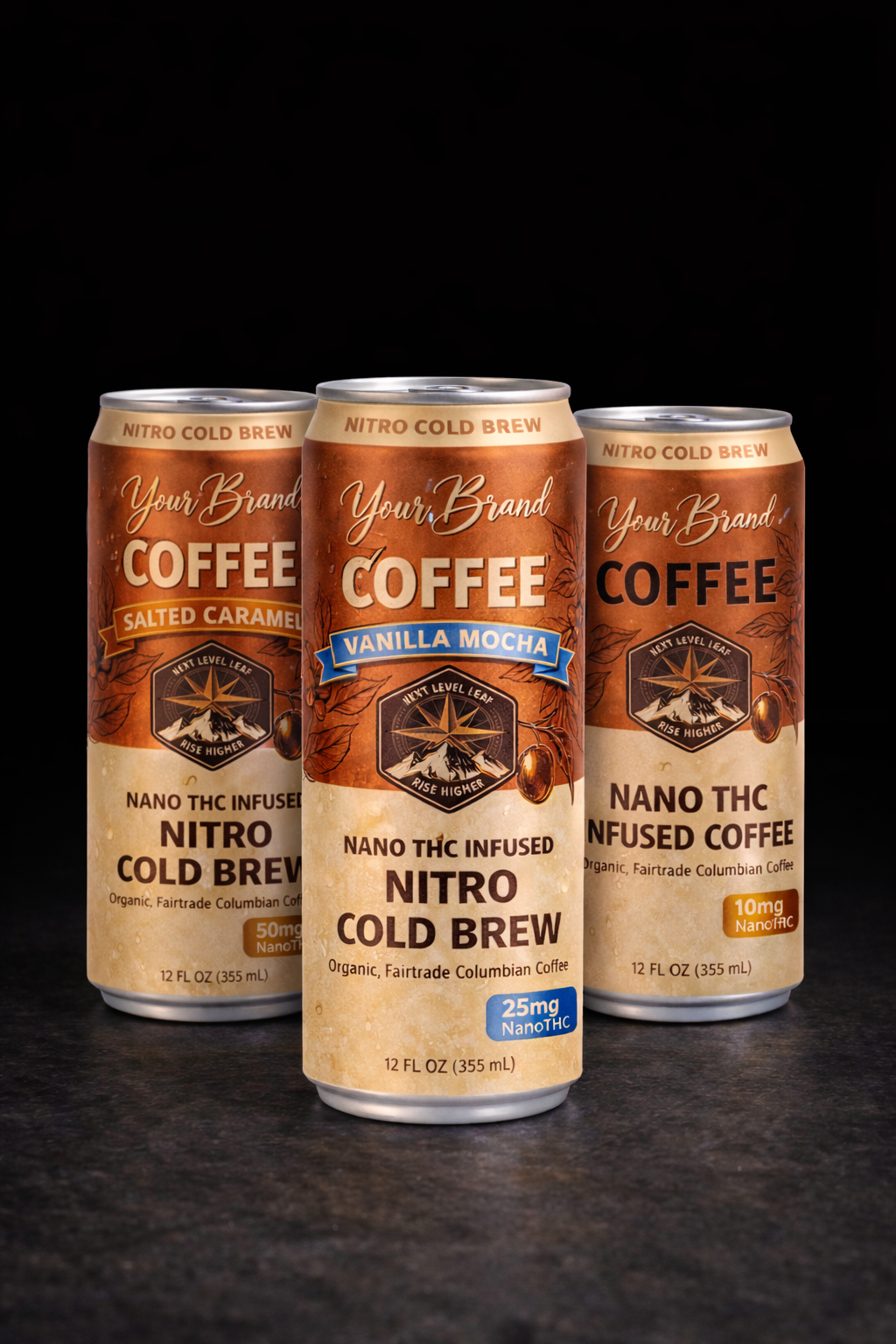
Private label may be the right fit when one of our coffees is close to what you want, but you still want to change it. If Black Nitro Cold Brew, Vanilla Mocha or Salted Caramel already fits your idea, White Label THC Coffee may be the faster path. If you want a completely new coffee or a complicated blend of ingredients, the project may need custom development.
What is the difference between white label, private label and custom coffee?
These terms can mean different things from one manufacturer to another. We use them to describe how much work the coffee needs before it is ready to produce.
Option
What you start with
Best when
What happens next
White label
One of our finished coffee recipes
You want the fastest and simplest way to launch
Choose the coffee and dose, finish the label and package, then schedule production and testing
Private label
An existing coffee that you want to change
You want your own flavor, sweetness, dose or added ingredients
We review the changes, make samples, collect your feedback and finish the recipe
Custom
A new idea that cannot be made from an existing coffee
The product depends on a unique coffee, process, flavor or blend of ingredients
More research, development, tasting and testing are needed before production
You do not have to begin with a blank page. These production-ready coffees give you a clear place to start:
Coffee-Forward
Black Nitro Cold Brew
A smooth, coffee-first option for a brand that wants less sweetness and a true cold-brew taste.
Coffeehouse
Vanilla Mocha
A familiar coffeehouse flavor with chocolate and vanilla notes that are easy for customers to understand.
Rich and Sweet
Salted Caramel
A sweeter option with a rich caramel flavor and a touch of salt to balance the coffee.
These are starting points, not limits. We can review the coffee, flavor, sweetness, cannabinoids and other ingredients you want. Some changes are simple. Others can affect taste, stability, cost or the way the beverage is made, so we confirm what will work before development begins.
Starting with one coffee and one dose can make the first launch easier to manage. More flavors and strengths can be added later.
What can you change in a private label THC coffee?
The final drink has to do more than sound good on paper. It has to taste good, stay consistent, work with the canning process and be practical to make again. We review all the ingredients together before we confirm the recipe.
Choice
What you may be able to change
What we need to check
Coffee
Coffee style, roast character or cold-brew direction
A completely different coffee base or brewing method may need custom development
Flavor and sweetness
Flavor, sweetness level and the balance between the coffee and added flavor
Some flavors or sweeteners need more development to work well in coffee
THC dose
A dose that fits the product and customer
Each different dose usually needs its own label, production run and finished-product test
Other cannabinoids
CBD, CBG, CBN or other cannabinoids when they work with the recipe
Higher amounts or more complex ratios may affect taste, cost and stability
Functional ingredients
Selected ingredients that fit the coffee and your product idea
Some ingredients change the flavor, color, texture or shelf life and need more testing
Can and artwork
Brand design, product name, flavor, dose and package style
Printed cans, unusual sizes or special parts can require more time and higher minimums
Tell us what you want to make. Explain the type of coffee, flavor, sweetness, THC dose, added ingredients and package you have in mind.
Choose the closest starting coffee. We compare your idea with Black Nitro Cold Brew, Vanilla Mocha, Salted Caramel or another workable coffee direction.
Review the changes. We determine which changes should be straightforward and which ones may need more development.
Taste the samples. You try the coffee, tell us what you like and what you want changed, and we make the agreed revisions.
Approve the final recipe. Before production, you approve the coffee, flavor, sweetness, dose and ingredients.
Finish the can and label. The artwork, UPC, product details and packaging are completed for the approved drink.
Produce and test the coffee. The coffee is made, canned and tested. The batch-specific certificate of analysis, or COA, reports the finished-product test results.
Ship the cases and plan the reorder. Once the batch is released, the finished cases ship to you. Your final recipe and approved label give the next run a clear starting point.
What is the minimum order for private label THC coffee?
A typical first production run is approximately 1,200 cans for each finished product. That equals 50 cases of 24 cans. A different flavor or THC dose usually counts as a separate product because it may need different ingredients, labels, production records and testing.
One product: approximately 1,200 cans, or 50 cases.
Two products: approximately 2,400 total cans when each one has its own 1,200-can run.
Larger established-brand programs: approved production of 50,000, 100,000, or 300,000 or more cans may be evaluated based on formula, packaging, available capacity, scheduling, and delivery requirements.
Selective prototype: a 360-can run, or 15 cases, may be considered for qualified projects after the approved recipe is ready.
Samples and a prototype run are not the same thing. Samples are used to develop and approve the recipe. A prototype run makes finished, packaged cans after the recipe is ready. The cost per can is usually higher, but the smaller run can be useful for buyer samples or a limited test.
A 1,200-can run gives you about 50 cases to sell across stores, direct customers or launch events. It also usually has a better cost per can. Read our Infused Coffee MOQ guide for more help planning the first run.
What should you include in your budget?
Private label coffee usually has two main costs: developing the drink and producing the finished cans. Your budget may include:
Reviewing the idea, making samples and completing the agreed revisions
Coffee, flavor, sweetener, THC and any additional ingredients
12-ounce slim cans, labels or printed cans, carriers, trays and cases
Finished-product testing and the batch-specific COA
Production setup and separate runs for different flavors or doses
Freight and any liftgate or delivery appointment charges
Storage, marketing samples and money set aside for the next run
A focused first product is usually easier and less expensive to develop. Starting with one coffee, one flavor, one dose and a short ingredient list makes it easier to judge the samples and control the cost.
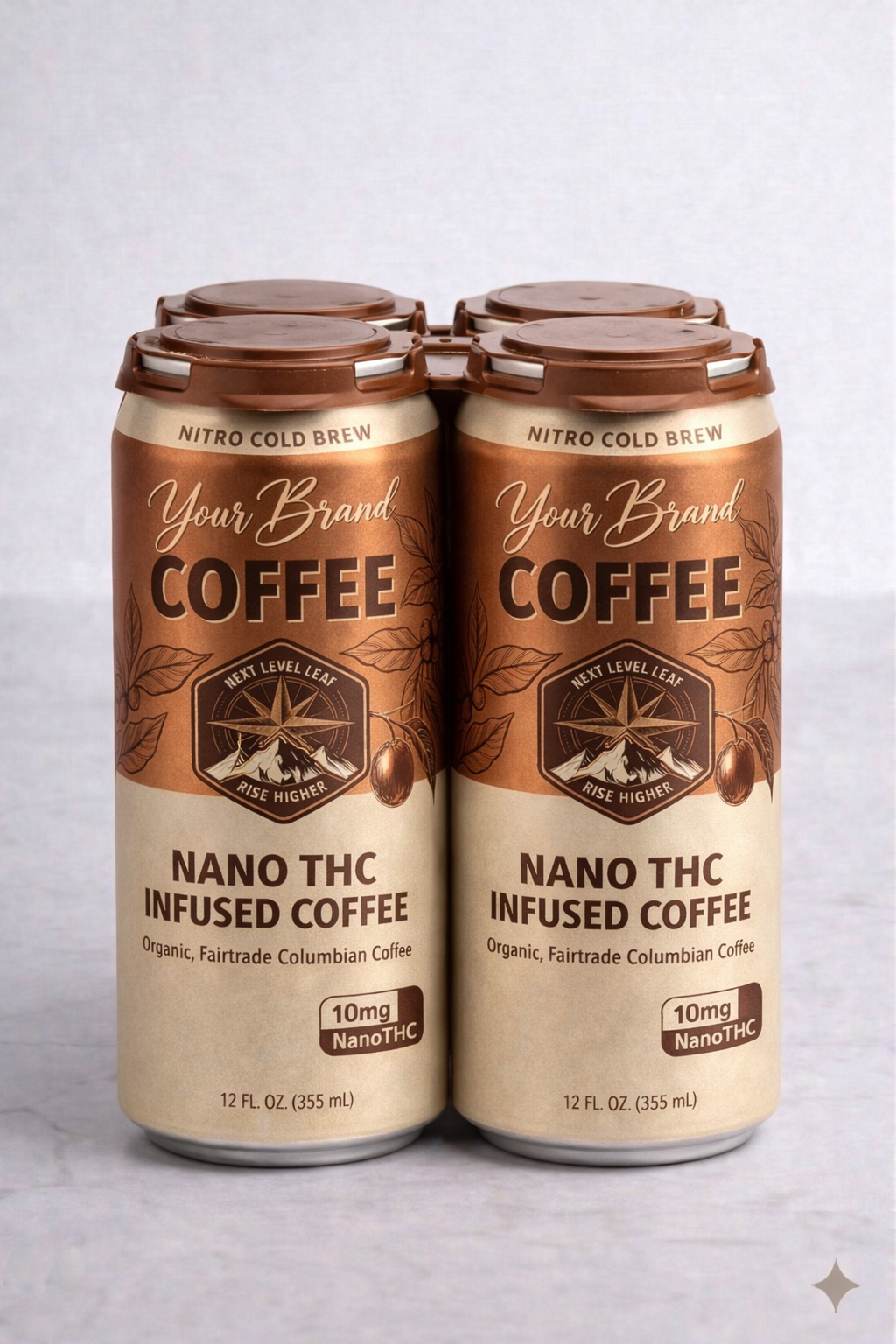
A common first-run package is a 12-ounce slim can with a pressure-sensitive BOPP label. The label is printed separately and applied to the can during production. This can be a practical choice for a smaller launch because you do not have to order a large number of custom-printed cans.
Pressure-sensitive labels: easier to use for lower volumes and easier to update after your first run.
Digitally printed cans: a polished option that usually requires more cans and more lead time.
Product information: the can may need the product name, flavor, net contents, THC dose, serving information, ingredients, UPC and other required details.
Cases and carriers: decide how the cans will be packed for shipping, retail and multipack sales.
Lot code: each can and case should be traceable to the batch in which it was made.
Finish the recipe before the final label is printed. Changes to the ingredients, dose or serving size can affect the artwork and product information.
How are the finished cans tested?
The COA for the raw THC ingredient does not replace testing the finished coffee. The final canned product should be tested under the plan approved for the project. This may include potency and other panels required for quality or the intended sales market.
A batch-specific COA connects the test results to the finished production run. Keep the COA, lot code, final recipe, label version and other batch records together. Retailers and distributors may ask for this information, and it also gives you a clean record for the next run.
THC beverage rules can differ by state. Review the THC Coffee Compliance guide while planning the product and label.
How long does private label THC coffee take?
The first part is product development. The time depends on the changes you request, the ingredients, how many sample rounds are needed and how quickly feedback is provided.
Once the final recipe, deposit, artwork, ingredients and packaging are ready, production may be scheduled in about three weeks. The schedule can be longer when the project needs custom-printed cans, hard-to-find ingredients, late artwork changes or more development.
Many ready-to-drink coffee programs are planned for an approximate 12-month shelf life. The final shelf life depends on the coffee, ingredients, recipe, canning process, package and storage. Read THC Coffee Shelf Life before making promises to retailers or distributors.
How do freight and reorders work?
A 1,200-can run is about 50 cases. Freight is usually quoted separately because the cost depends on the delivery address and how the shipment must be unloaded. Let us know whether the delivery location has a loading dock, forklift or pallet jack, or whether it needs liftgate or appointment service.
A reorder is simplest when the recipe and label stay the same. If you change the flavor, dose, ingredients or package, the new version may need another review, updated artwork, new materials and new testing.
Do not wait until the last few cases are gone to reorder. Watch how many cases you sell each week and allow enough time for ingredients, labels, production, testing and freight. If you plan to sell through stores or distributors, read THC Coffee Distribution.
What should you share when requesting a quote?
What your business does and the type of customer you want to reach
When you would like to launch
Which coffee is closest to your idea: Black Nitro Cold Brew, Vanilla Mocha or Salted Caramel
What you want to change about that coffee
Your THC dose and any other cannabinoids or functional ingredients
Examples that show the flavor, sweetness or coffee style you like
How many products you want to launch and how many cans you need
Your can, label and packaging preferences
Your delivery address and whether the location can receive a pallet
Your target shelf price and any retailer or distributor interest you already have
Tell us what kind of THC coffee you want to make
Share the coffee, flavor, dose, ingredients and packaging you have in mind. We can help you decide whether an existing coffee, a private label version or a fully custom recipe is the best fit.
Private label THC coffee is ready-to-drink coffee made for your brand. You start with a coffee that already works well in production, then choose the flavor, sweetness, THC dose, other ingredients and packaging that fit your idea. After you approve the samples and final recipe, the coffee can move into production.
White label uses one of our finished coffee options with few or no recipe changes, so it is usually faster. Private label gives you more room to change the flavor, sweetness, dose or ingredients. If your idea requires a completely new coffee or a complex blend of ingredients, it may need custom development.
Depending on the recipe, you may be able to choose the coffee style, flavor, sweetness, THC dose, additional cannabinoids, functional ingredients, can design and package. We review the full product before confirming what will work.
A typical first production run is approximately 1,200 cans for each finished product, which equals 50 cases of 24 cans. A different flavor or dose usually counts as a separate product. A 360-can prototype run may be possible after the recipe is ready.
Usually, yes. If you change an existing coffee, we may need to review the ingredients, make samples, collect your feedback and revise the recipe before you approve it. Simple changes may take less work. A new coffee base or complicated blend of ingredients may require full custom development.
The timing depends on how much development the coffee needs and how quickly the ingredients, samples, artwork and packaging are approved. Once everything is ready, production may be scheduled in about three weeks, subject to materials and capacity. Many programs are planned for about a 12-month shelf life, but the final shelf life depends on the recipe, process and package.
Yes. Established brands can discuss private-label coffee production programs of 50,000, 100,000, or 300,000 or more cans when the approved formula, packaging, available production capacity, scheduling, delivery requirements, and project economics support that volume.
Yes. Retailers, distributors, wholesalers, and established beverage companies can evaluate private-label coffee programs based on their brand, sales channels, target markets, order quantities, packaging requirements, replenishment needs, and approved manufacturing plan.
Yes. Once the formula, packaging, label, testing plan, and delivery requirements are approved, recurring production can be planned around projected demand, ingredient availability, manufacturing capacity, and replenishment schedules.
Black Nitro Cold Brew, Vanilla Mocha, and Salted Caramel are potential starting points. Final coffee format, flavor adjustments, cannabinoid or functional ingredients, packaging, and production availability must be confirmed for the approved project.
Brands can also discuss non-infused coffee and functional coffee concepts. Available ingredients, formulation requirements, packaging, testing, and production feasibility must be reviewed for the specific project.
Larger programs depend on the approved recipe, ingredient and packaging availability, planned order quantities, production capacity, lead time, finished-product testing, freight arrangements, delivery destinations, and whether the project requires recurring replenishment.
Ready to create your own THC coffee?
Tell us what kind of coffee you want, the flavor and dose you have in mind, and what you want to add or change. We will help you find the simplest path from your idea to finished cans.