

Established brands and larger programs
Discuss 50,000, 100,000, or 300,000+ can planning scenarios, subject to formula, packaging, available capacity, scheduling, and delivery requirements.
Choose the coffee manufacturing path that fits your actual product, sales channel, and production scope—from a 1,200-can-per-SKU commercial launch to larger established-brand programs.
Established beverage brands, retailers, distributors, and emerging founders can evaluate approved existing formulas or project-specific custom development based on the real business case.
Updated August 22, 2026 · Reviewed by Next Level Leaf
White-label coffee starts with an available approved formulation; custom coffee evaluates a more project-specific product direction. Neither path is automatically better. The right choice depends on the buyer, approved formula, product requirements, packaging, sales channel, production quantity, and manufacturing feasibility.
Emerging founders, established beverage brands, retailers, and distributors can all evaluate either approach. Project-specific scope, timing, pricing, and larger production capacity must be confirmed before commitments are made.
Evaluate an available approved coffee formulation when the product direction fits your brand, channel, packaging, and production requirements.
Evaluate custom development when an existing approved formula cannot support a defined product requirement or commercial objective.
White-label coffee begins with an available approved formulation and is developed into a commercial program around the buyer’s brand, agreed packaging, product requirements, sales channel, and manufacturing scope.
It does not mean generic branding, guaranteed exclusivity, automatic availability, or a fixed turnaround. Buyers should confirm the approved coffee format, flavor direction, label requirements, quantity per SKU, delivery needs, and whether the available formula actually supports the intended market.
Custom coffee development evaluates a more specific formula, flavor architecture, product specification, or manufacturing requirement that an available approved formulation cannot satisfy. Development is appropriate when the distinction solves a real customer or business need.
A custom program may require feasibility review, product development, ingredient evaluation, formulation approval, packaging coordination, testing, and manufacturing planning. Scope, cost, timing, availability, and production requirements depend on the actual project and should be quoted separately.
An established beverage brand, retailer, distributor, or focused startup may have a specific product requirement that makes custom development commercially useful. The deciding factor is not complexity for its own sake; it is whether the approved product better fits the intended buyer and channel.
A strong manufacturing decision starts with a clear commercial objective. Use an approved existing formula when it fits, and evaluate custom development when a defined product requirement justifies a different path.
Compare the two approaches against the actual product requirements rather than assuming white-label is only for small companies or custom development is automatically more premium.
| Decision factor | Approved white-label approach | Custom development approach |
|---|---|---|
| Product starting point | An available approved coffee formula that fits the requested direction. | A product specification that may require separate formulation or development work. |
| Brand identity | Buyer branding and approved packaging shape the commercial presentation. | Buyer branding and approved packaging are paired with a more specific product direction. |
| Development scope | Defined around the existing approved format, packaging, and production requirements. | Defined after feasibility, formulation needs, ingredients, packaging, and production are reviewed. |
| Buyer fit | Can fit emerging brands, established beverage companies, retailers, and distributors. | Can fit buyers with a concrete product requirement and an appropriate business case. |
| Production planning | Commercial and larger recurring production depend on the approved scope and available capacity. | Commercial and larger recurring production depend on the approved formula, manufacturing requirements, and available capacity. |
The formula decision is only one part of a viable coffee program. Buyers also need to define the customer, approved product format, packaging, number of SKUs, production quantity, documentation, sales channel, delivery plan, and how future reorders would be evaluated.
For established brands and larger wholesale buyers, the same decision may be driven by account requirements, portfolio fit, coordinated packaging, recurring demand, and the practical ability to scale production.
A standard commercial starting point is approximately 1,200 cans per approved SKU, equal to 50 cases of 24. Each approved flavor or formula is generally evaluated separately. Larger programs should be scoped around confirmed business requirements rather than the assumption that a manufacturing partner only supports small orders.
Discuss 50,000, 100,000, or 300,000+ can planning scenarios, subject to formula, packaging, available capacity, scheduling, and delivery requirements.
Define an approved product, 50 cases of 24, suitable packaging, the intended channel, and a realistic commercial scope.
A limited qualified prototype of 15 cases of 24 may be considered when the approved product, schedule, and manufacturing requirements support it.
These quantities describe planning scenarios, not guaranteed capacity, pricing, timing, product availability, or delivery commitments.
Premium positioning depends on the approved product, coffee format, packaging, customer, sales channel, and brand execution. An existing formula can support a strong commercial program when it fits the actual brief.
Established beverage brands, retailers, and distributors may also use an approved existing formula when it supports the requested product, volume, and channel strategy.
Development, approval, packaging, production, and delivery depend on the actual project. Confirm scope and manufacturing availability before discussing a specific schedule.
A product should be more complex only when the approved customer need, product requirement, or commercial objective supports it.
Different approved flavors or formulas are generally evaluated as individual SKUs. Volume planning should reflect the complete product lineup rather than a single combined assumption.
Once the formulation approach is clearer, define the approved coffee direction, production scope, packaging, sales channel, quote requirements, and delivery plan.
Explore the Infused Coffee hub, nitro cold brew, and THC coffee manufacturing.
Review coffee pricing, commercial MOQ, and launch cost planning.
Compare white-label coffee, private-label programs, and distribution readiness.
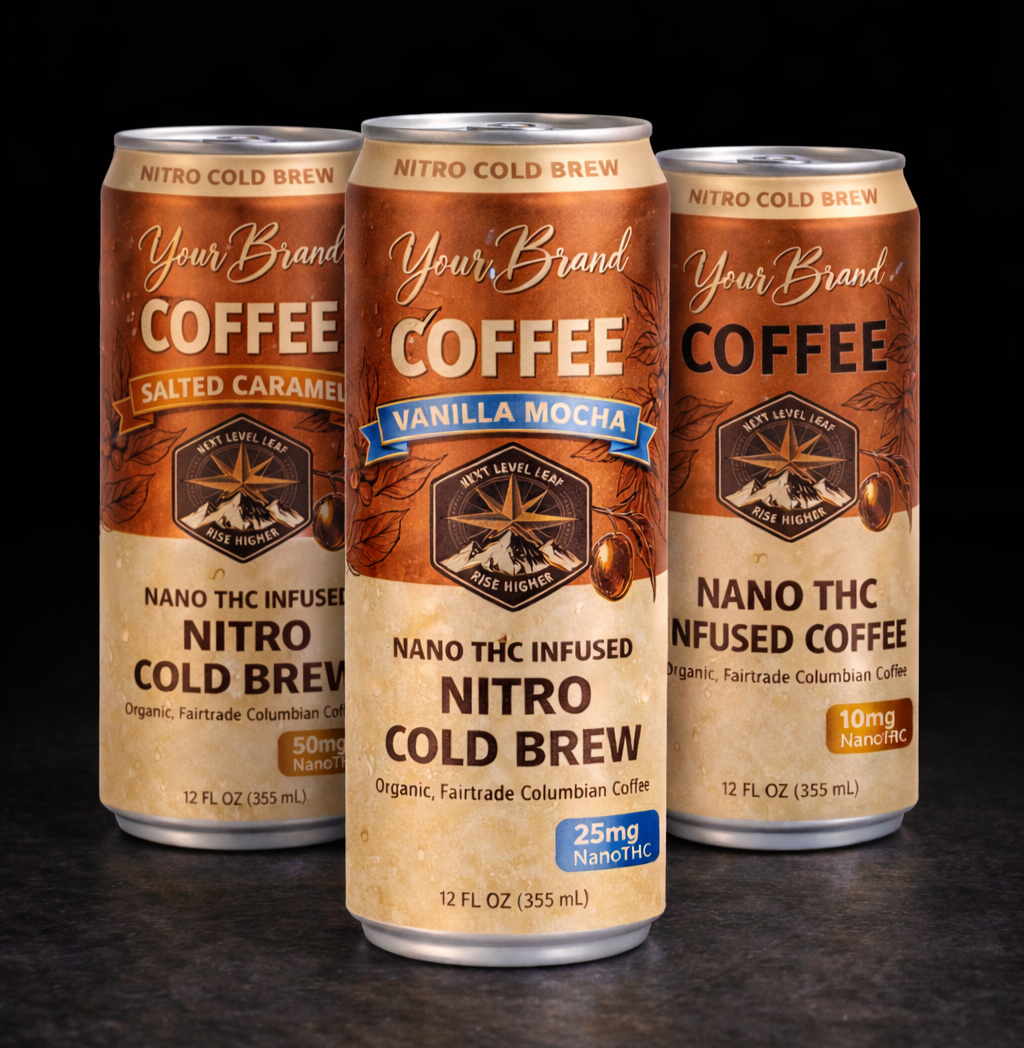
Approved product directions can include Black Nitro Cold Brew, Vanilla Mocha, and Salted Caramel when the requested format, formula, packaging, and manufacturing scope are confirmed.
To evaluate the right path, request a project-specific coffee manufacturing quote.
If you want to talk through whether a white-label or more custom infused coffee approach makes sense, the next step is to share what you want to build.