

Why Nitro Cold Brew THC Coffee Is Such a Strong Launch Format
Nitro cold brew coffee gives established beverage brands, retailers, distributors, and focused founders a distinctive ready-to-drink format to evaluate for approved hemp-derived or non-infused coffee programs.
Explore white-label and private-label manufacturing, nitrogen versus still cold brew, practical commercial starting quantities, and larger production programs built around your approved formula and distribution requirements.
Published and maintained by Next Level Leaf · Updated August 22, 2026
The practical answer: Nitro cold brew can give a brand a recognizable coffee-first ready-to-drink format, but the right manufacturing decision depends on the approved formula, nitrogen requirements, packaging, intended sales markets, testing, production quantity, and distribution plan. Both commercial launch programs and larger recurring production runs may be considered.
In this guide
Premium feel
Nitro cold brew gives the product a more elevated visual and sensory position than many broader beverage concepts.
Coffee-first identity
It reinforces a serious coffee lane instead of making the product feel like a novelty beverage.
Clear customer fit
It helps a founder own a more specific niche rather than getting lost in undifferentiated category noise.
Production programs for established brands and growing coffee companies
Nitro cold brew is not limited to small-batch startups. Next Level Leaf can evaluate approved coffee programs for established brands, multi-location retailers, distributors, wholesalers, and founders preparing a focused commercial launch.
Established and enterprise programs
Discuss production programs of 50,000, 100,000, or 300,000 or more cans when your approved formula, packaging, available capacity, scheduling, delivery requirements, and project economics support that volume.
Commercial launch quantities
A common commercial entry point is approximately 1,200 cans per product, or about 50 cases of 24, subject to the approved coffee format, ingredients, packaging, and production scope.
Selective prototype projects
Approximately 360 cans, or about 15 cases of 24, may be considered selectively for qualified prototype projects when the approved format, packaging, capacity, and customer objectives align.
Final quantities, production timing, packaging, freight, testing, and project eligibility are confirmed during project review; available formats and capacity depend on the approved manufacturing plan.
Why nitro cold brew stands out in the category
Not all infused coffee concepts create the same market signal. Nitro cold brew tends to stand out quickly because it already carries a more premium language in the coffee world. That matters when a new brand is trying to establish credibility and differentiation.
It feels more premium immediately
Nitro cold brew has a more elevated perception than standard ready-to-drink coffee. The format itself suggests more craft, more specialty positioning, and more intentionality.
It supports a stronger visual identity
Founders need formats that look good in brand execution, not just in theory. Nitro cold brew can help the product feel more polished and more distinct in packaging, storytelling, and overall presentation.
It aligns with coffee ritual
Coffee is already a repeat-use category. Nitro cold brew keeps that ritual structure intact while giving the founder a more premium lane to build around.
Nitro cold brew does not just change the beverage format. It changes how the entire brand can be perceived from day one.
Why nitro cold brew can work so well commercially
One of the reasons this format is attractive is that it can justify stronger positioning more easily than a broad undifferentiated beverage concept.
It can support better perceived value
When a beverage looks more premium and feels more category-specific, it is often easier to support stronger perceived value and more confident brand language.
It gives the brand a clearer story
Founders need a clean story. Nitro cold brew gives them an easier narrative than “just another beverage.” That kind of clarity matters in both marketing and sales.
It can create better market separation
If a founder is trying to avoid looking generic, nitro cold brew is often a stronger wedge. It narrows the brand into a more specific lane, which can make it easier to stand out.
When it makes sense to choose nitro cold brew THC coffee
This format is especially strong when the founder wants to lead with premium coffee identity rather than broad beverage positioning.
- when the brand wants a more elevated coffee-first image
- when category differentiation matters early
- when the founder wants a stronger specialty coffee feel
- when the goal is to launch with one clear lead concept
- when visual and experiential premium cues matter to the brand
That does not mean every founder should choose nitro. But for the right brand, it can create a better launch lane than more generic alternatives.
Why this matters in a white-label launch
White-label works best when the format itself helps support the positioning. Nitro cold brew is a good example of that. It gives the founder a more premium starting point without requiring unnecessary complexity just to create brand distinction.
That combination is powerful. It can reduce friction while still making the finished product feel serious and differentiated.
Common mistakes brands should avoid
Choosing nitro just because it sounds premium
The format needs to fit the brand. Premium language is useful, but it still needs to match the overall positioning and go-to-market path.
Overcomplicating the first run
Nitro cold brew already gives a founder a strong lane. There is usually no need to overload the first launch with too many variables on top of that.
Ignoring the importance of brand execution
Nitro helps, but it is not magic on its own. Packaging, messaging, and clarity still matter a great deal.
Thinking premium means slow
A founder can still move efficiently with a premium format. The right white-label path can preserve speed while supporting stronger perceived value.
What to look at next
Once nitro cold brew feels like a strong direction, the next questions are usually practical:
- What will the launch cost?
- What is the MOQ?
- Should the first run be white-label or more custom?
Those are the right next pages because they help translate product direction into an actual launch decision.
Move from a nitro coffee idea to a manufacturing decision
A good customer journey does more than explain why nitro sounds appealing. It helps you decide whether the coffee format, formula, order size, packaging, sales channel, and production timeline fit your actual program.
1. Choose nitro or still cold brew
Nitro cold brew uses nitrogen to create a smoother coffee experience, while still cold brew offers a non-nitrogenated alternative. Compare the format against your approved formulation, can or packaging requirements, shelf-life evaluation, distribution conditions, and customer preferences.
2. Confirm flavor and ingredient direction
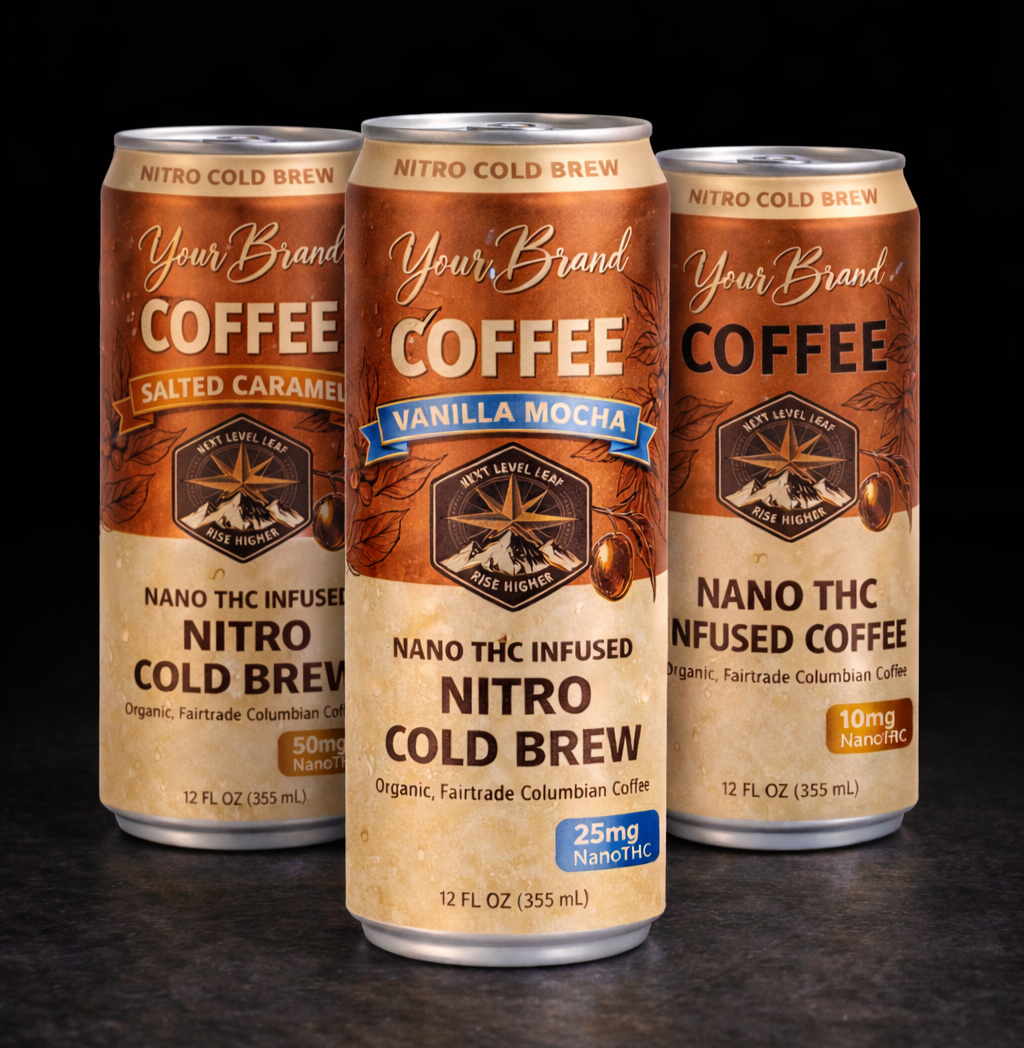
Discuss Black Nitro Cold Brew, Vanilla Mocha, and Salted Caramel as potential starting points. Flavor availability, nitrogen compatibility, coffee sourcing, cannabinoid or functional ingredients, testing, and final label requirements must be confirmed for the specific approved project.
3. Match production to your sales channel
Established brands may need larger recurring production, delivery coordination, and distribution planning. Retailers and distributors may need a private-label program aligned with store count, territory, replenishment, and packaging requirements. Founders may start with an approved commercial quantity and expand as demand develops.
4. Evaluate cost, process, and next steps
Manufacturing cost depends on your approved formula, ingredients, nitrogen requirements, packaging, order quantity, testing, customization, freight, and delivery schedule. Review the manufacturing process and project economics before selecting a production plan.
Frequently asked questions
Related reading
Ready to plan a nitro cold brew coffee production program?
Share your preferred format, target production quantity, intended sales markets, packaging needs, and timing. Whether you are planning an established-brand production program or a focused commercial launch, we can evaluate the right approved next step.