What should a THC beverage manufacturer handle?
Manufacturing involves more than filling cans. A useful production plan considers the beverage itself, the package, the order size, and what your brand needs to sell and reorder with confidence.
Which manufacturing path fits the project?
Your best starting point depends on whether you want an established beverage, a customized product, a completely new formula, or production of a drink you already own.
White label
Start with an established beverage profile, then choose your branding, cannabinoid amount, and available packaging.
Explore white label → Brand extensionPrivate label
Customize an existing beverage direction around your brand, flavor preferences, ingredient options, and packaging.
Explore private label → DifferentiationCustom formulation
Create a distinctive beverage around your preferred flavor, ingredients, cannabinoid amount, and customer experience.
Explore custom formulation → Existing formulaFormula transfer
Discuss manufacturing a beverage formula you already own and producing it at a volume that fits your business.
Compare production paths →What beverage formats can be evaluated?
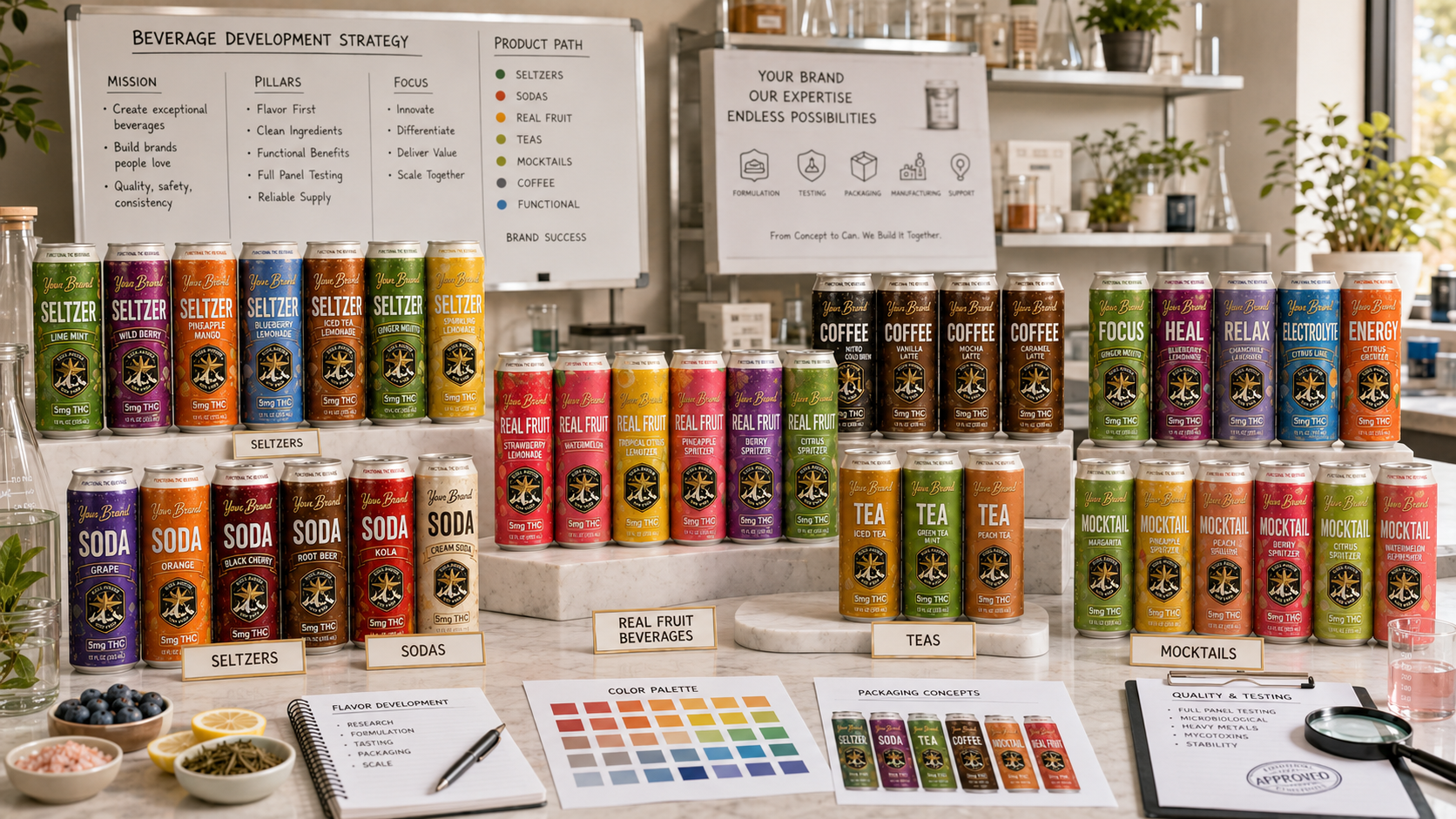
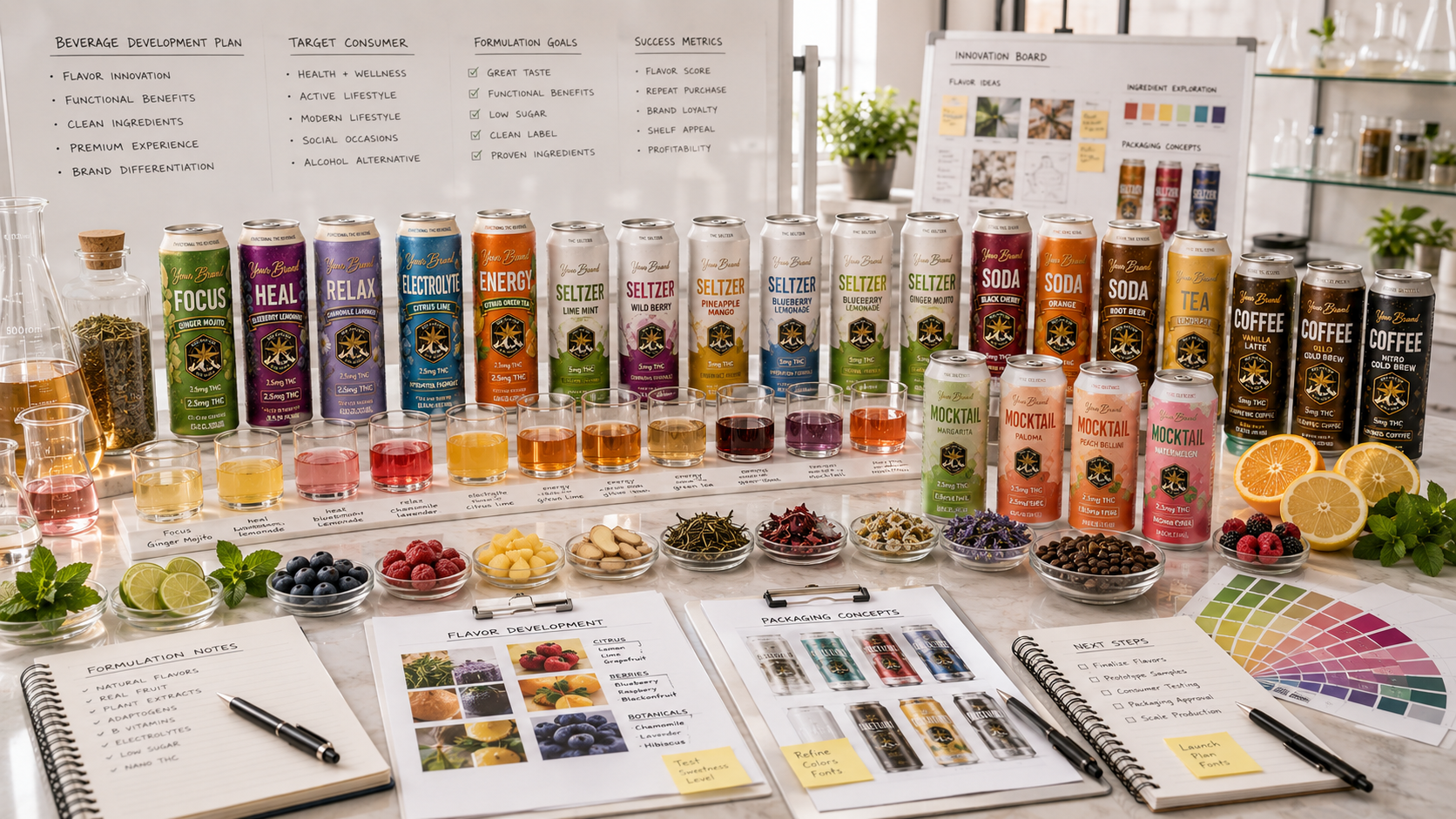
Manufacturing fit depends on the facility and formula, but the project can begin with many common ready-to-drink formats:
Seltzers and spritzers
Light, carbonated products for low-dose, social, refreshment, and alcohol-alternative occasions.
Sodas and lemonades
Fuller flavor systems that may support bolder profiles, higher sweetness, and more complex cannabinoid or ingredient systems.
Still drinks and juices
Tea, lemonade, fruit drinks, juice-style products, and other still formats with different processing and stability needs.
Coffee and tea
Cold brew, nitro coffee, iced tea, herbal tea, Arnold Palmer, and adjacent ready-to-drink concepts.
Mocktails and social drinks
Paloma, mojito, margarita, spritz, and cocktail-inspired profiles designed for adult beverage occasions.
Functional beverages
THC or non-THC products using mushrooms, adaptogens, nootropics, hydration ingredients, caffeine, or other functional directions.
How much should your brand produce?
Your first production order should reflect how you plan to sell the beverage, how many accounts you expect to supply, and how quickly you may need additional inventory. The starting minimum does not limit your ability to order more.
- Commercial starting point: approximately 1,200 cans per SKU, or 50 cases of 24.
- Larger brand programs: increase order volume or add SKUs based on retailer, distributor, or customer demand.
- Recurring production: coordinate ongoing supply around inventory, reorder timing, packaging, and delivery needs.
- Selective prototype: a 360-can product-evaluation run may be available for qualified projects.
Explore beverage manufacturing capabilities, review the commercial order size guide, or request a quote for the quantity your business needs.
What affects THC beverage manufacturing cost?
There is no single cost per can that applies to every project. The quote changes with the beverage base, dose, cannabinoid inputs, functional ingredients, formulation work, packaging, testing, label application, order size, freight, and project complexity.
Established formulas require less development than a fully custom product.
White label, adapted platform, custom R&D, or formula transfer.
THC, CBD, CBG, CBN, THCV, caffeine, mushrooms, adaptogens, fruit, and other inputs have different costs and sensory effects.
Per-can dose, serving structure, and ingredient priorities.
Pressure-sensitive labels, sleeves, digital decoration, and printed cans have different minimums, lead times, and costs.
Can size, label path, case pack, and artwork readiness.
Finished-product potency, microbiological, stability, and state-specific requirements affect scope.
Target markets and the testing plan required for release.
Smaller batches usually carry higher per-unit costs, while larger runs require more working capital and inventory planning.
Prototype, initial production, or scaled commercial volume.
Destination, pallet count, liftgate needs, commercial receiving, and shipment speed affect delivered cost.
Ship-to address and receiving capabilities.
For the full budgeting framework, review THC Beverage Manufacturing Cost and the broader pricing overview.
How long does the manufacturing process take?
- Define your beverage: discuss the product format, flavor, cannabinoid amount, packaging, order volume, and timing.
- Formula selection or development: choose an existing formula, adapt a production platform, transfer an owned formula, or complete custom R&D.
- Packaging and documentation: prepare labels, barcodes, ingredient statements, required warnings, certificates, and production specifications.
- Plan production and delivery: coordinate ingredients, packaging, product testing, production timing, and freight.
- Produce and ship: batch, fill, package, and test the finished beverage, then prepare it for delivery.
The schedule depends on your beverage formula, packaging, ingredients, product testing, production availability, and delivery needs. Custom development and specialized packaging can add time, so the right timeline should be discussed for your specific project. Learn more about the beverage production process.
What should you prepare before requesting a quote?
A useful quote begins with a specific product direction
You do not need every technical answer before reaching out. Share the decisions you have already made and identify the areas where you need guidance.
Request a Manufacturing QuoteHow should you evaluate a manufacturer?
A strong partner should be transparent about what it can manufacture, where it has limitations, what it needs from the brand, who owns the formula, what testing is included, when the product can be scheduled, and how the project moves from initial run to reorder.
Have you produced this beverage format and ingredient system before?
Specific capabilities, practical limitations, and a credible production path.
Who owns the formula, specifications, and development work?
Clear written terms for white label, custom R&D, or formula transfer.
What is the smallest practical run, and what changes at larger volumes?
A launch scope that matches realistic sales capacity and working capital.
What finished-product testing and release documentation are provided?
Defined specifications, COAs, quality review, traceability, and release procedures.
Which can sizes and decoration paths are available at this run size?
Accurate minimums, lead times, artwork requirements, and packaging responsibilities.
Who manages the project and what decisions are due from the brand?
Clear communication, practical next steps, and a production plan that fits the brand.