

What does a hemp beverage manufacturer do?
A hemp beverage manufacturer takes your beverage idea or existing formula through the steps needed to create a finished commercial product. Your project can begin with an established beverage, your own formula, or a custom concept.
Which production model fits the project?
An existing beverage foundation that can be sold under your brand.
Companies looking for a more direct path to a branded commercial product.
A branded beverage with selected product, flavor, or packaging options.
Retailers, distributors, and beverage brands that want a more distinctive product.
A concept requiring flavor, base, ingredient, cannabinoid, sensory, or process development.
Brands whose formula and customer experience are central to differentiation.
An existing formula and product specifications that can be evaluated for commercial manufacturing.
Established brands that need another production option or additional manufacturing support.
Production for new brands and established beverage companies
The right manufacturing plan should support your current sales goals and give you room to grow into larger orders and recurring production.
Starting production orders
Begin at approximately 1,200 cans per SKU when you need a practical commercial order for your first customers.
Larger brand launches
Support existing retailers, distributor relationships, multiple locations, and growing customer demand.
Recurring manufacturing
Plan repeat orders and additional products around your inventory needs, sales forecast, and expansion goals.
Qualified prototype projects
A smaller prototype may be available when a qualified beverage project needs a limited product test.
Your first order does not define your production ceiling
Whether you are launching a new beverage or supplying an established brand, production can be planned around larger quantities, multiple products, repeat orders, and expanding distribution.
What hemp-derived cannabinoid beverages can be manufactured?
The product can be built around a single cannabinoid or a deliberate blend when the inputs fit the formulation, documentation, sensory, testing, process, and intended market.
Hemp-derived THC
Dose, serving structure, flavor masking, emulsion behavior, testing, target market, and customer experience must be aligned.
CBD beverages
CBD may be used independently or with other cannabinoids when it fits the product purpose and commercial plan.
CBG and CBN
Minor cannabinoids can add product distinction, cost, sensory considerations, documentation, and formulation complexity.
THCV and other inputs
Specialty inputs may require higher budgets, narrower sourcing, additional feasibility review, and stronger commercial justification.
What beverage formats can a manufacturer support?
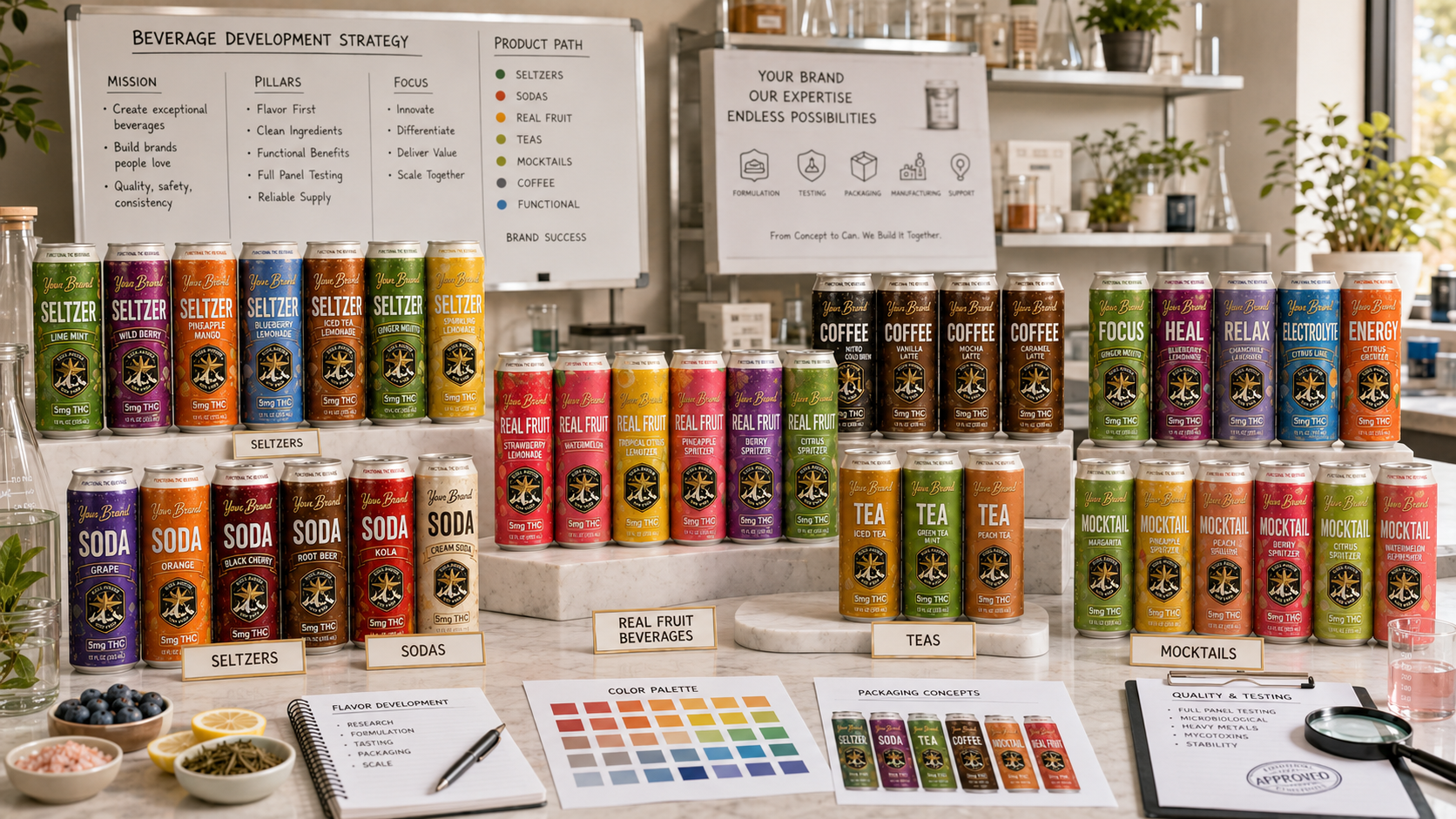
Seltzers and spritzers
Light, carbonated formats for social occasions, moderation, hospitality, and alcohol-alternative programs.
Sodas and lemonades
Bolder formulas that can support familiar flavors, sweetness, and a wider range of dose strategies.
Coffee and tea
Cold brew, nitro coffee, iced tea, herbal tea, sweet tea, and adjacent ready-to-drink programs.
Mocktails, juices and functional drinks
Cocktail-inspired, fruit-forward, still, juice-style, and functional beverages with distinct process requirements.
How should dose and format be matched?
Dose affects taste, ingredient cost, serving structure, package language, customer experience, testing, market fit, and channel acceptance. It should be selected before the formula and artwork are treated as final.
Seltzer-style beverages generally perform best at lower or moderate doses, often around 5–25 mg. Higher-dose beverages may be more practical in flavor-forward sodas, juices, and lemonades because the formula has more ability to manage cannabinoid sensory impact.
What should be expected from formulation and scale-up?
A good sample still needs to work as a commercial beverage. The finished product should maintain its intended flavor, dose, appearance, carbonation, and overall customer experience when produced at the required scale.
- Defined ingredients, suppliers, specifications, substitutions, and commercial availability
- Batch quantities, order of addition, mixing, temperature, processing, carbonation, and filling instructions
- Target dose, potency tolerance, pH, sensory standards, quality criteria, and finished-product specifications
- Package compatibility, can size, closure, label method, case pack, coding, and pallet configuration
- Testing plan, COA requirements, traceability, release criteria, and state-specific documentation
What testing, COAs and quality records matter?
Commercial customers should ask how the finished product will be tested, documented, reviewed, and released, not only whether a source-material COA exists.
How should packaging be evaluated?
Prototypes, lower-volume first runs, and programs needing flexibility.
Which materials, seams, condensation conditions, and application tolerances work best?
Full-can graphics and programs able to support added lead time and minimums.
Who sources and applies the sleeves, and how are distortion and recyclability handled?
Moderate quantities where available supplier specifications align.
What are the can, artwork, minimum, lead-time, and inventory requirements?
Established or repeat programs with predictable demand.
Who owns the can inventory, where is it stored, and what happens if artwork or formula changes?
Why target-state and channel planning matter
Hemp beverage requirements can vary by state, product type, cannabinoid profile, dose, package, labeling, and sales channel. Identify your target markets early so those differences can inform the product and packaging.
- Permitted dose, serving structure, and package treatment
- Warnings, symbols, QR codes, age statements, and label content
- Testing panels, lab qualifications, COA format, and batch requirements
- Product, brand, facility, distributor, or retailer registrations and permits
- Direct sales, general retail, alcohol channels, dispensaries, hospitality, event, or distribution requirements
- Restrictions affecting cannabinoids, conversion methods, ingredients, claims, packaging, or product category
Review the State Resources and Compliance pages for general information. Requirements can change, and final legal questions should be reviewed with qualified counsel.
How should freight, warehousing and reorders be planned?
Finished beverages are heavy and storage-intensive. A manufacturer comparison should include the path after the product leaves the line.
Questions to ask when comparing hemp beverage manufacturers
- Which beverage formats, cannabinoids, doses, ingredients, and packages can you actually run?
- What is the MOQ per SKU, and is a smaller prototype path available?
- Can you support multi-pallet, truckload, recurring, and multi-SKU production?
- What must be complete before a project is scheduled?
- How are formulas reviewed, developed, transferred, scaled, and controlled?
- Who sources ingredients, cannabinoid inputs, cans, labels, cartons, and cases?
- Which testing, COAs, quality records, specifications, and traceability documents are provided?
- How are lead time, production windows, packaging inventory, storage, freight, and reorders managed?
- How are formula ownership, confidentiality, substitutions, and transferability defined?
- What information is needed to produce an accurate and complete quote?
What should be prepared for an accurate quote?
Find the right manufacturing path for your brand
Tell us about your beverage idea, expected order quantity, packaging preferences, target markets, and sales goals.
Request a Manufacturing Quote