

What makes hemp-derived THC beverage production different?
Your beverage needs to taste good, look right, match its intended dose, and arrive in packaging that supports your brand. Hemp-derived THC adds another important consideration because the cannabinoid ingredient must work consistently within the finished drink.
The goal is a beverage customers can recognize, enjoy, and purchase again, supported by an appropriate formula, manufacturing plan, and finished-product testing.
Test the ingredient and the finished beverage separately
A certificate of analysis for the cannabinoid ingredient does not replace testing the completed drink. Finished-product testing helps confirm what is actually present in the beverage your customers receive.
What information should accompany the THC ingredient?
How THC is incorporated into a water-based beverage
THC does not naturally mix evenly with water. Beverage manufacturing commonly uses a water-compatible emulsion to distribute the cannabinoid more consistently through the finished drink.
The right option should fit your beverage flavor, appearance, target dose, packaging, and production requirements.
Target potency, concentration, batch calculation, mixing, tolerances, and homogeneity.
The stated dose must be reproducible in the finished product.
Bitterness, aroma, carrier notes, finish, flavor masking, and interaction with sweeteners and acids.
The cannabinoid system can change the way the beverage tastes.
Clarity, haze, color, separation, ringing, sediment, adhesion, and interaction with the package.
The chosen input should match the intended visual experience and stability target.
Order of addition, mixing, shear, temperature, carbonation, hold time, filling, and sanitation.
A system that works in a lab sample must also perform in a commercial batch.
Sampling, homogeneity, finished-product analysis, lot variation, and expected potency tolerance.
The quality plan must be able to verify the actual finished beverage.
How are dose and serving structure selected?
Dose should be selected around the customer, beverage format, use occasion, package, state, channel, flavor system, price, and serving expectations. It should not be chosen only because a competing product uses the same number.
2–5 mg
May fit moderation, social sipping, first-time consumers, hospitality, and alcohol-alternative occasions.
10 mg
A familiar commercial dose in many markets, but still dependent on state, package, channel, and customer expectations.
20–25 mg
Can fit experienced customers and some retail programs when flavor, package, serving language, and market rules align.
Above 25 mg
Requires stronger commercial justification, flavor management, serving review, target-market fit, and often a flavor-forward format.
Why beverage format matters at higher doses
Light seltzers reveal bitterness, emulsion character, and aftertaste more easily than bold sodas, juices, lemonades, or coffee-based products. That is why a dose that works in one format may be difficult to deliver in another without compromising the intended drinking experience.
Seltzer-style products generally perform best at lower or moderate doses, often around 5–25 mg. Higher-dose products may be more technically practical in flavor-forward beverages with greater sweetness, acidity, body, fruit, coffee, tea, or familiar soda character.
What about trace, naturally occurring, or converted cannabinoids?
The manufacturing team should understand the cannabinoid profile of both the input and the completed beverage. Source-material and finished-product testing may show minor or trace cannabinoids beyond the primary target.
How different cannabinoids are treated can depend on the target state, product type, labeling, and sales channel. Questions about specific market requirements should be reviewed with qualified counsel before the product is sold.
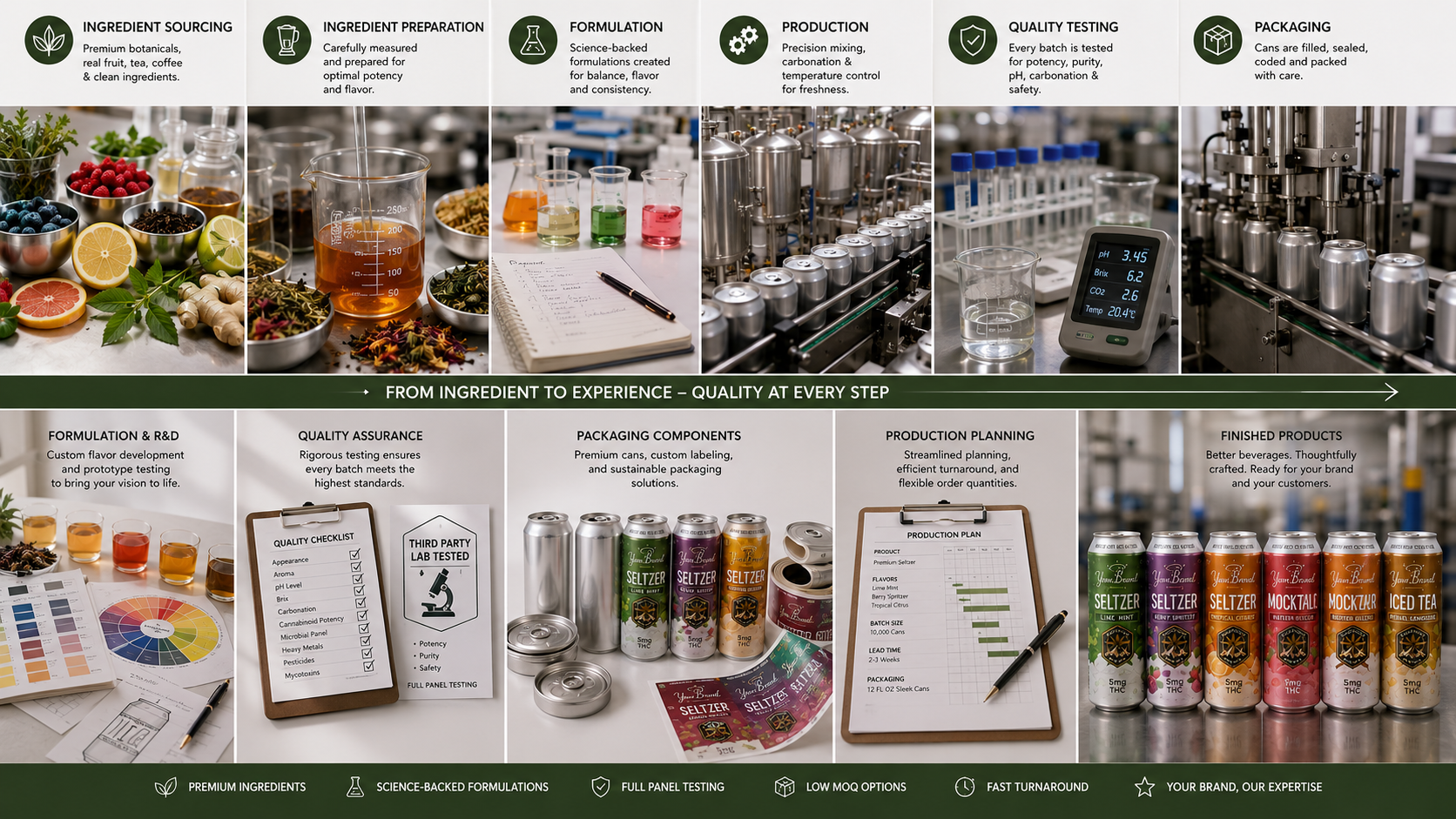
The hemp-derived THC beverage production process
Define the format, flavor direction, target customer, sales channel, THC dose, and number of products.
Choose an existing white-label beverage, a private-label product, custom formulation, or your current beverage formula.
Choose a suitable hemp-derived THC ingredient based on the intended dose, beverage compatibility, and supporting documentation.
Balance the beverage base, flavor, sweetness, carbonation, appearance, and overall customer experience.
Confirm the product, packaging, labels, order quantity, testing needs, and intended delivery location.
Prepare the beverage, incorporate the cannabinoid ingredient, fill the cans, and package the finished order.
Complete the testing and supporting documentation appropriate for the finished beverage and target market.
Ship the finished beverage and use your sales results to plan future quantities, additional products, or recurring production.
Source testing versus finished-product testing
The cannabinoid ingredient before it enters the beverage, including potency and reported analytical results.
The potency, homogeneity, stability, or quality of the completed drink.
Batch calculations, ingredient lots, mixing, sample procedures, process observations, and quality checks.
The final packaged beverage result without finished-product analysis.
The completed beverage batch after manufacturing, commonly including finished potency and other required tests.
Universal compliance for every state, channel, claim, or future storage condition.
What additional testing may be needed?
Commercial production that can grow with your brand
Approximately 1,200 cans
Start with approximately 50 cases of 24 per SKU for a focused commercial launch.
Larger production orders
Support established brands, multiple retail accounts, distributor programs, and expanding market demand.
Recurring production
Plan repeat beverage production around your inventory, customer demand, and sales growth.
Qualified prototype projects
A 360-can prototype may be available selectively when a qualified project needs a smaller product test.
How target states affect the formula and production plan
The intended market should be identified before the cannabinoid system, dose, package, and label are considered final.
Review State Resources and Compliance for general information. Requirements can vary, and specific legal questions should be reviewed with qualified counsel.
What packaging options should be considered?
Prototypes and lower-volume first commercial runs.
Label stock, application, condensation, seam placement, artwork, and finished appearance.
Full-can graphics and brands able to support additional minimums and lead time.
Sleeve sourcing, distortion, application, recyclability, and schedule.
Moderate quantities when supplier and can specifications align.
Minimums, artwork, can availability, production timing, and inventory.
Established or recurring programs with predictable demand.
Higher package commitment, ownership, storage, artwork changes, and formula changes.
What should be prepared for an accurate quote?
Build the beverage your customers will want to buy
Tell us about your beverage idea, preferred dose, packaging, expected quantity, target market, and sales goals.
Request a THC Beverage Quote