


THC emulsions
A liquid emulsion carries THC in small droplets. It can be added during beverage production, with the mixing approach matched to the formula and equipment.
Water-soluble THC is a common industry term. What your beverage actually needs is a THC ingredient that mixes consistently, tastes right, and performs in the finished can.
Learn what the label really means, how liquid emulsions and powders differ, and what to consider before choosing an ingredient for your drink.
Updated August 25, 2026
Water-soluble THC usually means water-dispersible THC. THC does not naturally dissolve in water like sugar. Instead, an emulsion, powder, or another delivery system helps distribute it throughout a beverage. The name alone does not guarantee clear color, fast onset, better taste, or shelf stability.
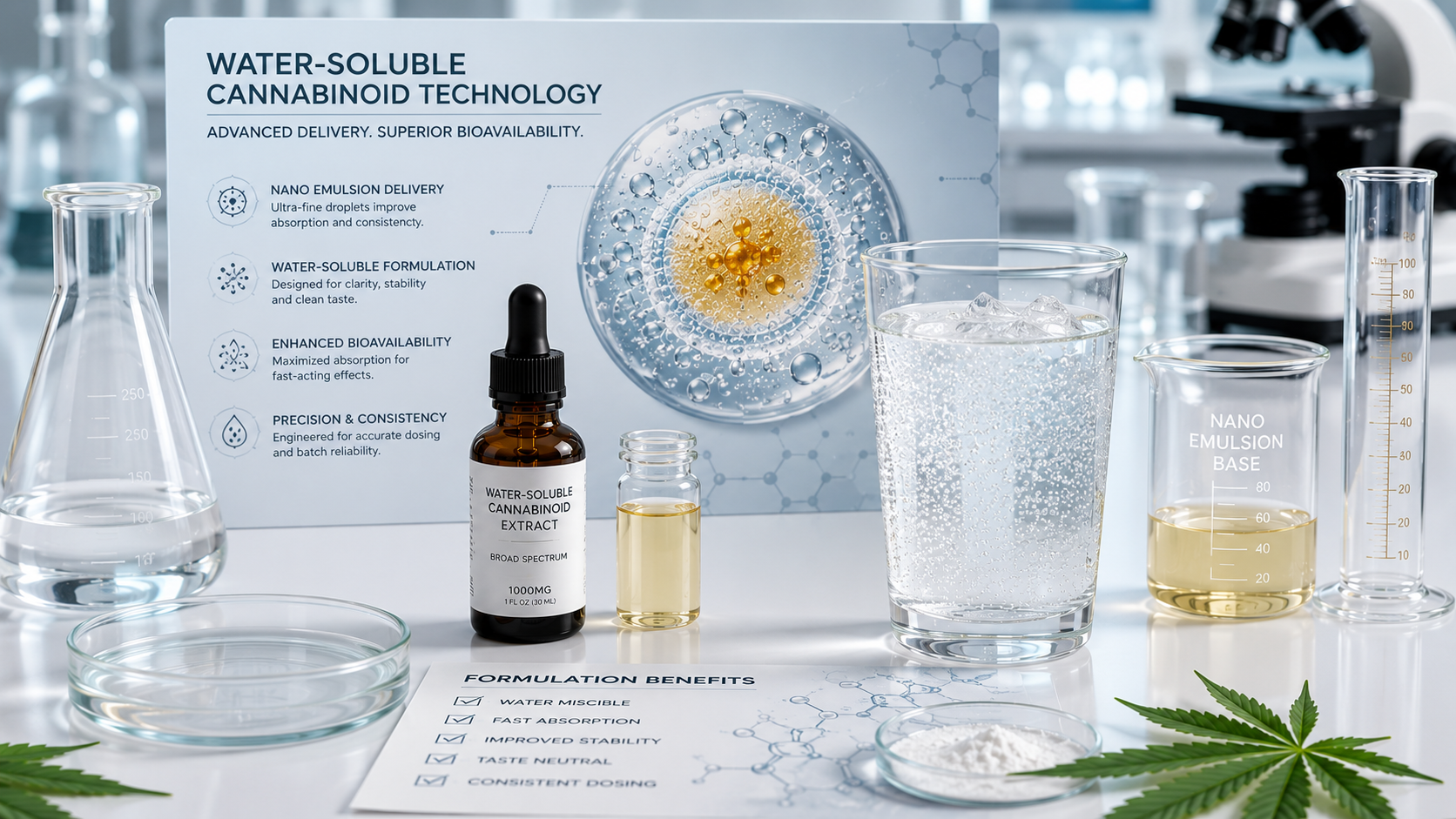
THC naturally mixes more easily with oil than water. If you add ordinary THC oil to a water-based drink, it can separate rather than staying evenly distributed. That creates obvious problems for appearance, consistency, and reliable dosing.
A beverage-ready THC ingredient uses a delivery system to help the cannabinoid mix into the drink. That might be a liquid emulsion, a nanoemulsion, a dispersible powder, or another suitable format.
Many suppliers call these ingredients water-soluble THC. In most beverage applications, water-dispersible THC is the more precise description.
For your brand, the practical question is simple: Does the ingredient perform well in your actual beverage after mixing, packaging, and storage?
These terms are related, but they do not all describe the same thing.
| Term | What it usually means | What it does not guarantee |
|---|---|---|
| Water-soluble THC | A general industry description for THC intended for a water-based product. | A specific ingredient type, clear appearance, or faster onset. |
| Water-dispersible THC | THC carried in droplets or another system that helps it distribute throughout water. | Compatibility with every formula, flavor, or production process. |
| Nano THC | Generally, a small-droplet emulsion or another nanoscale delivery system. | A universal onset time, a specific droplet size, or improved results in every drink. |
| Dispersible THC powder | A dry ingredient designed to mix into a beverage or form a dispersion. | That it will stay clear, mix without the right process, or fit every beverage. |
For a deeper comparison, see what nano THC means and how nano THC compares with other emulsions.
Both formats can work in beverages. The better choice depends on your formula, production process, flavor goals, and how the ingredient performs in the finished drink.
A liquid emulsion carries THC in small droplets. It can be added during beverage production, with the mixing approach matched to the formula and equipment.
A powder may be easier to store or handle in certain applications. Its performance still depends on how it is mixed and how it interacts with the complete beverage.
Neither format is automatically better. A good ingredient is the one that supports consistent potency, acceptable flavor, the desired appearance, and your production plan.
The right ingredient can help keep THC distributed through a properly mixed beverage rather than separating as visible oil.
Some systems suit lighter beverages. Others are better matched to cloudy drinks, coffee, tea, juice, or stronger flavor profiles.
A documented ingredient and manufacturing approach can help support consistency from batch to batch.
Ingredient choice may influence absorption or sensory experience, but any specific performance claim needs evidence relevant to the finished product.
A product labeled water-soluble does not automatically guarantee:
The complete beverage determines how the ingredient performs. That is why formula development and finished-product testing matter more than a marketing label.
A lighter drink may make haze, flavor carryover, and subtle changes in appearance easier to notice.
Flavor oils, acidity, sweeteners, and other ingredients can affect how a THC ingredient mixes and tastes.
Coffee, tea, milk alternatives, and other components can change the ingredient and processing requirements.
Mushrooms, adaptogens, hydration ingredients, and other additions should be evaluated as part of the complete formula.
Explore custom THC beverage formulation to see how ingredient selection fits into a complete product.
You do not need to become a chemist. You do need clear answers to a few practical questions.
An ingredient certificate shows what was measured in the ingredient. It does not replace testing the beverage people will actually buy.
The final formula, mixing process, packaging, and storage conditions can all influence the product. A practical manufacturing plan should account for finished-product potency, consistency, sensory quality, and stability based on the actual beverage.
Continue with THC beverage stability and shelf life or how to manage THC flavor in beverages.
Research supports the broader idea that delivery format can influence how cannabinoids are absorbed. It does not establish that every water-dispersible THC beverage will produce the same result.
A published review of CBD bioavailability and delivery strategies discusses why cannabinoid delivery systems matter. Because that review focuses on CBD, it should not be treated as direct evidence for a specific THC beverage.
A small human crossover study comparing a THC/CBD self-nanoemulsifying powder with oil-based drops reported different absorption outcomes for the specific systems studied. The study involved 14 people and does not guarantee a result for another ingredient, beverage, or consumer.
Learn more about fast-onset THC and bioavailability in THC drinks.
A common commercial starting point is approximately 1,200 cans per flavor and dose. That can be a practical entry point for brands preparing a market-ready launch.
Next Level Leaf also works with brands planning larger orders, multi-pallet programs, recurring production, and expanding product lines. The appropriate production plan depends on the formula, packaging, demand, distribution, and timing.
For qualified projects, a selective prototype of approximately 360 cans may be possible when a smaller development run makes sense.
See beverage manufacturing pricing factors or how THC beverage manufacturing works.
Choose the next topic based on the stage your product is in.
Tell us what you want to make, your target dosage, preferred flavor, expected order volume, and sales plans. We will help you explore a formulation and manufacturing approach that fits your product.