Define the finished product
Set the beverage format, can size, serving size, target dose, flavor, sweetness, carbonation or nitro direction, target markets, shelf-life goal, and expected run volume.
A commercial THC drink is built as one repeatable beverage system, not by simply pouring THC oil into a can.
Follow the process from a water-compatible cannabinoid input and bench formula through scale-up, production controls, filling, finished-product testing, COAs, and release.
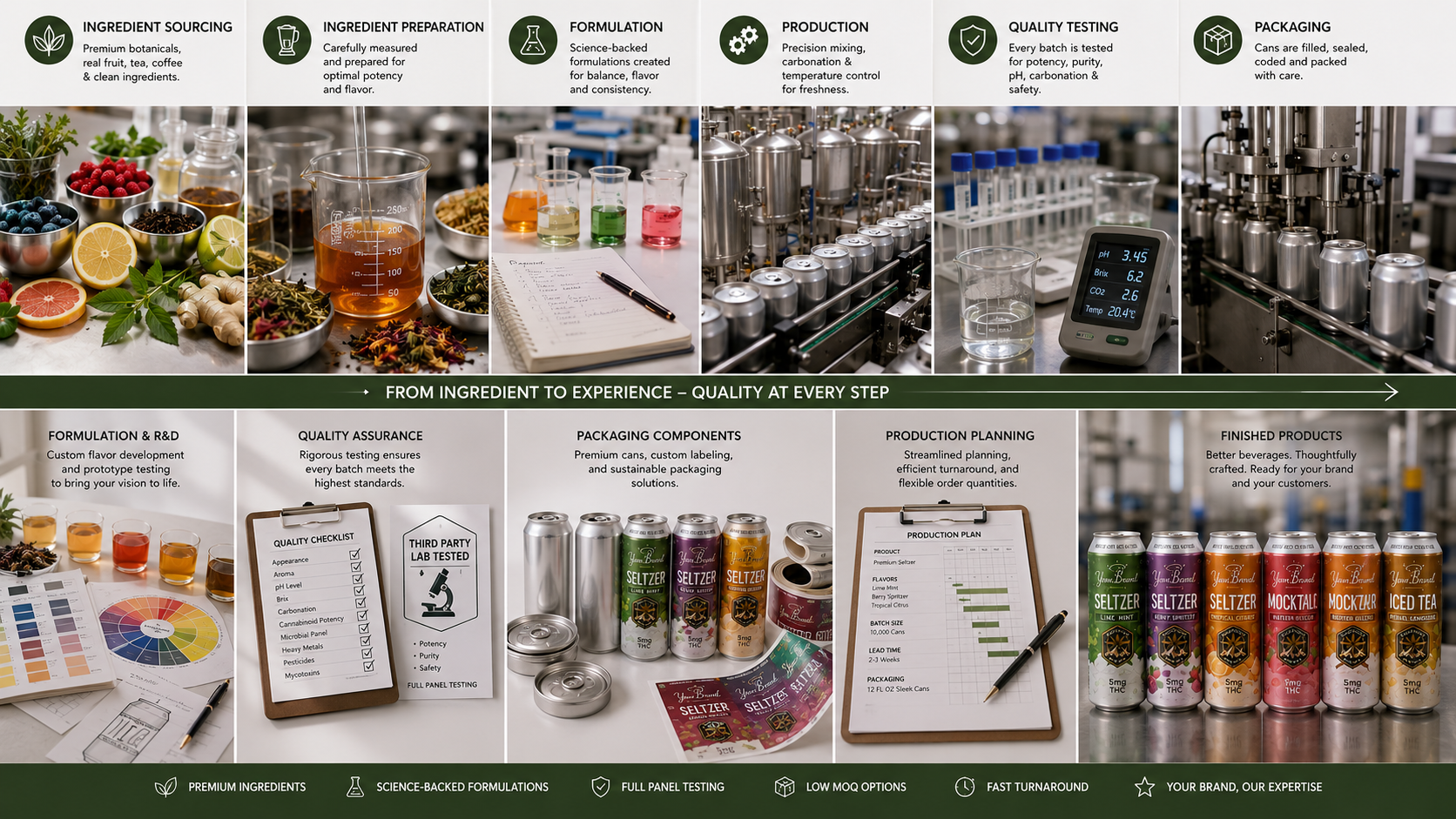
THC beverages are generally made by blending a measured water-compatible cannabinoid system into a formulated drink base, then controlling flavor, pH, sweetness, stability, processing, filling, packaging, and testing. The exact production sequence depends on the beverage, cannabinoid input, package, shelf-life target, and applicable process controls.
The Full Build
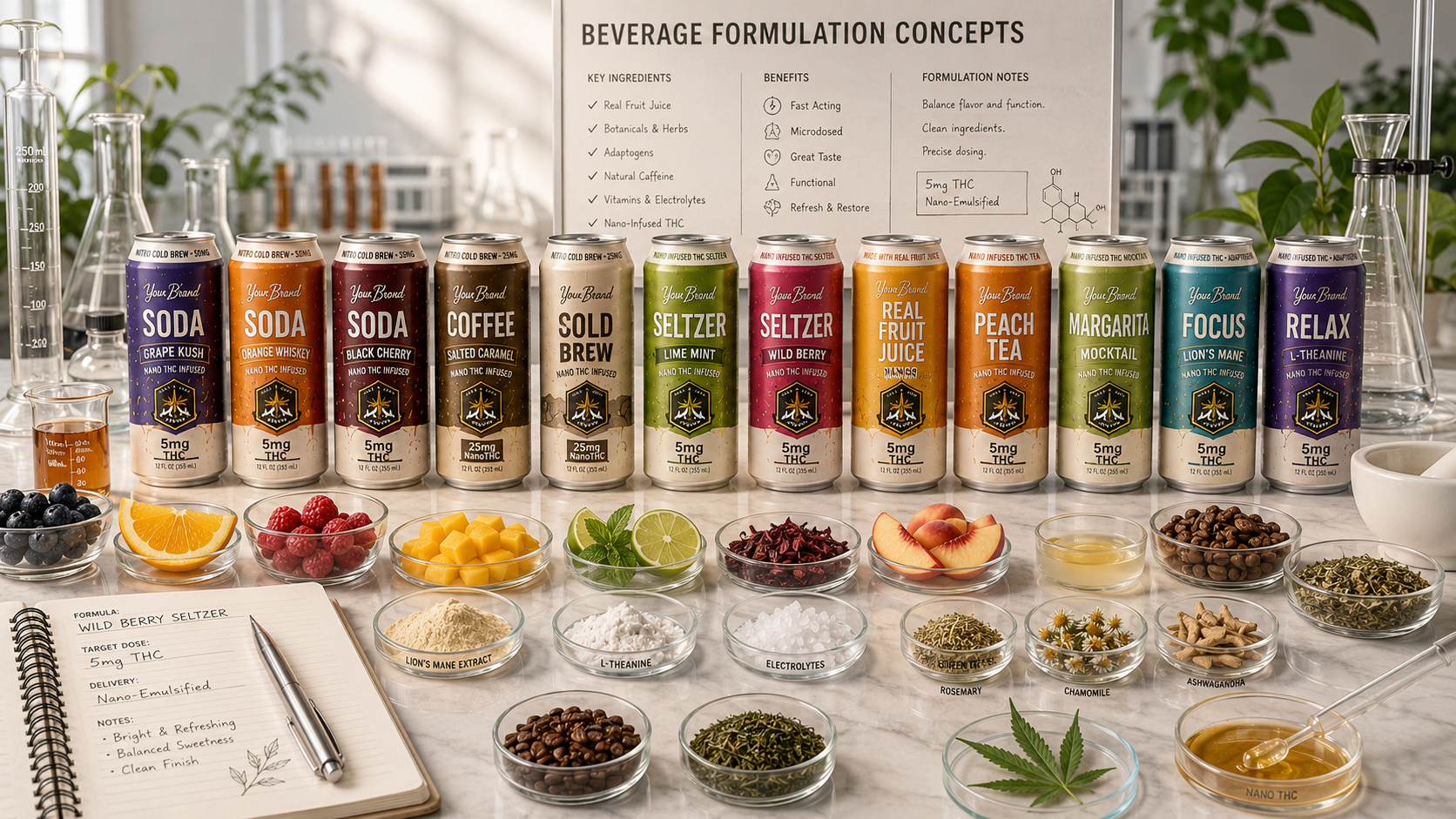
Projects can enter through white label, private label, co-packing, or custom development. Once the formula is defined, the physical production path usually includes these nine connected steps.
Set the beverage format, can size, serving size, target dose, flavor, sweetness, carbonation or nitro direction, target markets, shelf-life goal, and expected run volume.
Choose a documented emulsion, nanoemulsion, or other water-compatible input that fits the dose, flavor, appearance, pH, process, package, and supply requirements.
Balance water, flavor, sweetener, acids, color, body, preservatives where used, and functional ingredients around the cannabinoid system, not as unrelated additions.
Check physical stability, potency recovery, flavor, pH, appearance, package compatibility, and how the formula responds to mixing, heat, hold time, carbonation, or nitrogen.
Convert the bench formula into production weights and instructions. Confirm assayed ingredient potency, batch yield, order of addition, mixing energy, temperatures, hold times, and process losses.
Verify lots and COAs, weigh inputs, prepare the beverage base, incorporate the cannabinoid system in the validated sequence, and record critical batch measurements.
Depending on the formula, this can include filtration, deaeration, carbonation, nitrogen, cooling, heating, or another validated preservation and handling approach.
Fill the correct volume into the approved package, apply the closure or can end, verify seam or closure integrity, add batch coding, and pack finished units into cases.
Complete the planned finished-product checks, review batch records and COAs, resolve deviations, release acceptable inventory, and preserve the specifications needed for a repeatable reorder.
Cannabinoids are oil-soluble, while most beverages are water-based. Untreated oil can float, ring at the top, cling to surfaces, taste harsh, or distribute unevenly. Commercial formulators therefore evaluate emulsions, nanoemulsions, and other water-dispersible systems that can carry a measured cannabinoid dose through the beverage.
The label on an ingredient is not enough. The delivery system has to work in the actual formula. Acids, minerals, juice solids, coffee compounds, tea tannins, sweeteners, preservatives, heat, carbonation, and storage can all change how a dispersion behaves.
Important distinction: “nano” describes a delivery approach, not a universal guarantee of clarity, stability, onset, or bioavailability. Supplier documentation, finished-beverage compatibility, process validation, and testing matter more than a marketing term alone.
The planning math starts with the target milligrams per serving and the number of saleable servings. If a 12-ounce can is one serving, the pure-active requirement begins with:
Target active THC = target mg per can × number of saleable cans
Required cannabinoid ingredient = target active THC ÷ the input's assayed THC concentration
That is only the starting point. The production calculation must use the cannabinoid input's lot-specific COA, the validated total batch volume, expected yield, equipment hold-up or other demonstrated process loss, and the finished-product testing plan. A commercial formula should not rely on unverified overage or on the raw ingredient COA alone.
Many commercial beverage processes incorporate the cannabinoid system into a controlled batch before filling. That gives the manufacturer an opportunity to manage mixing, uniformity, batch volume, and in-process measurements before the beverage reaches the package.
Other validated dosing methods may exist, but the real standard is the result: accurate and repeatable finished-product potency, acceptable homogeneity, documented control, and a process that can be reproduced on the next run. A method should not be selected simply because it sounds convenient.
Batching is where the approved formula becomes a production lot. Ingredients are verified, weighed, and added in a defined sequence. Mixing speed, shear, temperature, hydration time, hold time, pH, Brix, total volume, and other measurements can matter depending on the beverage.
Order of addition is especially important. An acid, mineral, flavor, preservative, sweetener, botanical, or cannabinoid system can behave differently depending on when it enters the tank and what has already been dispersed. A repeatable batch record captures both the formula and the process.
No. A cold-filled sparkling drink, a shelf-stable tea, a juice-containing beverage, and a nitro coffee can require different process decisions. The appropriate approach depends on the product's pH, water activity, ingredients, microbial risk, package, storage conditions, and intended shelf life.
Possible production strategies can include refrigeration, preservatives, hot-fill, tunnel pasteurization, aseptic or other validated processes, but no method should be assumed from the product name alone. The formula and food-safety plan determine what is appropriate. FDA distinguishes acidified and low-acid shelf-stable foods using factors that include equilibrium pH and water activity, which is one reason process classification cannot be reduced to “it comes in a can.”
Once the beverage is ready, the line controls fill volume, carbonation or nitrogen where applicable, package handling, closure application, date or lot coding, and case packing. For cans, the end is attached through a double seam. A visually attractive can is not enough, the closure has to be formed and checked correctly.
Packaging also interacts with the beverage. Oxygen exposure, light, liner compatibility, pressure, headspace, storage temperature, and physical handling can affect flavor, stability, appearance, and shelf life.
Production Controls
The exact control plan is product-specific, but a serious commercial process connects measurements to specifications, records, and corrective action.
| Production point | Examples of what may be checked | Why it matters |
|---|---|---|
| Incoming ingredients | Identity, lot, COA, condition, potency, approved supplier, expiration or retest date | Confirms that production begins with the specified inputs. |
| Batch preparation | Weights, sequence, water volume, mix time, temperature, pH, Brix, visual appearance | Turns the formula into a traceable and repeatable production lot. |
| Cannabinoid incorporation | Input potency, calculated use amount, dispersion, mix parameters, batch uniformity plan | Supports accurate finished-product dose and consistency. |
| Processing | Time, temperature, pressure, filtration, carbonation, nitrogen, hold conditions | Confirms the beverage receives the process designed for that formula. |
| Filling and closing | Fill volume, package condition, seam or closure integrity, code date, case count | Protects package performance, traceability, and finished inventory accuracy. |
| Finished product | Potency, COA, sensory review, pH, micro or contaminant testing where applicable, package and stability checks | Provides evidence for release and a baseline for future production. |
Light flavor leaves little room for bitterness, oiliness, ringing, haze, or an unstable emulsion. Carbonation and package pressure add process variables.
Coffee offers flavor cover but introduces acidity, roast compounds, solids, mouthfeel, oxidation, caffeine positioning, and nitro-specific handling.
Tea extraction, juice content, pulp or haze, natural color, sweetness, thermal compatibility, and shelf-life targets shape the process.
Stronger flavor systems can help mask cannabinoid notes, while sugar, acids, botanicals, color, carbonation, and layered aromas need to stay balanced.
Minerals, vitamins, adaptogens, nootropics, electrolytes, proteins, and botanical extracts can change pH, flavor, solubility, stability, and claims review.
Without carbonation, the formula may need a different sensory, oxygen, filling, and preservation strategy. Still does not mean technically simple.
A bench formula may be mixed in seconds in a small container. A commercial batch has different tank geometry, mixing energy, addition time, temperature change, equipment surfaces, transfer lines, filtration, hold time, and yield. Those differences can change flavor, foam, dispersion, color, and potency recovery.
Scale-up therefore converts both the ingredient list and the method. The production team needs a controlled formula, approved inputs, target specifications, batch instructions, expected yield, packaging components, testing plan, and a way to manage changes.
Built for incubation and scale: Next Level Leaf can help evaluate possible 360-can prototype work, common 1,200-can initial production runs per SKU, recurring multi-pallet orders, and project-specific 50,000-to-300,000-plus-can programs. The production network supports more than one million cans per month, with growing capacity toward approximately 1.5 million depending on product mix and scheduling.
The raw cannabinoid ingredient COA confirms what entered the facility. Finished-product testing helps show what ended up in the beverage after dilution, mixing, processing, filling, and packaging.
Testing requirements vary by state, product category, retailer, and formulation. The practical goal is a testing and documentation plan that matches where the beverage will be produced and sold.
This page explains how the beverage itself is physically made. If you are looking for the brand-side sequence, from concept definition and feasibility through quote approval, packaging readiness, scheduling, freight, launch, and reorders, read the THC beverage production process.
If you already know the product you want and need a manufacturing partner, the THC Beverage Co-Packer guide explains white-label, private-label, co-packing, custom development, and quote readiness.
Source Context
These sources support the manufacturing principles behind the page without implying that every THC drink has the same regulatory classification or production method.
FDA identifies sanitation, equipment, and production and process controls as core parts of current good manufacturing practice for human food.
FDA's guidance shows why equilibrium pH, water activity, container, and processing method can change the production and filing requirements for shelf-stable products.
A primary study used high-pressure homogenization and tested a phytocannabinoid nanoemulsion under dilution, pH, temperature, and freeze-thaw stresses, useful evidence that delivery systems must be evaluated against real process conditions.
Continue from the physical production process into delivery systems, shelf life, project workflow, testing, cost, MOQ, and commercial production.
Share your beverage format, target dose, flavor direction, cannabinoid system or formula status, packaging, target markets, estimated volume, and launch date. We can help evaluate the development and production path from prototype through enterprise scale.