


Nano THC vs. Emulsion
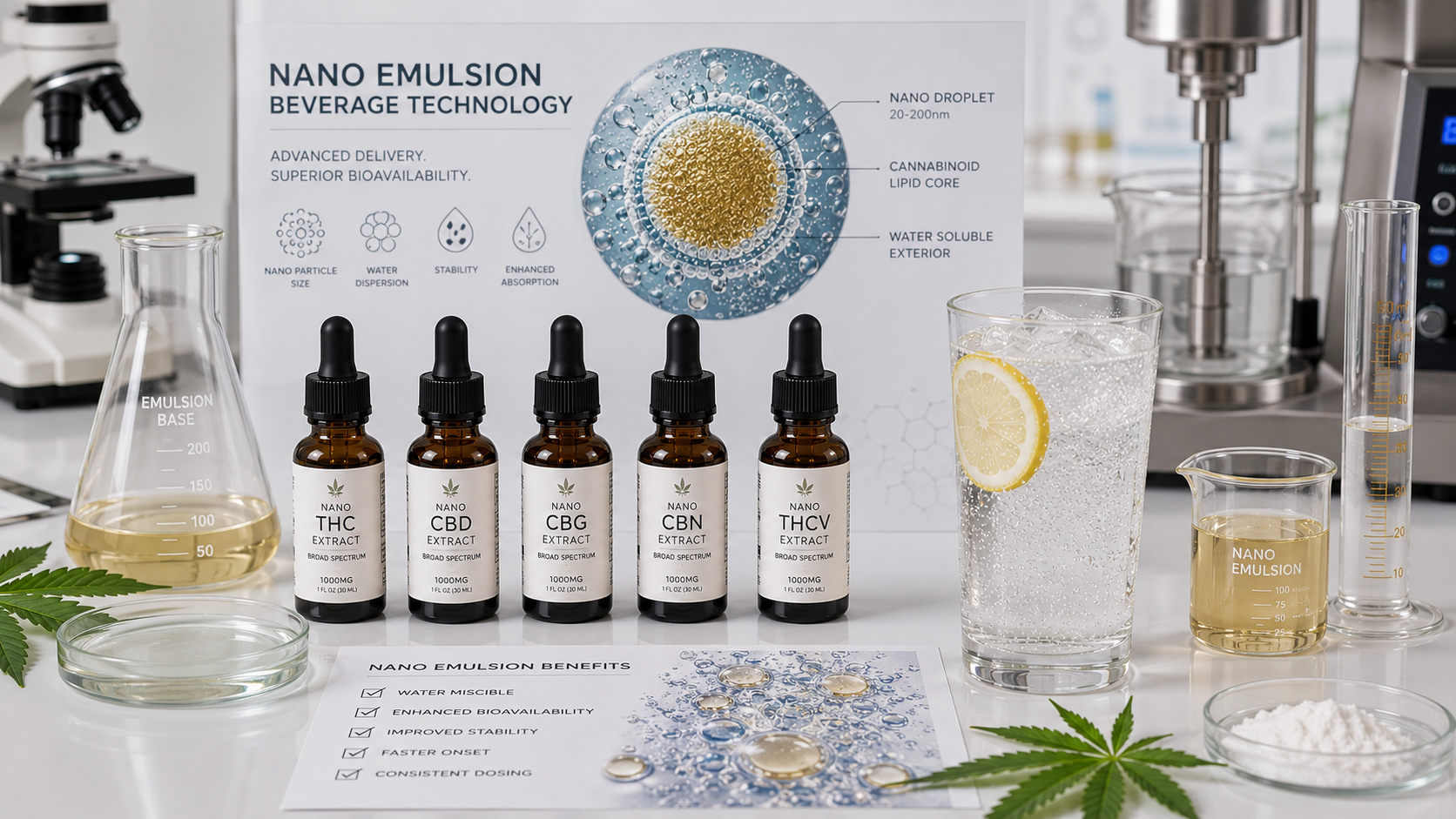
Nano THC is not the opposite of an emulsion. A nanoemulsion is one type of emulsion used to spread THC or CBD evenly through a drink.
Compare how conventional emulsions and nanoemulsions can affect flavor, appearance, onset, stability, cost, and production at different order sizes.
An emulsion helps oil-based cannabinoids mix evenly throughout a water-based drink. A nanoemulsion does the same job with much smaller oil droplets. Smaller droplets may help with clarity, consistency, or absorption, but the right choice still depends on your recipe, dose, flavor, packaging, and how the finished drink performs.
Is nano THC different from an emulsion?
THC and CBD naturally mix with oil, not water. To distribute either cannabinoid through a beverage, a manufacturer uses a delivery system that breaks the oil into small droplets and keeps those droplets spread throughout the drink.
That delivery system is an emulsion. A nanoemulsion is an emulsion with much smaller droplets. One food-science review describes nanoemulsions as commonly having average droplet diameters around 20 to 200 nanometers, although the exact definition can vary. Read the published nanoemulsion review.
The practical comparison is conventional emulsion versus nanoemulsion. The word "nano" alone does not tell you whether a drink will taste good, stay consistent, look clear, or meet your production goals.
Conventional emulsion vs. nanoemulsion for beverage manufacturers
Both options can work. The better choice depends on the drink you want to make and how that specific formula performs.
| What to compare | Conventional emulsion | Nanoemulsion |
|---|---|---|
| Droplet size | Generally uses larger oil droplets to disperse cannabinoids through the drink. | Uses smaller droplets that can remain more evenly distributed when the full formula is compatible. |
| Appearance | May add some cloudiness, which can be acceptable in soda, juice, coffee, or another naturally opaque drink. | May support a clearer appearance, but flavor oils, colors, juice, and other ingredients still affect the final drink. |
| Onset | Absorption depends on the delivery system, recipe, dose, and the individual consumer. | Some systems may support faster absorption, but no onset time should be assumed without evidence for the actual product. |
| Flavor | Can work well when the beverage has enough flavor to balance the cannabinoid ingredient. | Can fit lighter drinks, but the carrier ingredients and THC or CBD amount may still affect taste and mouthfeel. |
| Stability | Must be checked for settling, separation, changes in appearance, and consistent cannabinoid levels. | Also requires finished-product testing. Small droplets do not guarantee a stable beverage. |
| Cost | May be suitable when the drink tolerates some haze and the ingredient meets quality and budget goals. | May cost more depending on the supplier, cannabinoid concentration, recipe, and desired appearance. |
| Best fit | Often worth considering for flavor-forward sodas, juices, coffee drinks, and other less transparent beverages. | Often worth considering for clearer seltzers, lighter drinks, or products where the brand wants to evaluate a fast-onset option. |
Does nano THC mean water-soluble THC?
Not exactly. THC does not stop being oil-soluble simply because it is added to a nanoemulsion. The oil is broken into very small droplets that can remain dispersed through the water in a drink.
"Water-soluble THC" is common industry shorthand. Water-dispersible THC is often more accurate because the cannabinoid is carried throughout the drink rather than changing into a different molecule. Learn more about how water-dispersible THC works in beverages.
How do fast-onset hemp nanoemulsions compare?
Some nanoemulsifying systems may help cannabinoids absorb more quickly than certain oil-based products, but "nano" is not a guarantee of a specific onset time.
A 2025 crossover study involving 14 healthy adults compared a specific self-nanoemulsifying THC and CBD product with oil-based drops. The researchers observed differences in absorption, but the study did not test every nanoemulsion or prove the same result in every canned beverage. Review the published human study.
For beverage manufacturers, the useful question is whether the complete drink supports the experience the brand wants. Dose, recipe, food intake, individual response, and the specific ingredient system can all affect the result. See how fast-onset THC works for a closer look.
Will a nanoemulsion make the beverage clear?
It may help, but clarity depends on the entire recipe. Even a well-made nanoemulsion can appear cloudy when combined with flavor oils, juice, tea, coffee, sweeteners, colors, minerals, or other functional ingredients.
Seltzers and lighter beverages
Brands that want a crisp, transparent appearance may benefit from testing smaller-droplet systems with the actual flavor, carbonation, and intended dose.
Sodas, juices, and coffee
For drinks that are naturally darker or less transparent, taste, cannabinoid consistency, shelf life, and cost may matter more than perfect clarity.
What can cause a cannabinoid beverage emulsion to fail?
An emulsion can look fine during early mixing but change after the drink is packaged, stored, or shipped. Problems may include a visible ring, separation, settling, unexpected haze, uneven THC or CBD levels, or a change in taste.
- The droplets are not consistent. A supplier's average droplet size does not show whether the complete batch behaves the same way.
- The ingredients do not work well together. Acids, minerals, juice, coffee, proteins, and flavor oils can affect how the cannabinoid stays dispersed.
- The dose changes the recipe. A system that works at one cannabinoid level may behave differently at a higher concentration.
- Production changes the mixture. Mixing order, heat, filling conditions, and time before packaging can affect the finished drink.
- The drink changes after packaging. Temperature swings, light, storage time, and shipping can expose problems that a fresh sample did not show.
- The formula was not tested as sold. The best evidence comes from the actual beverage, package, dose, and expected storage conditions.
For more on what affects finished-product performance, explore beverage stability and shelf life.
What should a manufacturer test before production?
The cannabinoid ingredient matters, but the finished drink is what your customer buys. Review the ingredient, test the actual recipe, and confirm the completed product performs as expected.
Check the supplier details
Review cannabinoid strength, ingredient and allergen information, storage instructions, droplet data when available, and the ingredient certificate of analysis.
Test the drink you plan to sell
Check flavor, appearance, mouthfeel, acidity, carbonation, and cannabinoid performance at the amount you want in each can.
Confirm product consistency
Plan finished-product potency testing, a batch-specific certificate of analysis, and appropriate storage or shelf-life checks for the final package.
A certificate of analysis, often called a COA, documents test results for an ingredient or finished batch. An ingredient COA does not replace testing the drink that customers will receive.
Do THC and CBD emulsions change flavor or cost?
They can. The cannabinoid amount, carrier ingredients, flavor strength, and type of beverage all affect how noticeable the ingredient may be. A light seltzer can be less forgiving than a bold soda, juice, or coffee drink.
Cost also depends on the cannabinoid used, dose per can, ingredient supplier, whether the recipe already exists, and the amount being produced. Compare the full beverage rather than choosing an emulsion from a technical specification alone. Our guides to custom THC beverage formulation and beverage pricing explain the next decisions.
How does the formula move into larger production runs?
Once the drink tastes right and the cannabinoid system performs consistently, the next step is choosing a production size that fits the business. A common first commercial run starts around 1,200 cans per flavor and dose. Established brands can discuss multi-pallet orders, recurring production runs, and larger programs built around their expected demand.
A selective 360-can prototype may also be available for a qualified project when testing the product before a larger run makes sense. It is not the standard order size.
Whether you are launching a first product or expanding an established beverage line, the formula needs to stay consistent as it moves into larger production. Learn how THC beverages are made or explore THC beverage manufacturing.
The best cannabinoid system is the one that works in your actual drink. Start with the flavor, dose, appearance, customer experience, and order size you want. Then choose the delivery system that supports those goals.
Research supporting this comparison
The scientific sources below explain nanoemulsion droplet ranges and describe one human study of a specific THC and CBD delivery system. Neither source supports a guaranteed onset time or identical results across all beverages.
Food-science review of nanoemulsions for oil-soluble compounds
Human study comparing a self-nanoemulsifying cannabinoid product with oil-based drops
Frequently asked questions
Need help choosing the right cannabinoid system?
Tell us the type of drink you want to make, the THC or CBD amount, your preferred flavor, and how many cans you need. We can help you compare the options and plan the right first order or larger production run.