

When is white label the right hemp beverage path?
White label is a strong fit when you want to launch a branded beverage using an established formula. Instead of developing every ingredient from the beginning, you can focus on the product format, branding, customer, packaging, and sales plan.
White label, private label, co-packing, or custom formulation?
An established beverage formula manufactured under your brand.
Choose it when an existing beverage already fits your customer and product idea.
A branded beverage with additional options for product-specific choices.
Choose it when you want more differentiation without building an entirely new formula.
An existing formula that can be evaluated for commercial manufacturing.
Choose it when your brand already has a developed beverage and needs production support.
A product concept requiring flavor, base, ingredient, sensory, cannabinoid, or process development.
Choose it when the formula itself is central to the brand’s differentiation.
Choose the level of customization your brand needs
White label gives you an established starting point with available branding, flavor, dose, and packaging options. If your concept requires a substantially different formula, private label or custom formulation may be a better fit.
Which product decisions can usually be made?
Your available choices depend on the selected beverage. The right starting point should make it clear which flavors, cannabinoid options, packaging, and brand elements fit your project.
Brand name, design, required label content, barcode, QR code, and package presentation.
New package architecture, unusual label materials, specialty cartons, multipacks, or structural changes.
An available flavor or established profile supported by the formula.
A new proprietary flavor, culinary reference, or substantial sensory change.
A supported THC or cannabinoid dose that works within the formula and market plan.
A dose that materially changes taste, clarity, cost, serving structure, testing, or package requirements.
Available sweetener or ingredient options already validated in the production platform.
New sweeteners, real fruit, functional actives, botanicals, nutrients, or ingredients affecting stability and process.
Supported can size, pressure-sensitive label, case pack, and established filling configuration.
New container size, bottle, closure, nitrogen system, printed can, sleeve, or package requiring line adaptation.
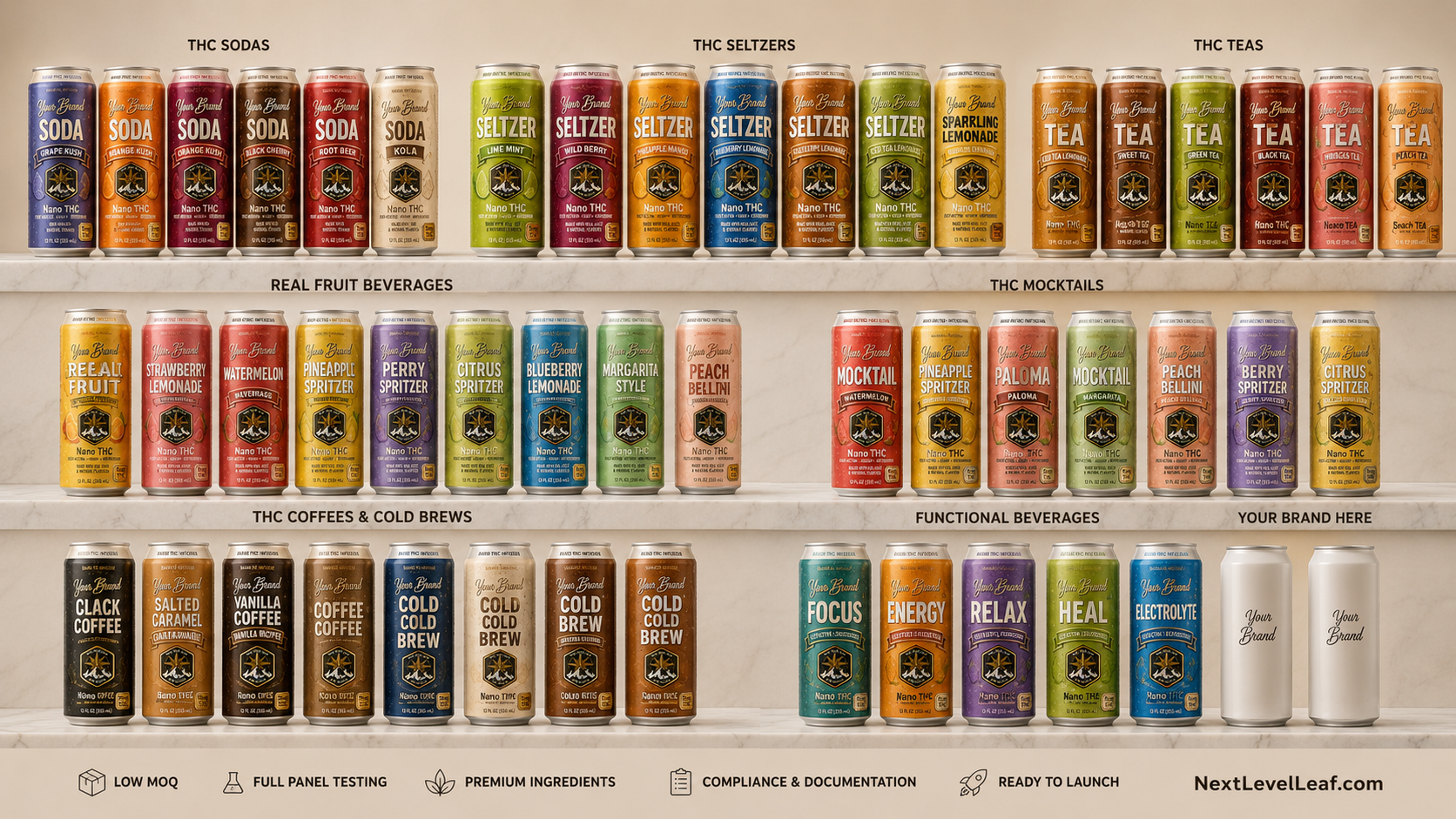
Available hemp beverage formats
Seltzers and spritzers
Light sparkling drinks for retail, hospitality, and social occasions. Available flavor examples can include Blueberry Lemonade, Pineapple Mango, Wild Berry, and Lime Mint.
Sodas and lemonades
Familiar beverage styles with flavor options that can include Orange, Root Beer, Grape, Black Cherry, Cream Soda, and Pink Lemonade.
Coffee and tea
Coffee and tea formats built around familiar routines. Available nitro coffee examples can include Black, Salted Caramel, and Vanilla Mocha.
Mocktails and functional drinks
Cocktail-inspired, juice-style, and functional concepts for a more distinctive beverage experience. Availability depends on the formula and project.
Which cannabinoid options can be considered?
Cannabinoid options depend on the selected beverage, desired dose, customer, target market, and applicable requirements.
Hemp-derived THC
Choose a dose and beverage format that fit the customer experience, finished-product testing, and intended market.
CBD
CBD may be used alone or with THC where it fits the established product and commercial positioning.
CBG and CBN
Additional cannabinoids can help shape a more specific product when they fit the formula and target market.
THCV and other inputs
Specialty cannabinoids may require additional product development and ingredient planning.
How dose and format should be matched
Seltzer-style beverages generally work best at lower or moderate doses, often around 5–25 mg. Higher-dose products may be more practical in flavor-forward sodas, juices, lemonades, coffee, or tea where the formula has more ability to manage bitterness, aroma, emulsion character, and finish.
The intended dose must also fit the customer, package, serving structure, target states, sales channel, pricing, and label strategy.
Commercial orders that can grow with your brand
Approximately 1,200 cans
Start with approximately 50 cases of 24 per SKU when you need a focused commercial order.
Larger brand programs
Support established businesses, multiple retailers, distributor relationships, and larger product launches.
Recurring production
Plan repeat orders and additional flavors as your customer demand and distribution grow.
Qualified prototype projects
A 360-can prototype may be available selectively when a qualified project needs a smaller product test.
Packaging and label options
Prototypes and lower-volume commercial runs requiring flexibility.
Label stock, condensation, seam placement, application tolerances, artwork, and final appearance.
Full-can graphics and programs able to support additional minimums and lead time.
Sourcing, distortion, application, recyclability, and production scheduling.
Moderate quantities where supplier and can specifications align.
Minimums, can availability, artwork requirements, timing, and inventory.
Established or recurring programs with predictable demand.
Higher commitment, ownership, storage, artwork changes, and formula changes.
Finished-product testing and documentation
An established beverage formula still needs the finished-product testing and documentation appropriate for the completed drink and intended market.
How target markets affect your beverage
Hemp beverage requirements can vary by state, cannabinoid profile, dose, packaging, labeling, and sales channel. Your target markets should inform the beverage you choose.
- Dose, serving structure, and package treatment
- Cannabinoid definitions and input restrictions
- Warnings, symbols, QR codes, age language, and label panels
- Testing panels, labs, sampling, batch rules, and COA formats
- Registrations or permits affecting products, brands, facilities, distributors, retailers, or sellers
- Direct sales, general retail, alcohol channels, hospitality, event, distribution, or dispensary requirements
Review State Resources and Compliance for general information. Specific legal questions should be reviewed with qualified counsel.
What affects white label cost and timing?
- Selected formula, flavor, dose, cannabinoid inputs, and number of SKUs
- Can size, decoration path, labels, cartons, cases, and printed-can commitments
- Finished-product testing, COAs, documentation, and target-state requirements
- Freight destination, pallet count, receiving conditions, storage, and release schedule
- Ingredient availability, package inventory, production window, payment, and artwork readiness
Your production timeline depends on the selected beverage, packaging, artwork, ingredients, testing, order quantity, and current manufacturing schedule.
What should be prepared for an accurate quote?
Choose a beverage that fits your brand and your customers
Tell us which drink format, flavors, cannabinoid options, packaging, and order quantity best match your business.
Request a White Label Quote