


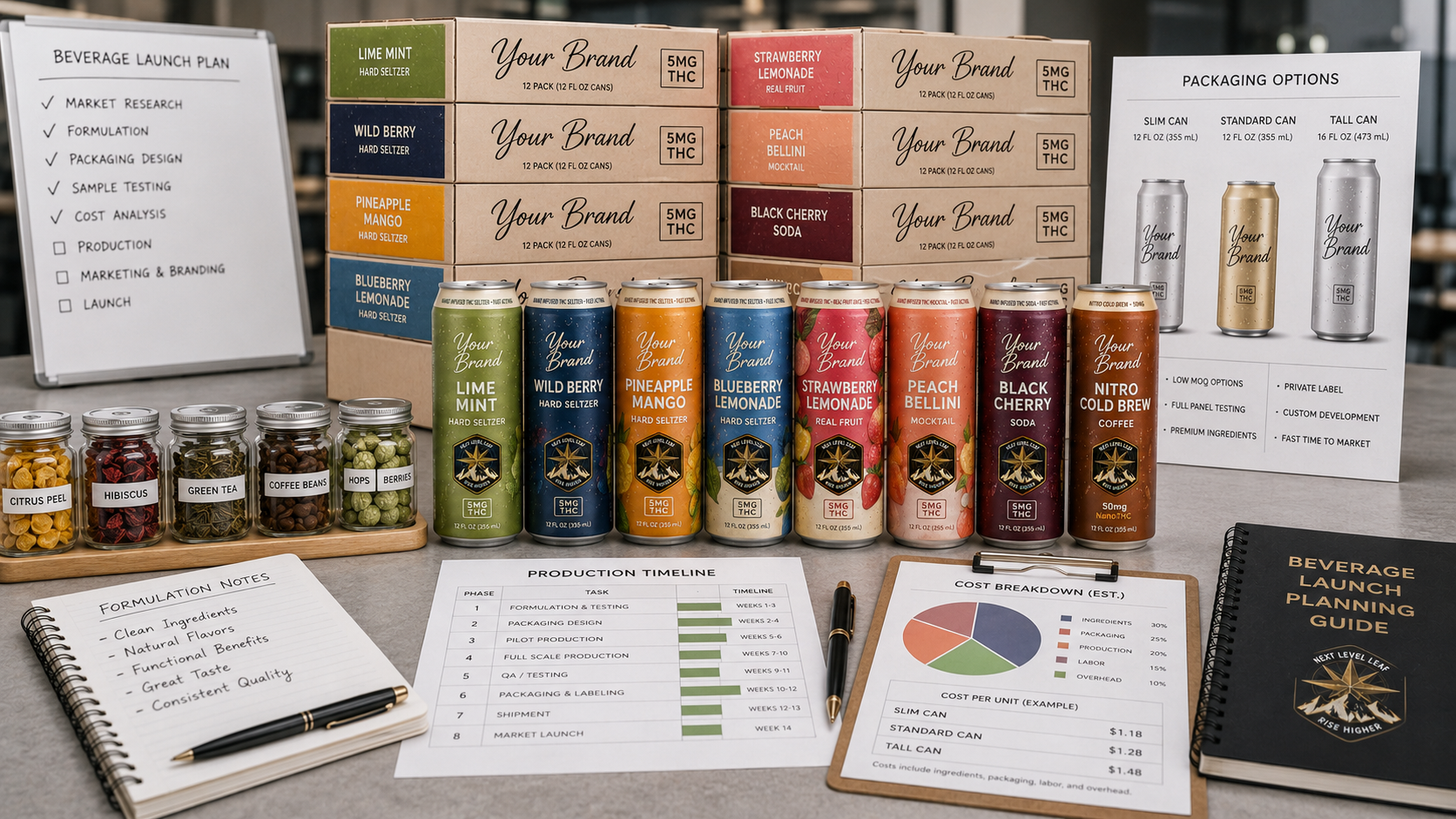
The complete hemp beverage cost equation
Total launch budget
Your quote may combine several of these categories. Ask which items are included in the manufacturing price and which costs are listed separately for your specific project.
Per-can manufacturing cost versus total launch budget
The quoted finished-unit scope, which may include formula ingredients, cannabinoid input, can, filling, label application, case packing, and selected production services.
Helps you compare manufacturing options and plan your customer pricing.
Production cost plus testing, freight, accessorial charges, warehousing, handling, and delivery.
Shows what it actually costs to place saleable inventory at the intended destination.
Development, artwork, labels, production, testing, freight, storage, registrations, samples, marketing, promotions, and channel costs.
Determines how much cash is needed to launch, not simply how much it costs to fill cans.
How the production path changes cost
Lowest development burden because the formula and production path are established.
Fastest path when the available product fits the customer and channel.
Adds product-specific flavor, dose, sweetener, ingredient, package, or positioning decisions.
Useful when the brand needs more differentiation without full custom R&D.
Depends on formula readiness, documentation, line fit, package compatibility, testing, and transfer work.
Best when the brand already has an existing beverage formula or developed product.
Adds development, samples, ingredients, testing, scale-up, and specification work.
Best when the product formula itself creates meaningful differentiation.
Formula and R&D costs
An existing beverage formula can reduce the amount of development needed before manufacturing. A custom product may require additional work to create the desired flavor, ingredient combination, cannabinoid profile, and finished beverage.
Custom development depends on the beverage, ingredients, number of products, and the amount of formulation work required. Your quote should explain whether development, testing, packaging, shipping, and manufacturing are included or listed separately.
Each flavor or dose can affect your total order
A different flavor, cannabinoid strength, or formula may require separate ingredients, production, labels, testing, and inventory. Starting with a focused product lineup can help keep your initial order practical.
How cannabinoid inputs affect cost
Cannabinoid type, dose, ingredient quality, and the complexity of the formulation can all affect the finished beverage price. Higher doses or specialized blends may also influence flavor, beverage format, packaging, and testing requirements.
More milligrams generally increase cannabinoid ingredient cost.
Higher doses may require stronger flavor masking, more emulsion, or a different beverage format.
Adds ingredient cost based on dose and supplier pricing.
May affect bitterness, cloud, testing, and positioning.
Minor cannabinoids can cost more per milligram than THC or CBD.
Can add formulation, taste, documentation, and positioning requirements.
Specialty cannabinoids can materially increase ingredient cost.
May require stronger commercial justification and sourcing lead time.
How cannabinoid choices influence your quote
The best cannabinoid profile balances your customer, beverage format, intended market, and overall product budget. Your project quote reflects the complete beverage rather than a separate public ingredient price list.
May support a lighter beverage profile and a simpler cannabinoid formulation.
Choose a dose that fits your customer, beverage format, and intended market.
Can increase ingredient and formulation requirements compared with a lower-dose beverage.
Flavor-forward formats may better support stronger cannabinoid profiles.
Changes the beverage profile, ingredient mix, and product positioning.
Consider how the selected combination affects flavor, labeling, and customer expectations.
CBG, CBN, THCV, and other supported options can create a more differentiated beverage.
Additional ingredients may affect product cost, formulation, testing, and market fit.
Cannabinoid options and final pricing depend on the complete beverage, target dose, order quantity, and intended markets.
Beverage-base and functional-ingredient costs
Packaging costs
Often a flexible starting option for commercial orders and branded product launches.
Lower package commitment, but label printing and application remain part of the cost.
Add sleeve sourcing, printing, freight, and application cost.
Creates full-can graphics but usually requires more planning and lead time.
Can be efficient at certain moderate quantities when can supply aligns.
Minimums, supplier schedules, and artwork requirements must be confirmed.
May be practical for established brands or recurring production with predictable demand.
Minimum quantities, unused inventory, artwork changes, and storage can affect the total project cost.
Add printed materials, assembly, case design, minimums, and packing needs.
Useful for retail presentation but can materially change budget and lead time.
How order size affects your beverage budget
Start around 1,200 cans
Approximately 50 cases of 24 per SKU provides a practical commercial starting order for retail, hospitality, events, and distribution.
Larger production runs
Manufacture larger orders for beverage companies, retailer programs, distributor commitments, and regional launches.
Multiple flavors and products
Build a broader lineup when separate flavors, cannabinoid profiles, or beverage formats fit your customer demand.
Recurring programs
Plan repeat manufacturing around established sales, ongoing distribution, and expected customer demand.
A 360-can prototype may be available selectively for qualified projects when the beverage, packaging, and production requirements support it.
Testing, COAs, stability, and documentation
Review our State Resources and Compliance pages for market-specific considerations. This website is informational and does not provide legal advice.
Freight, receiving, and warehousing costs
Finished beverages are heavy, and freight can materially change the landed cost of a small run. A quote should identify whether freight is included, estimated, or billed separately.
Linehaul cost changes with weight, pallet count, lane, fuel, and carrier availability.
Where is the product going, and can shipments be consolidated?
Locations without a dock or forklift may require additional services.
Does receiving have a dock, forklift, pallet jack, and business-hour availability?
Retail, warehouse, residential, event, and restricted locations may add accessorial charges.
What delivery conditions must the carrier meet?
Storage, handling, pallet movement, pick-and-pack, and staged distribution may be separate.
Will the full run ship at once or be held and released over time?
How volume changes the economics
Hidden costs brands commonly overlook
What information helps us prepare an accurate quote?
Get pricing for the beverage you actually want to produce
Tell us about your beverage format, flavor, cannabinoid profile, packaging, expected order quantity, target markets, and delivery location.
Request a Manufacturing Quote