

When does a hemp beverage need a custom formula?
Not every brand needs to develop a new recipe. If an existing drink already has the flavor, hemp-derived ingredients, and overall experience you want, a white-label hemp beverage or private-label hemp drink may be faster and simpler.
Custom formulation makes sense when your customers expect something an established recipe cannot provide. That might be an original flavor, a specific THC and CBD combination, functional ingredients, a different sweetener, or a beverage designed around an established retail or distribution program.
Start with an established beverage recipe and add your brand.
You want a simpler launch with fewer recipe changes.
Adapt an available beverage with brand-specific flavors, doses, or packaging.
You want more customization without developing everything from the beginning.
Bring an existing recipe for manufacturing and production review.
You already own a beverage formula and need a production partner.
Develop a beverage around a distinct flavor, ingredient combination, or product idea.
Your customer experience depends on a recipe that does not already exist.
Start with the drink your customers want to buy
Before discussing ingredients, consider who will buy the drink and why. A hemp seltzer for a grocery chain, a CBD cold brew for coffee shops, and a higher-dose soda for an experienced hemp retailer may require very different recipes.
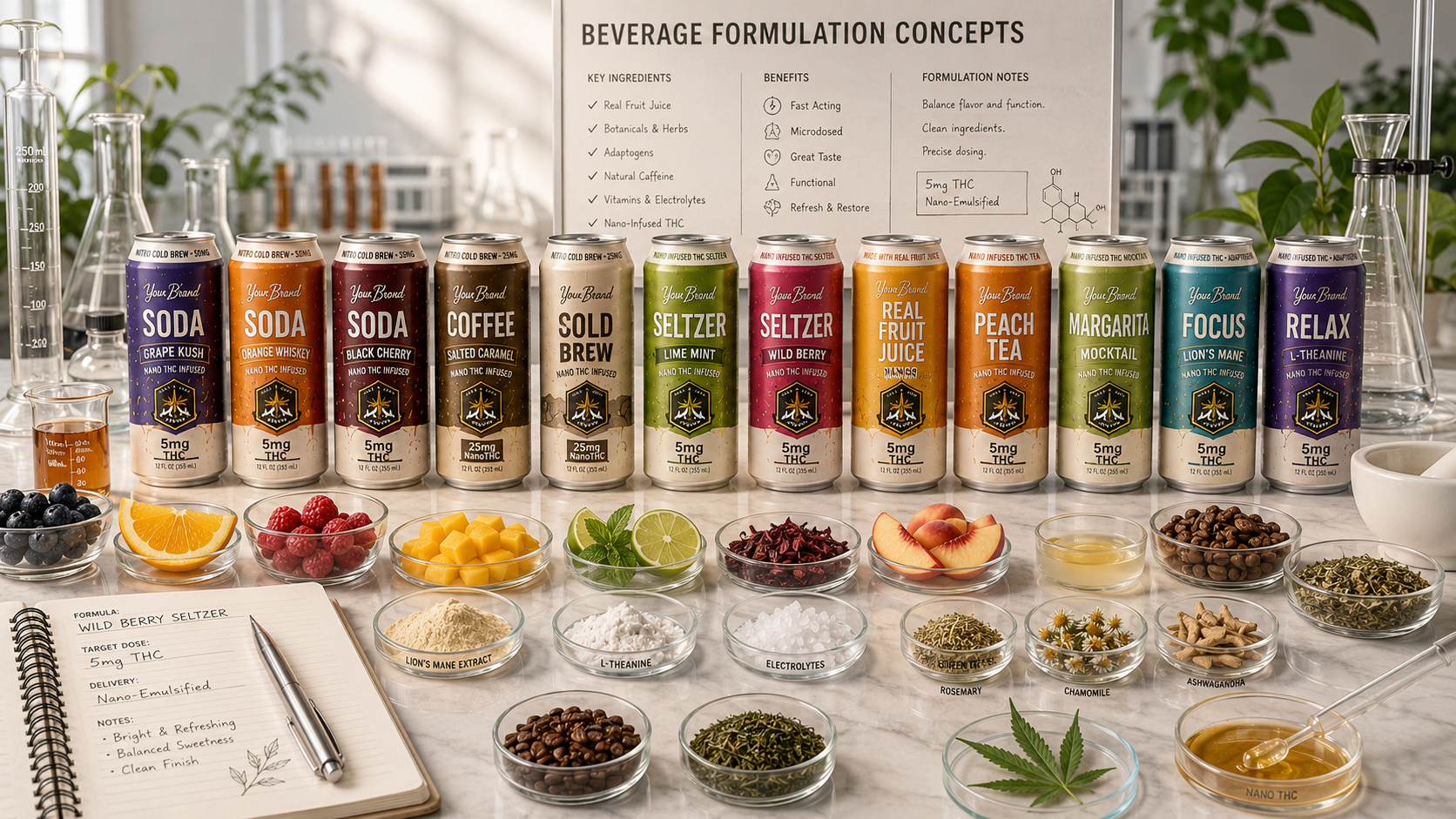
Choose the beverage format and flavor
The beverage format affects more than appearance. It changes how the hemp ingredients taste, how much sweetness or carbonation makes sense, which functional ingredients can be included, and how the finished drink will be produced.
Hemp seltzers
Lightly flavored sparkling drinks for social occasions, hospitality, retail, and alcohol-alternative customers.
Sodas and lemonades
Familiar, bolder flavors that can help balance stronger hemp ingredients and appeal to a wide range of buyers.
Coffee and tea
Cold brew, nitro coffee, iced tea, and related beverages built around drinking habits customers already understand.
Functional drinks
Mocktails, juice-based beverages, and other products combining hemp ingredients with a distinct flavor or functional direction.
If coffee is central to your concept, explore infused coffee manufacturing. If you are comparing broader product categories, the beverage manufacturing overview explains the available development options.
How do hemp-derived cannabinoids affect the formula?
A custom hemp beverage can be built around hemp-derived THC, CBD, or another cannabinoid when the ingredient fits the product, intended markets, and manufacturing requirements. Some brands want one primary ingredient, while others want a combination that differentiates the drink.
Hemp-derived THC
Choose a measured amount that fits the beverage format, flavor, intended customer, and applicable market requirements.
CBD
CBD can be considered on its own or alongside other hemp-derived ingredients when it fits the product and intended market.
CBG, CBN and CBC
Additional cannabinoids may help shape the product concept, although flavor, availability, testing, and cost must be considered.
THCV
Specialty cannabinoids require a closer look at ingredient availability, product fit, cost, and intended customer demand.
The right dose has to work with the beverage
Adding more hemp-derived ingredients can change bitterness, aroma, clarity, sweetness, and the overall drinking experience. Lighter seltzers often work best with lower or moderate amounts, while bolder sodas, lemonades, juices, coffee, or tea may provide more flavor support.
Why do hemp beverages need a compatible emulsion?
Cannabinoids do not naturally dissolve into water. A beverage-compatible emulsion helps distribute the ingredients throughout the drink so the finished product can support consistent dosing, a better taste, and a stable appearance.
The right ingredient system depends on the dose, beverage base, sweetness, carbonation, packaging, and production process. A clear seltzer and a rich nitro coffee may need different approaches even when they use the same hemp-derived ingredient.
Can a hemp beverage include functional ingredients?
Some brands want a hemp beverage built around a broader customer experience, such as an energy-focused drink, a coffee-based product, or a botanical sparkling beverage. Functional ingredients can be explored when they fit the recipe, taste, packaging, and production requirements.
Specific ingredients and product claims should be evaluated for the beverage and intended market. A functional ingredient should have a clear reason to be in the drink, not simply make the label sound more complicated.
What happens during custom beverage development?
Tell us what you want to make, who it is for, where it will be sold, and the flavors or ingredients you have in mind.
Decide whether an existing recipe can be adapted, a customer-owned formula can be transferred, or a new beverage needs to be developed.
Choose the beverage base, flavor direction, hemp-derived cannabinoids, functional ingredients, sweeteners, and packaging.
Review samples for flavor, sweetness, carbonation, appearance, and the overall experience you want customers to have.
Identify the changes that matter most, such as a stronger flavor, different sweetness, adjusted dose, or better ingredient balance.
Review ingredients, packaging, finished-product testing, first-order quantity, larger orders, and delivery needs.
Move into commercial production and plan future orders around retail demand, distributor programs, and recurring supply.
How should you evaluate beverage samples?
Start with the questions customers will notice first. Does the drink taste good? Does it smell right? Is the sweetness appropriate? Does the hemp ingredient leave an unwanted aftertaste?
Who owns a custom hemp beverage formula?
Formula ownership depends on how the beverage is developed and the specific project terms. A customer-owned formula, an adapted existing recipe, and a newly developed product may involve different rights.
Discuss confidentiality, exclusivity, future manufacturing, and whether the recipe can be transferred before development begins. If you already own a recipe, identify the formula, ingredients, production instructions, and supporting documents you can provide.
How are ingredients selected and documented?
Each ingredient should work in the finished beverage and be available in quantities that support the production plan. Flavor, sourcing, packaging, storage, and testing all matter when a sample becomes a commercial product.
Why can a good sample behave differently in production?
A beverage made in a small sample batch may behave differently when produced in commercial equipment. Mixing, temperature, carbonation, ingredient order, packaging, and filling conditions can all change the finished product.
Do the ingredients combine in a small sample?
Will they stay evenly distributed in a larger production batch?
Does the first sample taste right?
Will the same flavor remain consistent from batch to batch?
Does the drink feel refreshing in a test sample?
Will it fill, seal, ship, and store as intended?
Does the beverage look right in an early container?
Will the selected can, label, and package support the finished drink?
Does the sample have the intended dose and taste?
Can the finished beverage be tested and produced consistently?
What testing should a custom hemp beverage include?
Finished-product potency testing helps confirm the amount of hemp-derived cannabinoids in the completed drink. A certificate of analysis, or COA, documents the testing results and can support retailer, distributor, and customer questions.
Additional testing depends on the recipe, ingredients, packaging, and places where the product will be sold. Some projects may also need to consider microbiological testing, stability, shelf life, or market-specific requirements. The state resource center can help identify questions that need closer review.
What order sizes can custom hemp beverage manufacturing support?
Approximately 1,200 cans per SKU, or 50 cases of 24, is the normal commercial starting point. An SKU is one distinct product, such as a specific flavor, formula, or dose.
1,200 cans per product
A practical first commercial order for retail, wholesale, hospitality, or a focused brand launch.
Larger production orders
Plan higher quantities around established demand, several products, larger customers, and repeat sales.
Distributor programs
Build production quantities around store groups, distributors, regional programs, and delivery requirements.
Recurring production
Coordinate future orders around inventory, sales patterns, product availability, and business growth.
A selective 360-can prototype run may be available for qualified projects when the beverage and production requirements support it. This is not the normal commercial minimum.
Established brands and wholesale buyers can learn more about beverage opportunities for distributors and wholesalers.
What affects custom hemp beverage cost and timing?
Custom beverage pricing depends on the type of drink, flavor development, hemp-derived cannabinoids, functional ingredients, number of products, samples, testing, packaging, and production quantity.
A more complex formula may require more sample development or additional testing. An established recipe that needs only modest changes may move more quickly. For a clearer look at the main cost factors, read our hemp beverage manufacturing cost guide or visit the pricing overview.
What should you share to receive an accurate quote?
Tell us what you want to make
Share your beverage idea, preferred ingredients, expected order size, and target customers. We can help you determine the right next step.
Discuss Your Custom Beverage