What are white label THC beverages?
A white-label beverage begins with an established drink instead of requiring a completely new formula. Your brand selects an available beverage, chooses its packaging and product options, and develops an order around its customers and sales channels.
The beverage is sold under the customer’s brand. The formula may also be used for other customers, depending on the specific product and program. That is one of the main reasons white label can reduce research, development, and validation work.
Choose a beverage that fits your customers
The best white-label product matches your audience, flavor preferences, cannabinoid amount, packaging, and sales channels. An established beverage can simplify development while still giving your brand a clear identity.
Who is white label best suited for?
Founders testing demand
A focused white label launch can validate the customer, price, flavor, dose, and sales channel before funding a fully custom product.
Retailers and operators
Stores, hospitality groups, events, restaurants, bars, coffee shops, and other operators may use white label to add a branded beverage to an existing customer base.
Established beverage brands
A company with sales infrastructure may use white label to add an infused product without rebuilding its formulation and production system from zero.
Distributors and wholesalers
Distributors and wholesalers can build branded beverage programs around existing accounts, expected demand, delivery needs, and recurring orders.
Time-sensitive launches
An established formula may shorten the path when the brand has a real launch window and the available product already fits.
Focused first products
A focused beverage lineup can simplify a first launch, while larger brands can expand into multiple flavors, additional SKUs, and recurring production.
What beverage formats may be available?
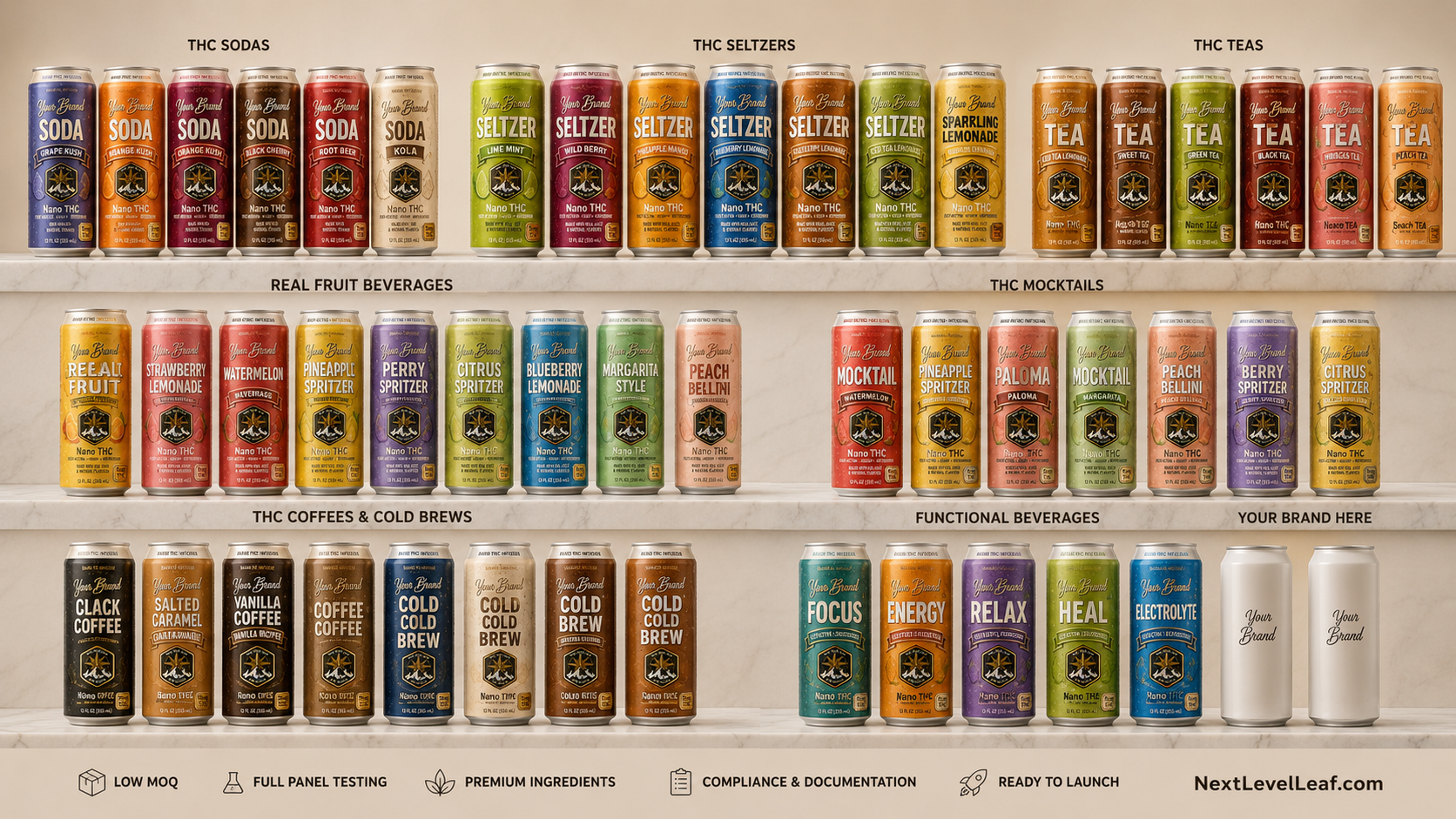
White label availability depends on the current production program. Common ready-to-drink directions may include:
THC seltzers
Light, carbonated products for social, refreshment, moderation, and alcohol-alternative positioning.
Sodas and lemonades
Bolder flavor systems that can support familiar soda, fruit, citrus, and lemonade experiences.
Still drinks and juices
Tea, lemonade, fruit drinks, juice-style products, and other still formats with different process and stability requirements.
Coffee and tea
Cold brew, nitro coffee, iced tea, herbal tea, sweet tea, and adjacent ready-to-drink concepts.
Mocktails and social drinks
Cocktail-inspired flavors designed around adult social occasions without traditional alcohol.
Functional beverages
Available programs may include caffeine, mushrooms, adaptogens, nootropics, hydration ingredients, or other functional directions.
Availability depends on the beverage, ingredients, packaging, and production requirements. Some drinks can start with an established formula, while others are better suited to private-label customization or custom development.
What can be customized?
White label does not mean every project is identical, but customization stays within the boundaries of the established formula and production system.
What usually cannot change without becoming custom?
A project begins to move beyond white label when the requested changes materially alter the formula, process, sensory profile, specifications, stability, or manufacturing requirements.
- A new flavor that requires ground-up development
- A new beverage base or major change in sugar, juice, coffee, tea, fruit, carbonation, or mouthfeel
- A complex cannabinoid or functional-ingredient stack that has not been validated in the formula
- An unusual package size or filling process
- A specific clarity, color, foam, nitrogen, texture, or stability requirement outside the existing specification
- A formula the customer wants to own exclusively
These requests may still be feasible, but they should be evaluated through Custom THC Beverage Formulation.
White label, private label, or custom formulation?
An existing or substantially established formula with defined production parameters.
An established beverage with your branding and less formula development.
An available manufacturing platform with more room for brand-specific product choices.
Additional brand-specific product choices without starting every detail from scratch.
A product concept, ingredient specification, owned formula, or unique sensory target that needs meaningful development.
A more distinctive flavor, ingredient combination, or beverage experience built around your brand.
Because the industry uses these terms inconsistently, the practical decision is based on how much of the formula is already established and how much technical work is required before production.
How are dose and cannabinoid options selected?
The dose should fit the intended customer, use occasion, serving structure, target states, sales channel, flavor system, and product positioning. A higher number is not automatically a stronger business decision.
Affects ingredient cost, taste, serving structure, positioning, and market fit.
Is the product for low-dose social use, a standard single serving, or another defined use case?
Can add product differentiation, ingredient cost, flavor considerations, and a need for clearer customer communication.
Does each cannabinoid support a meaningful product reason rather than simply expanding the ingredient list?
Caffeine, mushrooms, adaptogens, nootropics, electrolytes, and other ingredients can change cost, flavor, stability, and claims.
Which ingredients are essential to the customer promise and compatible with the available formula?
How much should your brand produce?
Choose an order size that reflects your customer demand, retail or distributor relationships, expected delivery needs, and plans for future reorders. The commercial starting minimum is not a production ceiling.
1,200 cans per SKU
Approximately 1,200 cans per SKU, or 50 cases of 24, is the normal commercial starting point.
Larger production orders
Plan larger orders, multiple flavors, additional SKUs, and recurring supply around actual sales and inventory needs.
360-can prototype
A smaller product-evaluation run may be available for qualified projects that need initial samples or product feedback.
Explore our manufacturing capabilities, compare commercial order options, or request a quote for the quantity your business needs.
How does SKU count affect the project?
MOQ is generally evaluated per SKU. A different flavor, dose, formula, or package may require its own batch, ingredients, labels, setup, testing, quality review, inventory position, and reorder plan.
Three flavors at a 1,200-can MOQ would commonly mean approximately 3,600 total cans. A focused first product can be easier to launch, finance, explain, sell, store, and reorder.
What packaging works for white label beverages?
Often the most practical path for prototypes and lower-volume first runs.
Artwork, label material, application, seam placement, condensation, and finished appearance.
Can provide full-can coverage but may add lead time, minimums, and application requirements.
Sleeve production, distortion, recyclability, application quality, and schedule.
May be useful at moderate quantities when supplier capabilities and can specifications align.
Supplier minimums, artwork, can availability, and timing.
Usually better suited to established or repeat programs with predictable volume.
Package quantities, inventory storage, artwork requirements, and future formula or label changes.
The package path should be chosen before artwork is finalized. Review THC Beverage Manufacturing Cost for the broader impact of labels, sleeves, printed cans, testing, freight, and inventory.
What testing and documentation should be expected?
A white label formula may already have production history, but each production run still needs an appropriate quality and release plan.
How long does a white label beverage take?
An established white-label beverage can reduce formula development work, but the actual timeline depends on the selected drink, ingredients, packaging, label design, product testing, production schedule, and delivery needs.
Specialized packaging, new artwork, ingredient changes, additional testing, or custom beverage adjustments can add time. Review the beverage manufacturing process to understand the main production steps.
What does a white label project cost?
The formula may reduce research and development costs, but the total project still includes the product, cannabinoid inputs, package, labels or decoration, testing, production, freight, and launch-specific costs.
Cost also changes with run size, SKU count, dose, ingredient stack, can size, label method, destination, and receiving requirements. The lowest unit price is not necessarily the lowest-risk launch if it requires more inventory than the brand can sell.
What should be prepared before requesting a quote?
White label works best when the existing product already supports the launch strategy
Share the product direction, target quantity, package, dose, intended markets, launch channel, and the decisions that are still open.
Request a White Label Quote