

THC Beverage MOQ
Choose the right beverage order for your first commercial launch, growing retail program, or larger recurring production.
Approximately 1,200 cans per SKU is the normal commercial starting point. Larger orders, multiple flavors, distributor programs, and recurring production can be planned around your actual demand.
The standard commercial starting point is approximately 1,200 cans per SKU, or 50 cases of 24. Your order can grow to support multiple flavors, larger retail programs, distributor demand, and recurring production.
A selective 360-can prototype may be available for qualified projects. The best production quantity depends on your beverage, packaging, sales plan, delivery needs, and anticipated reorders.
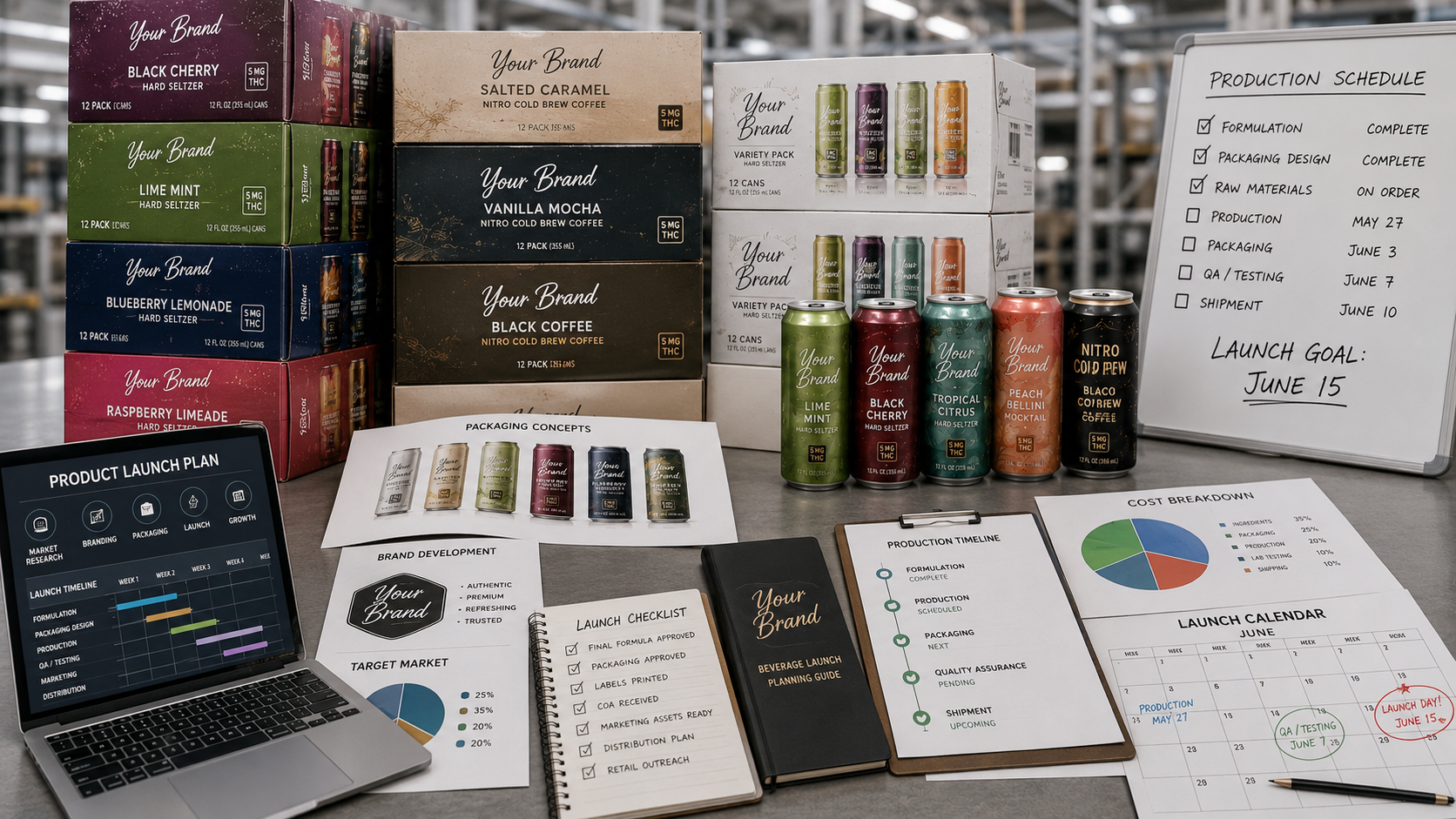
Match your beverage order to your sales plan
A first commercial launch, an established retail program, and a distributor rollout each require a different production plan. Your minimum starting order is not a limit on how much your brand can produce as demand grows.
| Brand stage | Production path | Best used for | Pricing approach |
|---|---|---|---|
| Commercial launch | Approximately 1,200 cans per SKU, or 50 cases of 24 | Initial retail placements, product sampling, and early customer demand | Product-specific manufacturing quote |
| Growing retail program | Larger orders and additional SKUs | Supporting more accounts while maintaining dependable inventory | Pricing based on the beverage, packaging, and order volume |
| Distributor or established-brand program | Higher-volume orders and recurring production | Coordinating account demand, delivery schedules, inventory, and reorders | Custom production and delivery plan |
| Selective product testing | A 360-can prototype for qualified projects | Evaluating a product before a broader commercial production run | Prototype pricing based on product and scope |
Need more than a first commercial run? Next Level Leaf supports larger beverage orders, multiple SKUs, retail expansion, distributor programs, and recurring production. Share your projected volume, packaging, delivery needs, and reorder schedule so the production plan reflects your actual opportunity.
Explore manufacturing capabilities or request a quote for your production program.
Why THC beverage manufacturers use MOQs
Even a relatively small beverage run requires production scheduling, ingredient ordering, batching, sanitation, filling, packaging, testing, labor, case packing, and logistics. These fixed setup requirements need to be spread across enough units for the run to work operationally and economically.
Line setup
Batching, filling, canning, cleaning, and changeovers influence the workable run size.
Ingredient ordering
Cannabinoids, flavors, sweeteners, cans, labels, trays, and cartons can have their own purchase minimums.
Formula and flavor count
More SKUs and more complex products create additional setup, purchasing, testing, and coordination.
Labels and cans
Pressure-sensitive labels, shrink sleeves, printed cans, and secondary packaging can change minimum commitments.
Testing and documentation
Finished-product testing, batch documentation, and quality controls are part of professional production planning.
Freight and storage
Case configuration, palletization, receiving, freight lanes, warehousing, and fulfillment shape the practical quantity.
Your minimum order is a starting point, not a ceiling
The right order gives your brand enough inventory to serve customers without tying up more cash than the sales plan supports. Established brands and distributors can move directly into larger orders when their account demand and inventory needs justify them.
Commercial starting point
Approximately 1,200 cans per SKU, or 50 cases of 24, for an initial commercial production run.
Growing retail programs
Additional flavors and larger order volumes planned around actual account demand.
Distributor and retail supply
Larger production programs coordinated with inventory, delivery needs, and reorder schedules.
Qualified prototype
A smaller product-evaluation run may be available for qualified projects.
The right quantity protects both momentum and cash flow. Too little inventory can interrupt selling just as accounts begin to reorder. Too much inventory can tie up cash that the brand needs for samples, sales, freight, promotion, and the next production run.
First-run THC beverage inventory planner
Use the planner to translate cans into cases, freight planning, launch accounts, and estimated weeks of inventory. It does not set your MOQ or forecast demand; it helps you test whether a proposed quantity can support the sales plan you already have.
Estimate how far a production run may go
Adjust every field to match your actual case pack, pallet configuration, account count, and expected weekly sales velocity.
Planning estimate only. Actual case packs, pallet patterns, freight requirements, allocations, sample reserves, damaged-can allowances, launch velocity, and reorder timing vary by project. Round quantities and shipping units should be confirmed in the production quote.
How multiple flavors change the total order
Minimum orders generally apply per SKU, not across the entire brand. At approximately 1,200 cans per SKU, one flavor equals 50 cases of 24, two flavors equal approximately 2,400 cans, and three flavors equal approximately 3,600 cans. Different cannabinoid amounts or formulas can also create separate SKUs.
Concentrated launch
Simpler production, one inventory position, one label file, and clearer product feedback.
Focused variety
More choice for accounts and sampling while keeping sales attention relatively concentrated.
Broader lineup
A stronger shelf set, but more cash, packaging, testing, inventory, and reorder decisions to manage.
A focused first lineup can make it easier to identify the best-selling product and build repeat demand. An established brand, distributor, or committed retail program may have enough demand to support multiple SKUs from the beginning. See who can launch a THC beverage brand for examples of different business models and starting points.
White-label, private-label, and custom MOQ
The liquid and production path matter. White-label products can often move faster because the beverage base or flavor system already exists. Private-label programs allow more brand and product choices within a proven path. Full custom R&D can add development runs, sourcing, stability work, and validation before commercial scale.
| Path | MOQ consideration | Best for | Primary tradeoff |
|---|---|---|---|
| White-label | Often the most accessible commercial path | Speed, lower development burden, and testing a market with a proven beverage | Less uniqueness at the formula level |
| Private-label | Varies with flavor, dose, packaging, and available base options | Brands seeking a distinct market presentation within an efficient production path | More decisions and coordination than a straightforward white-label launch |
| Custom R&D | May add development quantities before commercial MOQ | Unique formats, formulas, ingredient stacks, or proprietary flavor direction | More development time, cost, and validation before production |
| Enterprise program | Built around forecasts, cadence, packaging, and capacity reservation | Major retail, distribution, hospitality, and recurring high-volume demand | Requires stronger planning, forecasting, logistics, and supply coordination |
How packaging affects MOQ
Packaging can shape the production commitment as much as the beverage itself. The smallest workable liquid run may not match the minimum for custom printed cans, sleeves, cartons, or other materials.
Pressure-sensitive labels
Often practical for early launches and brands that want flexibility while refining packaging.
Shrink sleeves
Can create a full-can design, with added material, application, and scheduling considerations.
Printed cans
Often strongest for larger or recurring programs with stable artwork and confident demand.
How MOQ affects cost and cash flow
Order volume can change purchasing, packaging, production, and freight costs. A larger order may affect the price per can, but the actual difference depends on the beverage, ingredients, packaging, schedule, and total quantity. Do not assume a specific discount without a product-specific quote.
Use the Cost to Start a THC Beverage Brand guide to model production, development, packaging, freight, launch costs, and reorder cash without relying on one universal per-can price.
Match the order to states and sales channels
A group of independent retailers, a distributor rollout, an established beverage brand, and a larger hospitality program can require very different quantities. Consider the number of accounts, expected sales, delivery timing, and how quickly inventory may need to be replenished.
Build the first run around the states and channels you actually expect to serve. The State Resources hub can help frame state-specific planning while the THC Beverage Launch Checklist connects the product, sales, inventory, and reorder decisions.
What to provide for an accurate MOQ quote
You do not need every detail finished, but a useful quote depends on the variables that shape production.
- Beverage format and preferred can size.
- THC dose and any CBD, CBG, CBN, functional, or other active ingredients.
- Number of flavors or SKUs.
- White-label, private-label, co-packing, or custom-development preference.
- Target states and sales channels.
- Packaging preference and current artwork status.
- Expected first quantity and projected recurring volume.
- Case-pack, freight, warehousing, fulfillment, and delivery needs.
- Target launch date and any buyer, retailer, event, or distribution deadline.
Share the production plan that fits your brand. Whether you need approximately 1,200 cans per SKU or a larger recurring order, include your expected volume, packaging, delivery needs, and anticipated reorders. That information helps shape a practical manufacturing quote and production schedule.
Where to go next
Start a THC Beverage Brand
See the complete path from product concept through manufacturing and launch.
Read the founder guide →THC Beverage Cost Guide
Plan your production, packaging, freight, launch expenses, and reorder budget.
Plan the budget →Launch Checklist
Organize your product, packaging, sales, production, and inventory decisions.
Review the checklist →Beverage Pricing
Learn how your beverage, packaging, order volume, and production plan shape the quote.
Explore pricing →Manufacturing Capabilities
Explore production support for first commercial runs, larger orders, and recurring programs.
Review capabilities →Production Process
Understand the steps from product planning and packaging through production and delivery.
See the process →Beverage Manufacturing
Explore white-label, private-label, formulation, packaging, and production options.
Explore manufacturing →Distributor Programs
Plan larger beverage orders around account demand, delivery, and recurring supply.
Explore distribution →Request a Production Quote
Share your beverage, order volume, packaging, delivery needs, and expected timing.
Request your quote →Frequently asked questions
How much beverage inventory do you need?
Tell us about your beverage, packaging, expected order size, delivery needs, and timing. We can help plan your first commercial run, a larger order, or recurring production for your brand.