


Cost to Start a THC Beverage Brand
Build a realistic beverage budget for your first commercial run, a growing retail program, or larger recurring production.
Understand how your beverage, packaging, order volume, freight, launch expenses, and next reorder affect the total investment. Use the calculator to compare scenarios, then request a quote for your actual product.
Your beverage budget includes production plus any formulation, packaging, testing, freight, storage, launch expenses, and money reserved for your next order. Exact pricing depends on your product and order, so there is no single reliable cost for every brand.
Approximately 1,200 cans per SKU, or 50 cases of 24, is the normal commercial starting point. Next Level Leaf also supports larger orders, multiple flavors, retail and distributor programs, and recurring production. A selective 360-can prototype may be available for qualified projects.
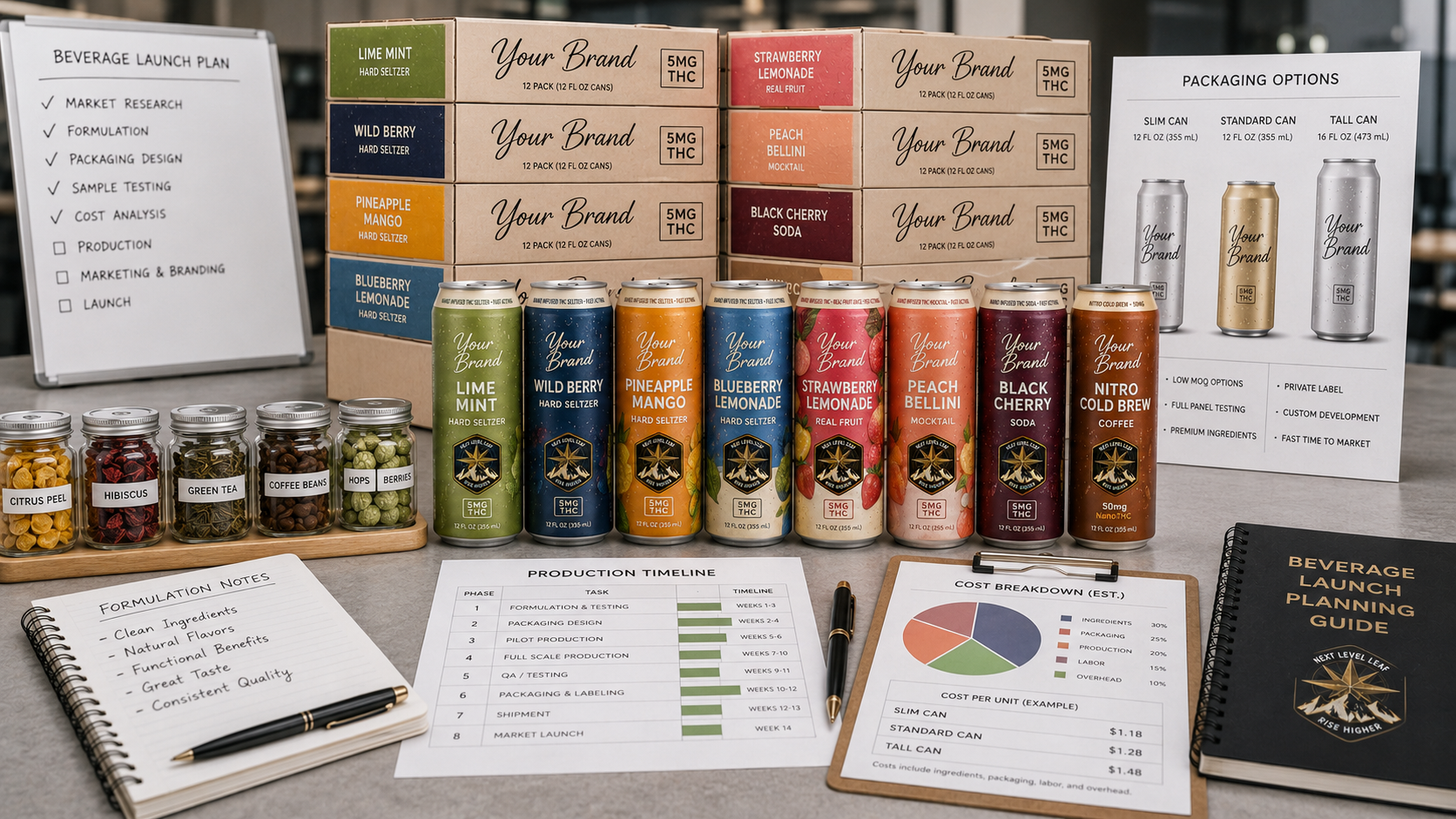
Choose a production plan that matches your stage
A new brand and an established beverage company need different production plans. Next Level Leaf supports first commercial runs as well as larger orders, multiple SKUs, retail expansion, distributor programs, and recurring production.
| Brand stage | Typical production path | Primary goal | Pricing approach |
|---|---|---|---|
| Commercial launch | Approximately 1,200 cans per SKU, or 50 cases of 24 | Enter the market with enough inventory for initial sales and customer feedback | Product-specific production quote |
| Retail expansion | Larger orders and additional SKUs | Supply more accounts while keeping inventory aligned with demand | Pricing based on the beverage, packaging, and order volume |
| Distributor or established-brand program | Higher-volume orders and planned reorders | Coordinate distribution, account needs, freight, and inventory availability | Custom production and delivery plan |
| Selective product testing | A 360-can prototype for qualified projects | Evaluate a product before committing to a broader commercial run | Prototype pricing based on the specific product and scope |
Planning a larger production program? Next Level Leaf works with brands preparing larger orders, multiple SKUs, retail placements, distributor programs, and recurring production. Share your expected volume, packaging, delivery needs, and reorder schedule so your quote reflects the actual project.
Explore beverage manufacturing capabilities or request a quote for your production program.
Build the THC beverage startup budget in four layers
A strong budget shows what it costs to make the first inventory, prepare it for market, sell it, and continue operating if the launch works. Separating those layers makes production quotes easier to compare and exposes expenses that do not appear in the can price.
Finished cans, beverage ingredients, cannabinoids, production, case packing, and the items included in the manufacturing quote.
R&D when needed, samples, brand and label work, packaging setup, and testing or documentation outside the quote.
Freight, receiving, storage, fulfillment, samples, retailer materials, sales activity, events, and promotion.
Cash reserved for the next deposit, production run, freight movement, and continued selling before all first-run revenue is collected.
Start with your customer, not a market forecast. A useful budget reflects the accounts you expect to serve, how much inventory they may need, how quickly you can replenish it, and the cash required to support the launch. Explore broader category considerations in the THC Beverage Market guide.
How to estimate THC beverage production cost
Start with the applicable quoted unit price and production volume, then add the costs that sit outside the quote. This works for a prototype, a first market run, or a large recurring program. High-volume pricing is project-specific because product design, packaging, ingredient purchasing, production cadence, and total committed volume affect the economics.
| Planning scenario | Core calculation | What to add | Best use |
|---|---|---|---|
| 360-can prototype | 360 × quoted prototype price per can | Any development, setup, freight, samples, and evaluation costs | Product evaluation, buyer samples, and concept validation when the path is available |
| 1,200-can first run | 1,200 × quoted production price per can | Separately quoted R&D, artwork, packaging, testing, freight, launch, and reorder reserve | A focused single-SKU market launch with enough inventory to support real selling |
| Two-SKU launch | Run quantity × quoted price for each SKU | Separate flavor, artwork, packaging, testing, inventory, sampling, and reorder needs | Brands with enough demand, sales coverage, and cash to support both products |
| Growth-stage run | Quoted volume price × total cans | Freight, storage, account support, promotion, fulfillment, and reorder timing | Regional growth, distributor programs, and repeat production |
| Enterprise program | Project-specific volume quote × scheduled cans | Packaging inventory, production cadence, freight lanes, warehousing, forecasts, and account requirements | 50,000–300,000+ cans, recurring programs, and larger planned deployments |
| Custom development | Development scope + prototype/pilot + production run | Ingredient sourcing, iterations, stability work, packaging, testing, freight, and launch | Concepts whose differentiation justifies more development before production |
Use the right price for the right volume. Enter a preliminary estimate or quoted finished-can price in the calculator below. Per-can pricing can change materially with the beverage, formula, packaging, and run size, so a prototype, 1,200-can launch, and 100,000-can program should not be modeled from one universal price assumption.
THC beverage startup cost calculator
Use this calculator to organize a first-pass budget for one product or an entire production program. It starts at approximately 1,200 cans per SKU, or 50 cases of 24. Enter a larger order volume, additional SKUs, or your own quoted price to model the production plan that fits your brand.
Estimate the cash needed for launch
The calculator keeps production, setup, launch, and reorder cash separate so one low line item does not hide the full investment.
Enter a preliminary estimate or quoted figure. Actual beverage pricing and included line items depend on format, formula, dose, ingredients, packaging, run size, production cadence, testing, freight, and production fit. High-volume programs receive project-specific pricing.
White-label versus custom: the biggest early cost decision
The easiest way to control startup cost is to put customization where it creates customer value. A production-ready white-label or private-label path can reduce early formulation work and help a founder get into the market faster. Custom development is the better investment when the formula itself is central to why the brand should win.
| Production path | Early cost profile | What the budget is paying for | Best fit |
|---|---|---|---|
| White-label | Usually the lowest-complexity path | A more production-ready product or flavor framework, brand packaging, manufacturing, and launch inventory | Fast market entry, controlled first investment, and demand testing |
| Private-label | Moderate complexity | A proven base plus selected dose, flavor, packaging, or positioning choices | Brands that want more control without building every formula element from zero |
| Custom or co-packed | Higher development variability | Unique formulation, ingredient sourcing, samples, iterations, stability work, or an existing proprietary formula | Products whose differentiation justifies the extra work, time, and capital |
Compare production options in the co-packing versus white-label guide, or see how custom THC beverage formulation affects product development.
MOQ and SKU count can multiply the launch budget
Approximately 1,200 cans per SKU, or 50 cases of 24, is the normal commercial starting point. Larger orders, multiple flavors, retail placements, distributor programs, and recurring production can be planned around actual demand. A selective 360-can prototype may be available for qualified projects.
Order size affects both the amount of cash required and the cost of each can. Larger orders can change packaging, purchasing, production, and freight economics, but any pricing difference depends on the product, schedule, and exact volume.
Concentrated learning
One formula, package, inventory position, sales story, and reorder decision give an early brand a clearer test.
More customer choice
Two strong products may expand account appeal, but they also require enough cash and selling capacity to support both.
Multiplying complexity
Every additional flavor can add production minimums, artwork, packaging, testing, samples, inventory, and forecasting work.
Use the THC Beverage MOQ guide to choose a run size that supports a real market test rather than simply chasing the smallest or largest number.
What changes the finished cost per can?
The beverage format, formula, packaging, production volume, and delivery plan all affect the quote. These are the variables worth comparing before deciding whether two per-can prices represent the same product and service.
Beverage base
Seltzer, soda, coffee, tea, lemonade, real-fruit drinks, mocktails, and functional beverages have different ingredient and processing requirements.
Dose and cannabinoids
THC amount, CBD, CBG, CBN, THCV, emulsion systems, and functional ingredients can change input cost and formulation complexity.
House versus custom
House profiles can shorten development, while custom sweetness, acidity, masking, flavor, or functional stacks may require more iterations.
Run size and SKUs
Production setup, ingredient ordering, packaging coordination, and testing are spread across the number of sellable cans.
Labels, sleeves, and printed cans
Can size, pressure-sensitive labels, shrink sleeves, printed cans, trays, cartons, and case configuration affect cost and lead time.
Testing and COAs
Finished-product testing, batch-specific COAs, lot traceability, and any additional panels should be included or clearly identified in the scope.
Calculate landed cost, not only the production invoice
Landed cost measures what each sellable can costs when it is where the brand can actually sell or ship it. It should include the production invoice, freight, receiving, storage, fulfillment, loss or damage assumptions, and any other cost tied directly to moving inventory into position.
Next, work backward from the intended retail price. Account for retailer and distributor economics, promotions, samples, fulfillment, and the margin the brand needs to keep selling. The THC beverage pricing guide explains the broader quote and unit-cost framework.
Commercial test: If the landed cost cannot support the intended channel and retail price, change the formula, packaging, SKU count, run size, channel, or price before committing to inventory.
Do not spend the entire budget on the first production run
Inventory does not create sales by itself. Preserve enough cash to place samples, support accounts, promote the launch, move freight, absorb payment timing, and start the next run before the first cans are gone.
Create velocity
Budget for samples, retailer outreach, sell sheets, product photography, events, promotions, and the work required to open and support accounts.
Protect continuity
Plan the next deposit and production cycle around sales velocity, weeks of inventory on hand, production lead time, and when customer payments arrive.
Common startup-cost mistakes
- Comparing only the per-can number: confirm what the quote includes, the product specification, testing, packaging, case pack, and delivery terms.
- Launching too many SKUs: more flavors can spread the same cash across weaker inventory positions and slower learning.
- Ignoring freight and receiving: beverages are heavy, and liftgate, appointment, storage, or accessorial needs can change delivered cost.
- Underfunding sales: a polished product still needs account outreach, samples, retailer materials, promotion, and follow-up.
- Forgetting the reorder: strong early sales can create a stockout if the next run is not funded and scheduled in time.
How to get an accurate THC beverage quote
You do not need every decision finalized. You do need enough direction to scope the product, production path, quantity, packaging, freight, and timeline honestly.
Define what you want to make
Beverage format, flavor direction, target THC dose, other cannabinoids or functional ingredients, can size, and whether the path should be white-label, private-label, custom, or co-packed.
Define how you plan to launch
First states and channels, estimated quantity, number of SKUs, packaging status, shipping destination, target timing, and any retailer, distributor, event, or seasonal deadline.
Ready for real numbers? Request a beverage manufacturing quote with your preferred format, flavor, cannabinoid amount, packaging, estimated volume, delivery location, and timing. You can also review the production process before deciding how to move forward.
Continue building the launch economics
Use the guide that matches the next decision in front of you.
Start a THC Beverage Brand
Connect the market opportunity to product, production, compliance, and quote strategy.
Read the founder guide →THC Beverage Launch Checklist
Move from market validation through production readiness, launch, and reorder planning.
Use the checklist →THC Beverage MOQ
Choose a first run that supports real selling and learning without unnecessary inventory exposure.
Understand MOQ →THC Beverage Pricing
Review how format, dose, complexity, packaging, volume, testing, and freight shape the quote.
Review pricing →Co-Packing vs. White Label
Compare speed, customization, formula readiness, responsibility, and development cost.
Compare production paths →Beverage Manufacturing
Explore white-label and private-label THC beverage formats and manufacturing capabilities.
Explore manufacturing →Manufacturing Capabilities
See how production can support first commercial runs, larger orders, multiple SKUs, and recurring programs.
Explore capabilities →Beverage Production Process
Understand the steps from product planning and packaging through production and delivery.
Review the process →Distributor and Wholesale Programs
Plan production around account demand, delivery needs, inventory, and repeat orders.
Explore distribution →Frequently asked questions
Get pricing for the beverage you want to make
Tell us about your preferred beverage, flavor, cannabinoid amount, packaging, expected order size, delivery needs, and timing. We can help you plan a first commercial run, a larger order, or recurring production.