

THC Beverage Launch Checklist
Build a practical plan for your beverage, packaging, commercial production, sales channels, larger orders, and recurring growth.
Use this checklist to connect the customer, product, formulation, production volume, budget, testing, distribution, and next production run.
A useful THC beverage launch checklist connects the buyer, beverage, packaging, commercial production, sales plan, and next order. Define the product, intended markets, cannabinoid amount, flavor, production volume, testing, freight, retail or distribution channels, and reorder timing.
Approximately 1,200 cans per SKU, or 50 cases of 24, is the standard commercial starting point. A selective 360-can prototype may be available for qualified projects. Larger orders, multiple SKUs, and recurring production can be planned around established demand.
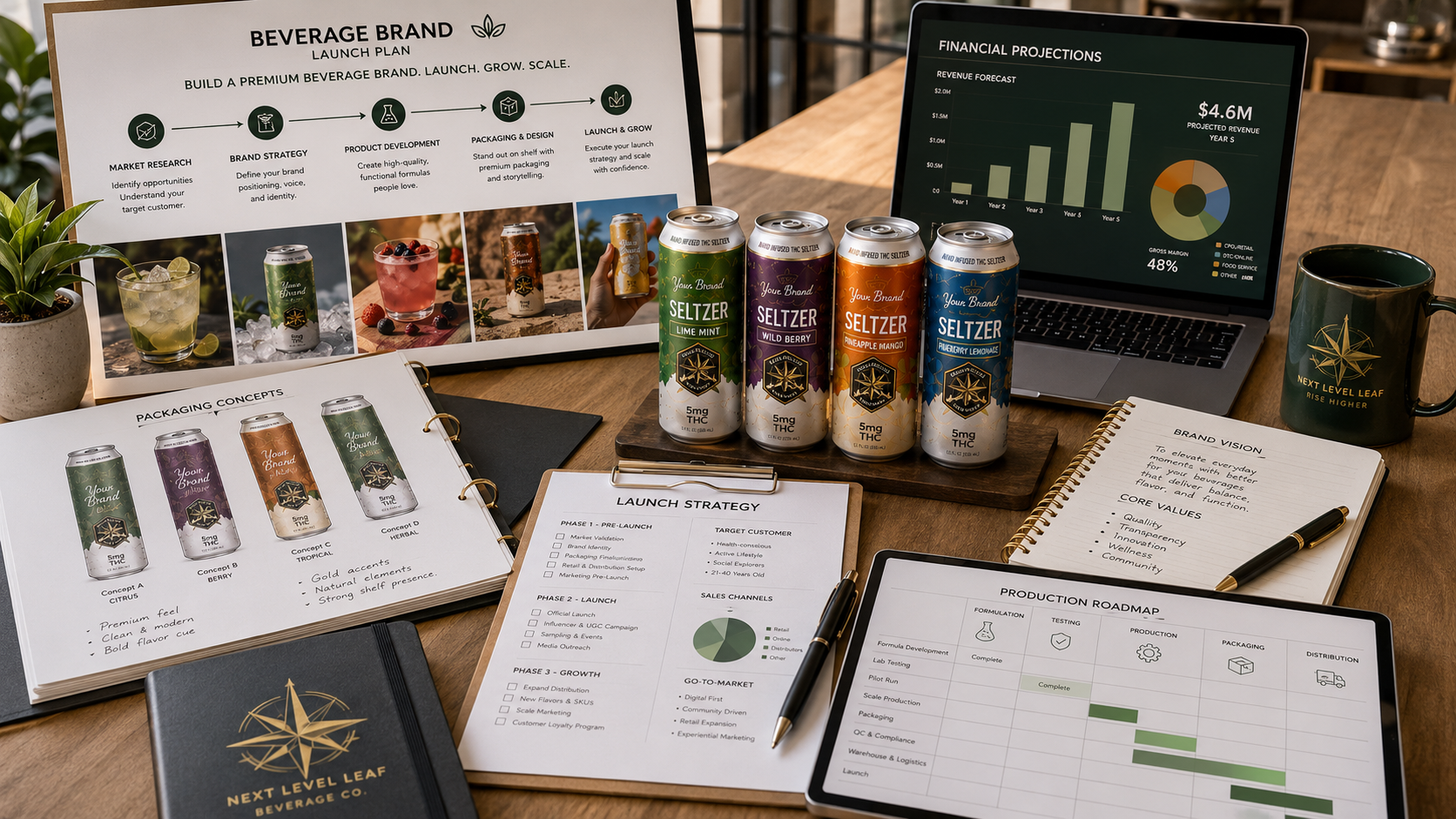
The five phases of a THC beverage launch
Use these five phases to connect product planning with commercial production, account growth, and reliable reorders.
Choose the buyer
Define the customer, sales channel, product occasion, and reason the beverage should be stocked.
Define the drink
Select the format, flavor, cannabinoid amount, intended markets, SKU count, and formulation path.
Build the budget
Connect production volume, packaging, landed cost, selling price, margin, and working capital.
Plan production
Set the formula, packaging, testing, manufacturing schedule, freight, and delivery requirements.
Sell and reorder
Prepare accounts, sales materials, inventory tracking, larger-order needs, and recurring production.
The category has meaningful commercial momentum. Grand View Research estimated the global cannabis beverages market at about $1.16 billion in 2023 and projected approximately $3.86 billion by 2030, a 19.2% compound annual growth rate. IWSR separately projected no-alcohol analogues to grow 36% in volume from 2024 through 2029. These broader and adjacent forecasts support the opportunity signal; the checklist below helps turn that opportunity into a specific product and sales plan.
Sources: Grand View Research cannabis beverage forecast (September 2024) and IWSR no-alcohol and functional drinks analysis (January 2026). Explore the broader category in the THC Beverage Market guide.
Phase 1: Validate the customer, occasion, and first sales channel
The market may be growing, but a first product still needs a precise reason to exist. Define who will buy it, when they will drink it, where they will find it, and why they will choose it over another beverage.
Identify the customer and occasion
Choose the adult consumer and moment the beverage should own: social drinking, alcohol replacement, relaxation, coffee ritual, a flavor-forward treat, or a clearly defined functional occasion.
Choose the first sales channel
Decide whether the first run is built for your retail locations, independent retailers, distributors, hospitality accounts, events, direct sales where permitted, or an existing audience.
Build a first-market hypothesis
List the states, cities, accounts, audience, and price tier most likely to support the launch. A focused opening market is easier to learn from than a vague national plan.
Validate demand before maximizing complexity
Use retailer conversations, distributor feedback, waitlists, audience polls, sampling plans, competitive pricing, or purchase intent to test the concept before expanding flavors and SKUs.
If you are evaluating who can bring a product to market, review who can launch a THC beverage brand.
Phase 2: Scope the product and production path
The product should be easy for the customer, retailer, and manufacturer to understand. More ingredients, flavors, formats, and claims do not automatically make a stronger first launch.
1. Choose the beverage format
| Format | Customer and channel fit | Planning implications | Helpful next page |
|---|---|---|---|
| THC seltzer | Social, refreshing, lower-calorie, alcohol-alternative positioning | Clear retail story; flavor and dose should support approachability and repeat drinking occasions. | Infused Seltzers |
| THC mocktail | Premium evening ritual, hospitality, cocktail replacement | Usually more flavor-forward, experiential, and packaging driven. | Infused Mocktails |
| THC soda | Bold flavor, nostalgia, convenience, mainstream familiarity | Can support stronger flavor masking and a distinctive shelf presence. | Seltzer vs. Soda |
| THC coffee | Coffee ritual, premium café positioning, functional crossover | Requires a clear coffee experience, roast/flavor direction, and thoughtful caffeine positioning. | Infused Coffee |
| Tea, lemonade, or still drink | Familiar refreshment, fruit-forward concepts, seasonal or regional appeal | Sweetness, acidity, flavor system, shelf stability, and still-beverage processing matter. | Beverage Manufacturing |
2. Select dose, cannabinoid profile, and flavor direction
The cannabinoid amount shapes the product, sales channel, label, and intended markets. Choose an amount that fits the customer, beverage format, retail strategy, and applicable market requirements.
CBD, CBG, CBN, THCV, caffeine, L-theanine, mushrooms, adaptogens, electrolytes, or other functional ingredients can add differentiation when they make the concept clearer. They can also add cost, sourcing, flavor, stability, testing, and claims considerations. Review cannabinoid selection for THC beverages before building an ingredient stack.
3. Keep the first SKU plan focused
Every additional flavor multiplies artwork, inventory, production, sampling, forecasting, and sales complexity. A tightly chosen first SKU or small lineup often creates better learning than launching several unproven variations at once.
4. Choose white-label, private-label, co-packing, or custom development
White-label
Begin with an existing beverage direction and build the product around your brand, packaging, and cannabinoid amount.
Private-label
Start with an established profile and evaluate changes that fit your flavor, product, or packaging requirements.
Custom or co-packed
Use this path when a distinct formula, ingredient system, beverage format, or existing formula drives the project.
Use the co-packing versus white-label guide to compare the production paths in more detail.
5. Identify launch states before locking the product
State rules can shape dose, cannabinoid profile, label, packaging, registration, testing, age controls, taxes, and sales channels. Start with the markets most important to the business, then use the State Resources hub to evaluate the current pathway before final artwork and inventory decisions.
Phase 3: Plan production volume, cost, pricing, and cash
The production run should match your sales plan, available working capital, and the price your market can support. Include both the first commercial order and the next run in the financial plan.
Choose the right commercial volume
Order enough inventory to support samples, account placements, direct sales, promotion, and expected demand without tying up more cash than the sales plan supports.
Calculate landed cost
Combine beverage production, cannabinoids, packaging, testing, freight, receiving, storage, and fulfillment. The quoted can price is only one part of what inventory costs when it is ready to sell.
Build the price ladder
Work backward from the intended retail price through distributor and retailer margins, promotions, samples, and freight to understand what the brand can afford to pay per unit.
Protect launch and reorder cash
Plan for artwork, development, deposits, production, freight, marketing, and the next order. Growing brands should account for larger runs and additional SKUs before existing inventory runs low.
Commercial production benchmark: Approximately 1,200 cans per SKU, or 50 cases of 24, is the standard commercial starting point. A selective 360-can prototype may be available for qualified projects. Larger orders, multiple SKUs, and recurring production can be planned around retail, distributor, or direct-market demand.
Compare the THC beverage MOQ guide, the cost to start a THC beverage brand, and the broader THC beverage pricing guide before choosing your production volume.
Phase 4: Prepare the beverage for production
Before manufacturing begins, the formula, packaging, label, testing, schedule, freight, and delivery requirements need to fit the actual product and order.
Set the formula, flavor, and samples
Define the beverage format, cannabinoid amount, ingredients, flavor, sweetness, carbonation, and any development work needed before manufacturing.
Complete packaging and label artwork
Confirm the can size, label method, net contents, product identity, ingredients, required disclosures, batch information, and case configuration.
Confirm testing and documentation
Align the finished-product testing, batch-specific COA, potency verification, traceability, and documentation access with the product, launch states, and retailer expectations.
Lock schedule, freight, and receiving
Confirm production timing, ingredient and packaging lead times, delivery address, receiving hours, liftgate or appointment needs, pallet handling, storage, and the freight assumption used in the budget.
The Next Level Leaf compliance approach explains how testing, COAs, labels, and professional documentation support a stronger product and retailer conversation.
Phase 5: Prepare to sell, launch, and reorder
Production creates inventory. The sales plan turns that inventory into accounts, customers, repeat orders, and larger production opportunities.
Build retailer and distributor materials
Prepare a concise sell sheet, wholesale pricing, product specifications, case pack, COA access, product images, brand story, target customer, and clear reason the beverage should be stocked.
Create the account and sampling plan
List priority accounts, decision-makers, distributor conversations, sampling opportunities, events, and follow-up dates before inventory arrives.
Schedule the launch story
Coordinate product photography, website, email, social content, retailer announcements, events, founder outreach, and sampling so demand creation begins before the first cans are ready to ship.
Set the reorder point
Track units sold, account growth, inventory on hand, production timing, available cash, and upcoming promotions. Plan the next order before strong sales turn into an avoidable stockout.
Plan for larger orders and recurring production
Your first commercial order is a starting point, not a ceiling. Established brands, retailers, and distributors should build the production plan around expected sales volume, additional SKUs, account expansion, and reorder timing.
Start with the right inventory
Match the opening run to actual accounts, sampling needs, direct sales, and available working capital.
Increase volume as accounts expand
Use sales history, account growth, and upcoming placements to plan larger production runs and additional SKUs.
Protect inventory continuity
Coordinate reorder timing, packaging availability, freight, and production forecasts before stock becomes constrained.
Review our manufacturing capabilities, production process, and distributor and wholesale opportunities when planning higher-volume growth.
Choose the next step for your business stage
Use your current stage to identify the information that matters and the most useful next action.
| Stage | What should be clear | Best next action |
|---|---|---|
| Exploring the concept | Target customer, beverage direction, possible sales channel, and reason the product fits the market. | Review Start a THC Beverage Brand and the market guide. |
| Planning the order | Beverage format, cannabinoid amount, flavor, intended markets, estimated quantity, packaging, and timing. | Request a beverage manufacturing quote. |
| Preparing production | Formula, flavor, order quantity, packaging, testing, schedule, freight, and receiving details. | Complete the product, label, manufacturing, and delivery plan. |
| Launching the product | Inventory, product documentation, pricing, sales materials, target accounts, fulfillment, and promotion. | Begin the retail, distribution, sampling, and promotional plan. |
| Scaling the brand | Sales, inventory on hand, account growth, future demand, working capital, and production timing. | Plan larger orders, additional SKUs, and recurring production before inventory becomes constrained. |
What to include in your beverage quote request
Share the product and commercial details you already know:
Brand and product direction
Company name, beverage format, flavor, cannabinoid amount, other ingredients, and whether you prefer an established profile or custom development.
Commercial and growth plan
Intended markets, sales channels, initial order, larger-volume needs, expected reorder timing, and retailer or distributor interest.
Packaging status
Can size, label or can-art status, existing brand guidelines, packaging preferences, and whether design or packaging support is still needed.
Anything unusual
Special ingredients, certifications, sweeteners, clarity requirements, existing formulas, supplied inputs, shipping constraints, or other details that could affect feasibility.
Ready to discuss your beverage? Request a manufacturing quote with the product direction, packaging status, expected volume, and intended sales channels.
Continue planning your THC beverage brand
Use the guide that matches the next decision in front of you.
Start a THC Beverage Brand
Review the complete path from product selection through commercial production and growth.
Read the launch guide →Cost to Start a THC Beverage Brand
Separate development, production, packaging, testing, freight, launch, and working-capital needs.
Review launch costs →THC Beverage MOQ
Compare commercial starting volumes, larger orders, multiple SKUs, and production planning.
Understand production volume →Co-Packing vs. White Label
Compare the production paths by speed, customization, cost, formula readiness, and operating responsibility.
Compare production paths →Production Capabilities
Review beverage formats, packaging paths, commercial volumes, and larger production support.
Review capabilities →Beverage Manufacturing
Explore private-label, custom formulation, packaging, testing, and commercial manufacturing.
Explore manufacturing →Frequently asked questions
Ready to plan your beverage production?
Share the beverage format, flavor, cannabinoid amount, intended markets, packaging, initial order, larger-volume needs, and expected reorder schedule.