What are private label THC beverages?
A private-label beverage is produced for a specific business and sold under its own brand. Your drink can begin with an established beverage and incorporate product choices that better reflect your customers and brand identity.
Compared with a basic white label product, private label usually places more emphasis on the brand’s audience, product story, dose, flavor direction, package, price point, channel, and customer experience.
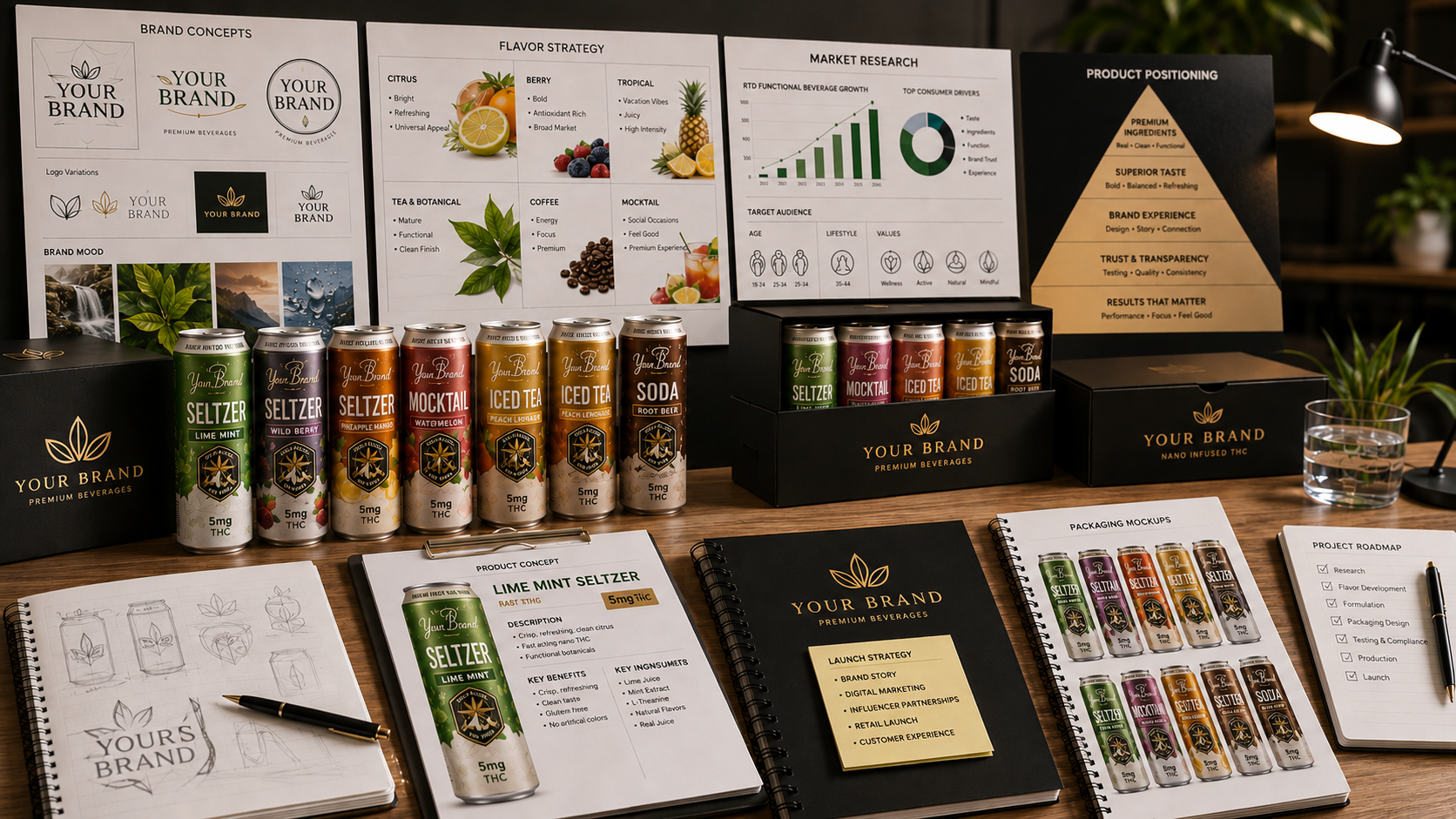
Build a beverage your customers will recognize as yours
Choose the format, flavor, cannabinoid amount, ingredients, packaging, and product positioning that make sense for your audience. The best product is defined by what your customers want, not unnecessary complexity.
Who should consider private label THC beverages?
Retailers and store groups
A house beverage can create a branded product that supports merchandising, repeat traffic, margin, and customer loyalty.
Distributors and wholesalers
A private-label line can give distributors and wholesalers a branded product for existing accounts, larger orders, and recurring regional supply.
Existing beverage companies
An established brand may use private label to enter THC beverages through a product that reflects its current audience and positioning.
Restaurants, hotels and venues
A branded beverage may support menus, events, alcohol-alternative programs, retail coolers, and guest experiences.
Coffee shops and breweries
Operators with a clear product identity may use private label to extend into cold brew, tea, soda, seltzer, mocktails, or other ready-to-drink formats.
Entrepreneurs with a defined customer
Private label is strongest when the founder already understands the audience, channel, use occasion, price point, and reason the product should exist.
How is private label different from white label?
White label starts with an established beverage and your branding. Private label provides additional flexibility to shape the product around your customers. Custom formulation is the right fit when the beverage itself needs more substantial development.
An existing or substantially established formula and production path.
An established beverage with your brand and less formula development.
An available manufacturing platform with more room for product decisions tied to the brand and channel.
Additional flavor, ingredient, packaging, or brand-specific product choices.
A concept, owned formula, unique ingredient system, or sensory target requiring meaningful development.
A more distinctive beverage built around a specific flavor, ingredient combination, or customer experience.
The practical question is how much of the drink you want to customize and whether your preferred product can start with an established beverage or requires a new formula.
What can be customized in a private label beverage?
The available choices depend on the formula and production program, but private label may allow more brand-specific decisions in several areas.
When does private label become custom formulation?
A project moves toward custom formulation when the requested changes materially alter the formula, process, sensory profile, specifications, stability, or manufacturing requirements.
- A new beverage base or a major change in sugar, juice, coffee, tea, fruit, carbonation, texture, or mouthfeel
- A flavor that requires ground-up development rather than selection or adaptation
- A complex cannabinoid or functional-ingredient stack that has not been validated in the available platform
- An unusual package size, closure, nitrogen process, or filling requirement
- A specific clarity, color, foam, preservation, shelf-life, or stability target outside the existing specification
- A formula the customer expects to own exclusively
These requests may be feasible, but they should be evaluated through Custom THC Beverage Formulation.
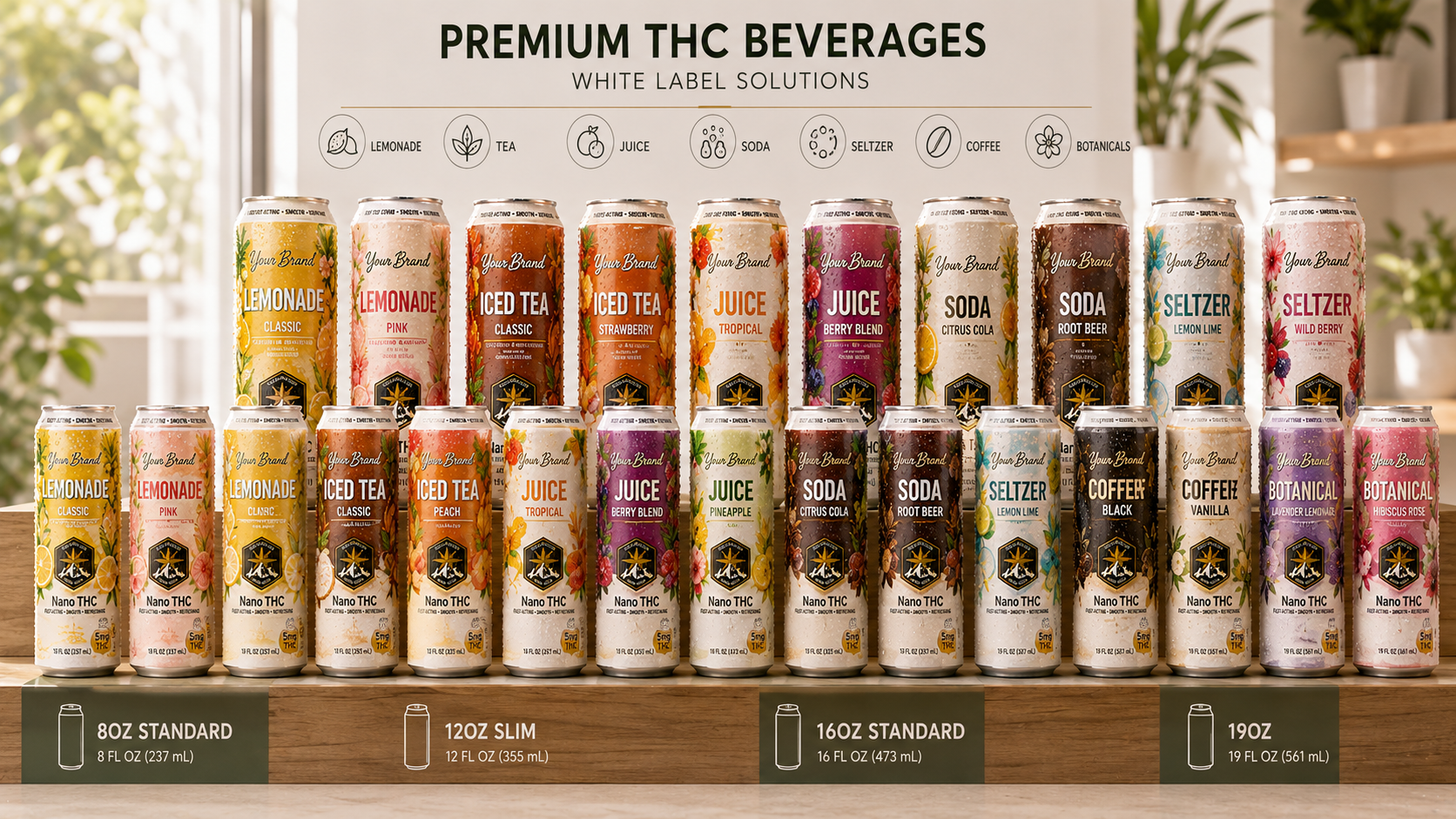
What beverage formats can be evaluated?
Seltzers and spritzers
Light, carbonated products for social use, refreshment, moderation, and alcohol-alternative occasions.
Sodas and lemonades
Bolder flavor systems that can support familiar soda, citrus, fruit, and lemonade experiences.
Still drinks and juices
Tea, lemonade, fruit drinks, juice-style products, and other still formats with different processing requirements.
Coffee and tea
Cold brew, nitro coffee, iced tea, sweet tea, herbal tea, and adjacent ready-to-drink concepts.
Mocktails and social drinks
Cocktail-inspired flavors built around adult social occasions without traditional alcohol.
Functional beverages
Available directions may include caffeine, mushrooms, adaptogens, nootropics, hydration ingredients, or other functional inputs.
How should dose and ingredient options be selected?
The ingredient list should support the product promise. A private label project becomes harder to explain, formulate, price, and sell when ingredients are added without a clear customer-facing purpose.
Affects ingredient cost, flavor, serving structure, positioning, market fit, and customer expectations.
What dose fits the intended audience, state, channel, occasion, and package?
CBD, CBG, CBN, THCV, and other inputs add cost and may change flavor or formulation.
Does each ingredient create a meaningful reason to buy?
Caffeine, mushrooms, adaptogens, nootropics, electrolytes, and fruit systems can change cost, sensory profile, and claims.
Which ingredients are essential to the product’s customer promise?
How much should your brand produce?
Your order should match the customers, retail locations, distributor accounts, and delivery needs you expect to serve. The commercial starting minimum does not limit larger production orders or recurring supply.
1,200 cans per SKU
Approximately 1,200 cans per SKU, or 50 cases of 24, is the normal commercial starting point.
Larger production orders
Coordinate larger orders, multiple SKUs, retail or distributor supply, and recurring production around actual demand.
360-can prototype
A smaller product-evaluation run may be available for qualified projects that need initial samples or market feedback.
Explore our manufacturing capabilities, compare commercial order options, or request a quote for the quantity your business needs.
How many SKUs should a private label line launch?
One or two focused SKUs are usually easier to fund, explain, merchandise, store, sell, and reorder than a broad initial lineup. Each flavor, dose, formula, or package may require its own batch, label, testing plan, quality review, inventory position, and reorder decision.
Three flavors at approximately 1,200 cans per SKU would mean about 3,600 total cans. Additional flavors should reflect customer preferences, sales channels, and the inventory your business plans to support.
What packaging options are available?
Often the most practical path for prototypes and lower-volume first runs.
Artwork, label material, application, condensation, seam placement, and finished appearance.
Can provide full-can coverage but may add lead time, minimums, and application requirements.
Sleeve production, distortion, recyclability, application quality, and schedule.
May be useful at moderate quantities when supplier capabilities and can specifications align.
Supplier minimums, artwork, can availability, and timing.
Usually better suited to established or repeat programs with predictable volume.
Package quantities, inventory storage, artwork requirements, and future formula or label changes.
Who owns the formula and is it exclusive?
Private label does not automatically mean the formula is exclusive. An available base or manufacturing platform may be used in more than one program, while a custom-developed formula may have different ownership terms.
The project should define what is being provided, what is being developed, whether the formula or specifications are shared or exclusive, whether the customer can transfer the formula, and what happens if the product changes in the future.
What testing and documentation should be planned?
How long does private label development take?
The timeline depends on your beverage, flavor development, ingredients, packaging, label design, product testing, production schedule, and delivery needs.
An established beverage may require less development than a product with a new flavor, specialized packaging, or additional ingredient work. Review the beverage manufacturing process to understand the main production steps.
What does a private label project cost?
Cost depends on the formula path, beverage format, dose, ingredient stack, SKU count, package, label method, testing, run size, freight, and the amount of development required.
Private label may cost more than a basic white label product when it includes new flavor work, ingredients, package changes, additional testing, or a more complex production specification. It may still require less development than a fully custom product.
Review THC Beverage Manufacturing Cost for the full cost stack and landed-cost framework.
What should be prepared before requesting a quote?
Private label works best when the product choices support a specific brand and channel strategy
Share the customer, format, dose, flavor direction, ingredient priorities, package, quantity, target markets, and the areas where you want more customization.
Request a Private Label Quote