
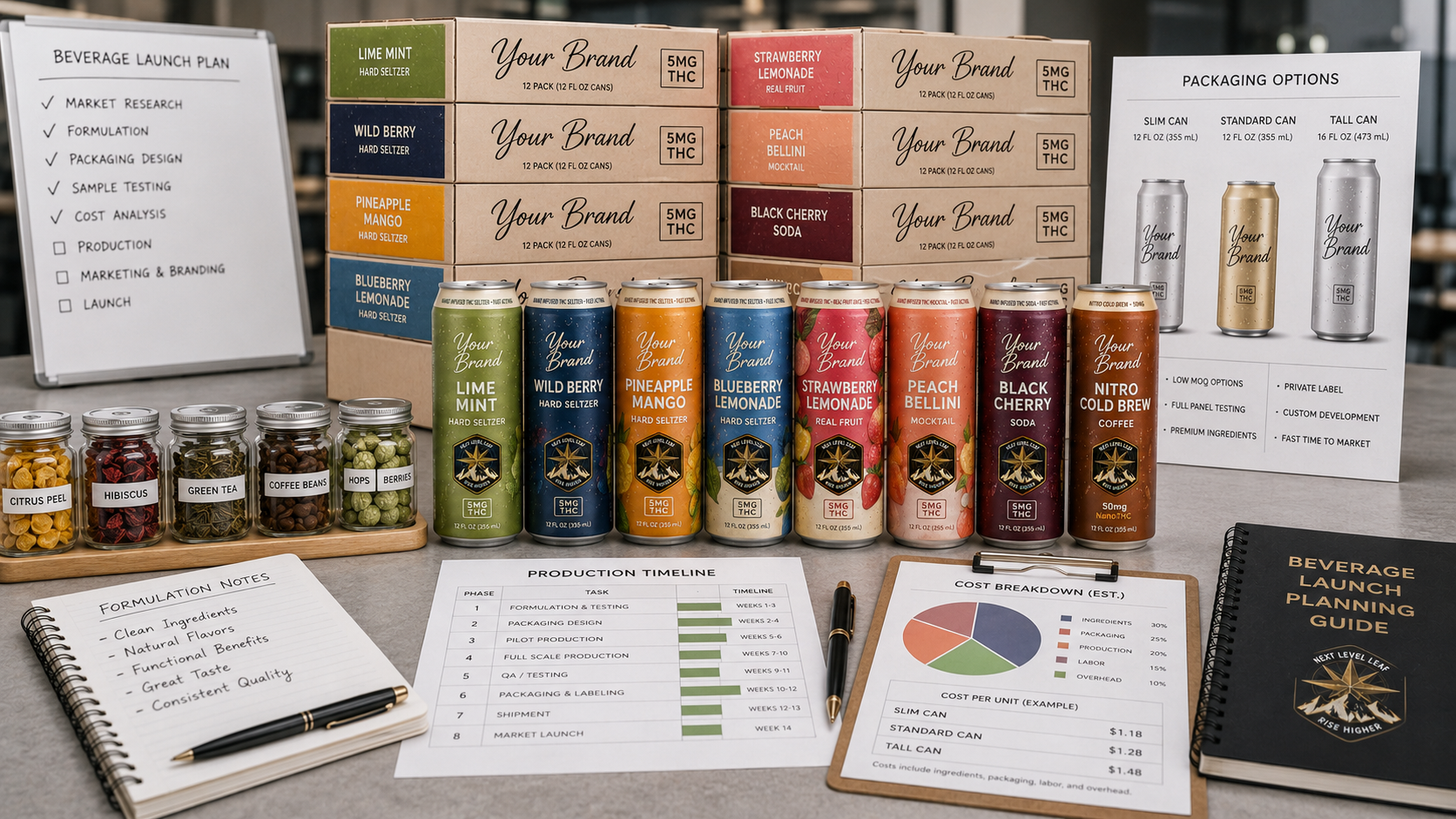
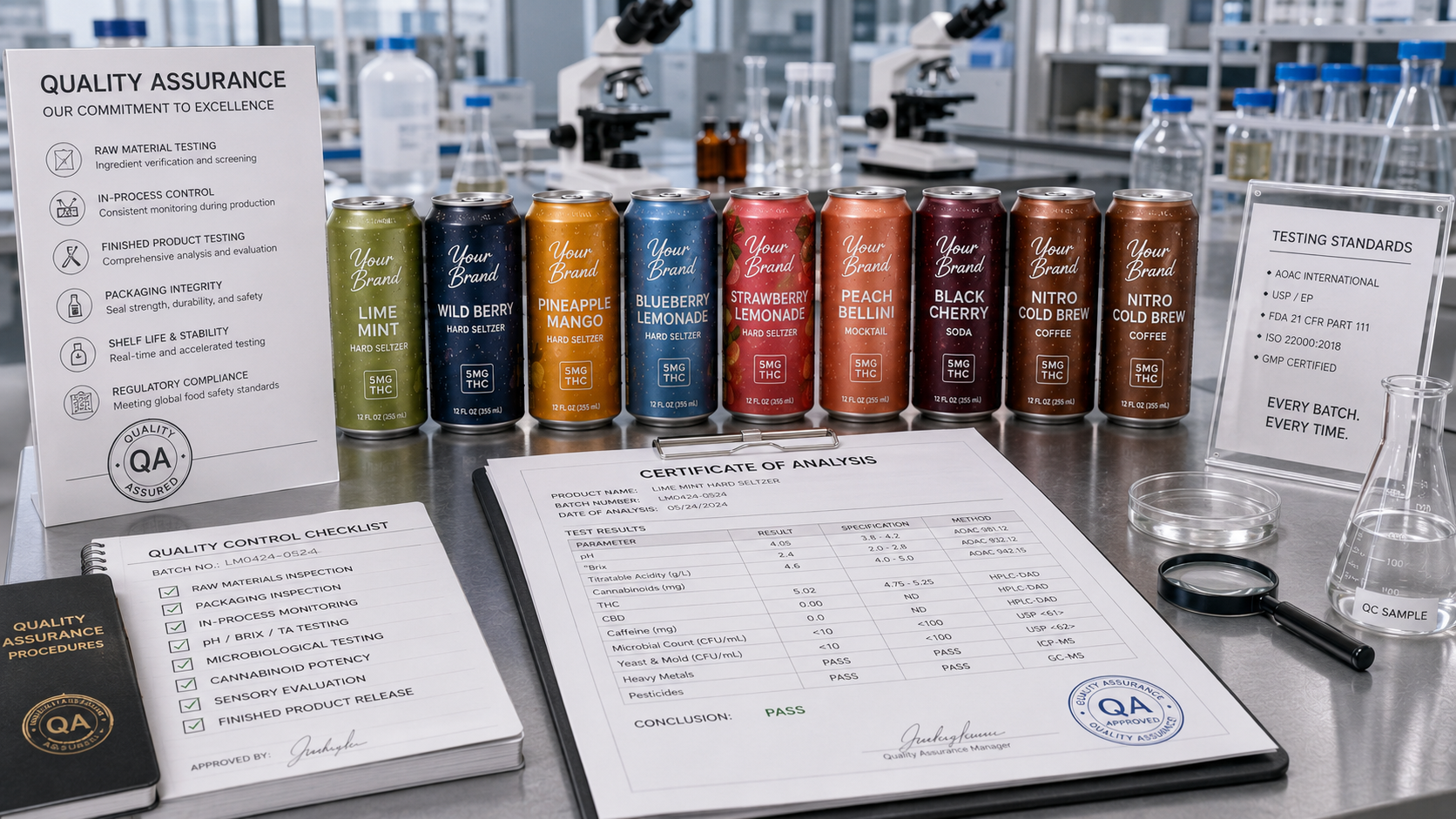
What is included in THC beverage manufacturing cost?
A quote can be structured differently by project, so the first step is to identify which items are included and which remain the brand’s responsibility. The finished cost often includes several layers.
Formula and R&D
White-label selection, formula adaptation, custom formulation, flavor revisions, pilot work, process validation, and formula transfer.
Beverage base
Water, juice, coffee, tea, sweeteners, acids, flavors, colors, preservatives, fruit, carbonation, and other base ingredients.
Cannabinoid system
THC dose, emulsion or water-compatible input, minor cannabinoids, sensory impact, dosing accuracy, and process compatibility.
Cans and decoration
Cans, ends, trays, cases, pressure-sensitive labels, sleeves, digital decoration, printed cans, coding, and application.
Testing and release
Finished-product potency, COAs, microbiological or other required testing, quality review, documentation, and release.
Freight and receiving
Palletization, outbound freight, liftgate or appointment service, limited-access delivery, insurance, storage, and receiving needs.
What costs occur before production?
The production invoice is only one part of the launch budget. Depending on the project, the brand may also need to fund work that happens before the production slot is ready.
How does formula path affect cost?
Usually the lowest development burden because the beverage platform is already established or substantially established.
Brands prioritizing speed, lower development risk, and a focused first launch.
Can add selected customization, package decisions, or product variables while using an available production platform.
Retailers, operators, and brands that need a differentiated presentation without a ground-up formula.
Adds development time, tasting rounds, ingredient work, specifications, validation, and possibly additional testing.
Products built around a unique flavor, function, ingredient stack, mouthfeel, or customer promise.
May reduce invention work but still requires technical review, ingredient matching, process validation, and commercial reproducibility.
Brands that own a formula and need it reproduced at manufacturing scale.
Compare the options in White Label THC Beverages, Private Label THC Beverages, and Custom THC Beverage Formulation.
How do THC dose and additional cannabinoids affect cost?
Cannabinoid cost generally scales with the amount used per can and the number of cannabinoids in the formula. A 5 mg THC beverage uses less cannabinoid input than a 25 mg or 100 mg product, but dose also affects flavor, positioning, state-market fit, serving structure, and testing expectations.
CBD, CBG, CBN, THCV, and other cannabinoids each add their own raw-material cost and may change flavor, clarity, formulation, documentation, or product-positioning decisions.
More milligrams generally increase cannabinoid input and may increase flavor-masking work.
What dose fits the intended customer, state, channel, occasion, and serving format?
Each additional input adds ingredient cost and may add sensory or formulation complexity.
Does the ingredient create a clear customer-facing reason to buy?
Mushrooms, adaptogens, caffeine, nootropics, hydration ingredients, and fruit systems can materially change formula cost.
Which ingredients are essential to the product promise?
How do beverage format and ingredients affect cost?
A simple flavored seltzer usually has a different cost structure from nitro coffee, tea, juice, lemonade, soda, a fruit-forward drink, or a functional beverage. The format can change ingredient costs, processing requirements, flavor work, carbonation, filling, shelf-life planning, and quality controls.
Seltzers
Often use a lighter ingredient system, but dose, emulsion, flavor quality, carbonation, and package still drive the final quote.
Sodas and lemonades
Sweetener, acids, flavor systems, juice, color, and bolder sensory profiles can increase ingredient and development costs.
Coffee and tea
Brewing, extraction, nitrogen, sweeteners, dairy alternatives, flavor systems, and process controls can change production cost.
Juice and real fruit
Fruit content, puree, juice, color, pulp, acidity, preservation, and stability can increase cost and process complexity.
Mocktails
Layered flavors, botanicals, extracts, sweeteners, acids, colors, and premium positioning can support a higher cost structure.
Functional beverages
Mushrooms, adaptogens, nootropics, electrolytes, caffeine, and specialty ingredients create additional raw-material and formulation costs.
How does MOQ change the cost per can?
Production setup, sanitation, batching, line preparation, changeover, testing, labels, and quality review exist whether the run is small or large. A smaller run spreads those costs across fewer units.
Lower total cash exposure and a controlled product-validation path.
Higher unit cost, limited package options, and not always available for every formula.
Creates a more meaningful commercial test while remaining manageable for many early-stage brands.
Requires enough sales capacity, storage, freight planning, and working capital for approximately 50 cases per SKU.
Can improve unit economics, ingredient purchasing, and packaging options.
Creates more inventory exposure, larger cash requirements, and greater sell-through risk.
Review Low-MOQ THC Beverage Manufacturing for a deeper comparison of prototype and commercial first-run planning.
How does each additional SKU affect the budget?
A separate flavor, dose, or formula usually creates its own production and inventory position. Each SKU may require another formula, ingredient set, batch, label, setup, testing plan, quality review, pallet position, and reorder decision.
For example, three flavors at a 1,200-can MOQ normally means approximately 3,600 total cans—not one 1,200-can run divided into three products.
One strong SKU often protects working capital better than several products launched without enough budget or channel support.
How do labels, sleeves, and printed cans affect cost?
Often the most practical option for prototypes and lower-volume commercial runs.
Label material, printing, application, seam placement, condensation, and finished appearance.
Can provide full-can coverage but may add sleeve production, application, lead time, and minimums.
Distortion, recyclability, application quality, supplier minimums, and schedule.
Can be useful at moderate quantities when supplier capabilities and can specifications align.
Can availability, artwork requirements, minimums, and lead time.
Can improve repeat-program economics and presentation at scale but require a larger packaging commitment.
Printed-can inventory, storage, artwork approval, cash timing, and future formula or label changes.
What testing and quality costs should be planned?
Testing should be defined before production because the target market, beverage type, claims, shelf-life goals, and facility program can change what is required.
How should freight and receiving be budgeted?
Freight can materially change delivered cost, especially on a prototype or first pallet. The destination and receiving conditions matter as much as the distance.
- Commercial dock or forklift availability
- Liftgate requirement
- Residential, limited-access, or appointment delivery
- Pallet count, case count, weight, and dimensions
- Shipment insurance and carrier service level
- Storage and receiving hours
- Parcel versus less-than-truckload freight for smaller shipments
How do you calculate landed cost per can?
Landed-cost formula
Use the full cost required to create and receive sellable inventory—not only the factory price.
Total project and delivery costs may include:
- Formula development or transfer
- Production and standard ingredients
- Cannabinoid and functional inputs
- Cans, labels, sleeves, printed cans, cases, and pallets
- Testing, COAs, quality review, and documentation
- Inbound materials freight and outbound finished-goods freight
- Storage, fulfillment, insurance, damage, and receiving costs
- Samples, promotional product, sales commissions, and launch-specific expenses
Use sellable cans as the denominator. Product used for samples, buyer meetings, events, damage replacement, internal review, and promotion does not generate direct sales revenue.
Why the lowest per-can quote may not be the lowest-cost launch
A lower unit price can require a larger order, more packaging inventory, longer lead times, greater storage, or more cash tied up in slow-moving SKUs. The financially better project is the one that balances cost per can with sell-through risk, channel margin, product quality, reorder timing, and working capital.
Two quotes can look similar while covering different ingredients, labels, tests, or freight responsibilities.
Production scope, exclusions, deposits, testing, packaging, and delivery.
A lower unit cost may require more total cash and create more unsold-product risk.
MOQ per SKU, case count, total cans, storage, and expected sell-through.
Printed cans, sleeves, or specialty materials may require inventory beyond the first run.
Package minimums, storage, ownership, lead time, and future-use assumptions.
A first run can sell out before the next batch is ready if lead time is not planned.
Materials, production slot, forecast, reorder trigger, and working capital.
What information is needed for an accurate quote?
A useful quote starts with a defined product and launch scope
Share the decisions already made and identify the areas where you need manufacturing or formulation guidance.
Request a Manufacturing Quote