Hemp-derived, infused and functional beverage manufacturing Commercial production for new and established brands
Functional • Cannabinoid • Trace-THC • Nootropic • RTD

Functional Beverage Manufacturing for Brands Planning Beyond THC

If hemp rules change, your beverage company may still have several viable product directions to evaluate.

Updated October 7, 2026. Explore trace-THC, cannabinoid, functional, nootropic, energy, coffee, tea, and non-infused beverage options, then turn the direction that fits your brand into a practical production plan.

Functional beverage formulation and product planning

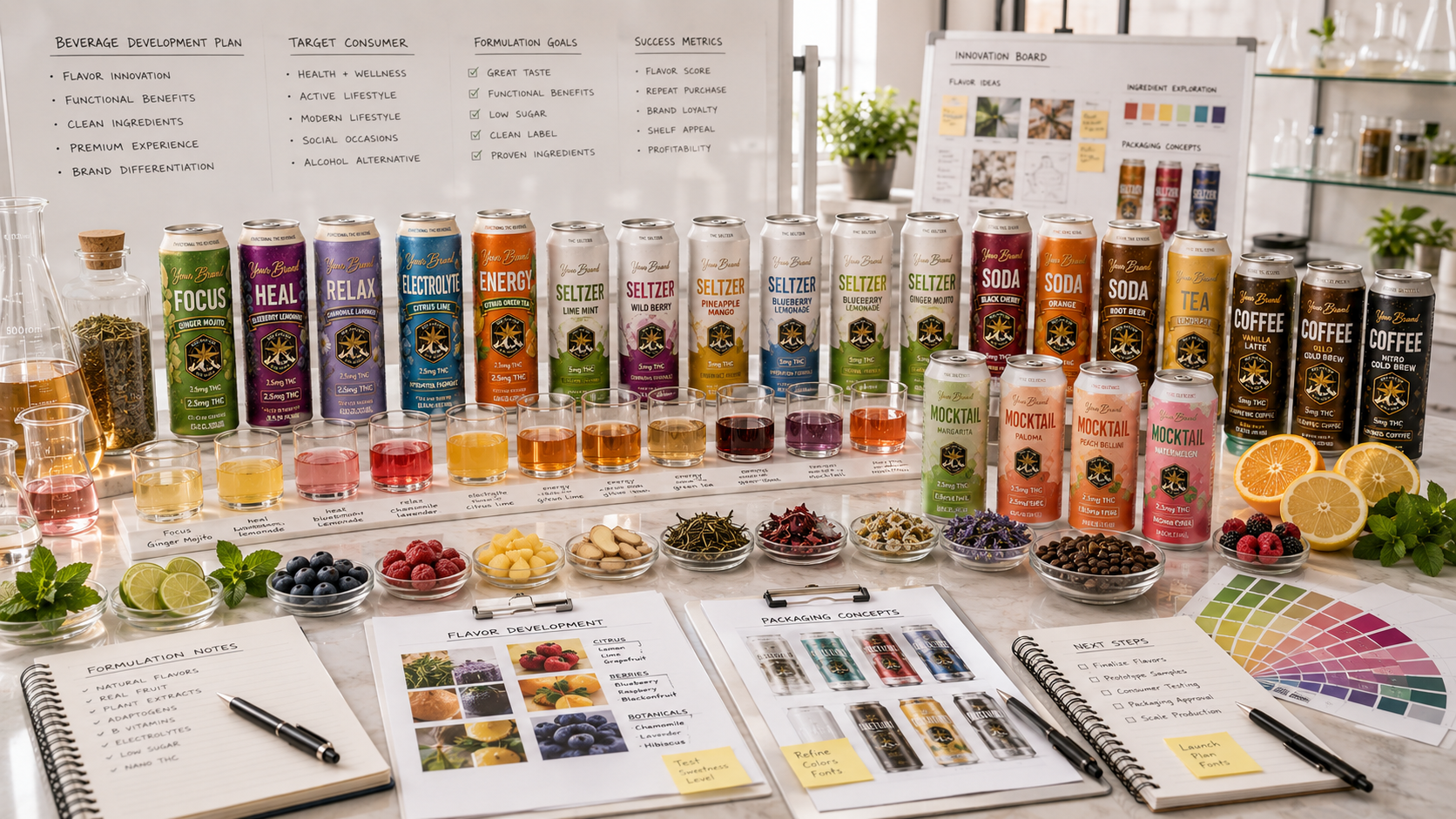
You do not necessarily have to choose between keeping today's THC formula and leaving the beverage category. A brand can evaluate several paths, including very-low-THC functional beverages, non-intoxicating cannabinoid products, nootropic and adaptogenic beverages, energy drinks, coffee, tea, mocktails, and conventional non-infused ready-to-drink products.

The right path depends on the rules that ultimately apply, the markets you want to serve, what customers already understand about your brand, and the kind of product you can manufacture and sell repeatedly.

Start With the Scenario

What are you planning for?

The federal framework is still moving. Instead of betting your entire beverage company on one outcome, start by understanding the main paths that are currently worth watching.

Current enacted framework

If the 0.4 mg per-container framework takes effect

Public Law 119-37 created a new federal hemp definition that, if the broader amendments take effect without another change, would exclude final hemp-derived cannabinoid products containing more than 0.4 mg combined total per container of total THC and certain similar-effect cannabinoids. Public Law 119-103 delayed most of those broader changes until December 11, 2026.

Regulated beverage proposal

If Congress creates a regulated THC beverage pathway

H.R. 10079, the Beverage Regulatory Parity Act, proposes a separate regulated pathway for qualifying hemp-derived beverages. As introduced, it would allow no more than 5 mg of total intoxicating THC per serving. It is a proposal, not current law.

Diversification

If you want less dependence on THC rules

Functional, nootropic, energy, coffee, tea, non-intoxicating cannabinoid, and conventional RTD products can give a beverage company additional product directions that do not rely on the same THC framework.

Product Directions

What could your next beverage look like?

The best option is not necessarily a replacement for your current product. It may be an additional line that gives the company more flexibility as regulations, retailers, and customer preferences change.

Option 1

Trace-THC functional beverage

Build the consumer proposition around flavor, function, and occasion while keeping THC at a very low target amount. If a 0.4 mg per-container threshold becomes operative, the production specification would need an appropriate margin below the applicable limit rather than targeting the ceiling itself.

Option 2

Non-intoxicating cannabinoid + functional

Explore CBD, CBG, CBN, or other appropriate cannabinoid directions paired with mushrooms, adaptogens, botanicals, tea, fruit, or other functional ingredients. Removing intoxicating THC does not eliminate the need to evaluate applicable product and market rules.

Option 3

Functional or nootropic beverage

Build around a clear product occasion such as daytime, social, active, or evening use, using ingredients such as mushrooms, adaptogens, botanicals, vitamins, minerals, electrolytes, or nootropic-style ingredients.

Option 4

Energy or focus beverage

Create a differentiated energy concept around caffeine level, flavor, functional ingredients, can size, sweetness, and the customer occasion instead of competing as another generic energy drink.

Option 5

Functional coffee or tea

Ready-to-drink coffee and tea give a brand a familiar everyday beverage format that can support mushroom, adaptogen, botanical, caffeine, vitamin, or cannabinoid product directions.

Option 6

Conventional non-infused RTD

Keep the brand while expanding into sparkling drinks, soda, lemonade, mocktails, coffee, tea, fruit drinks, or other ready-to-drink products that do not depend on cannabinoids.

Package size may become part of the product strategy. If a per-container THC framework becomes operative, brands may also evaluate smaller cans, mini formats, or functional shots when the beverage concept and production economics support them.

Existing Product Platforms

Start with an established formula or build something custom

Some brands want a faster path using an existing product platform. Others need a formula built around a distinct customer, flavor, ingredient stack, or channel.

Daytime

Focus

Ginger Mojito Functional Mushroom Beverage

A crisp ginger mojito built around a daytime functional beverage direction.

  • 100 mg caffeine from guarana
  • Organic lion's mane, reishi, and cordyceps
  • Vitamins B12, D3, and K2
  • Capsaicin, electrolytes, and xylitol
Evening

Relax

Sparkling Lemonade Adaptogen Beverage

A bright sparkling lemonade built around an evening and social-occasion functional direction.

  • L-theanine
  • Ashwagandha
  • Magnesium L-threonate
  • Beta-carotene
CBD-forward

Heal

Blueberry Lemonade

A fruit-forward blueberry lemonade that gives brands an established CBD-forward option to evaluate.

  • 100 mg CBD per can
  • Ashwagandha
  • Lemon balm
  • Established blueberry lemonade formula

Market Signal

Why we think beverage optionality matters right now

The current federal debate is not limited to whether hemp-derived beverages continue under today's rules. Congress is also considering whether beverages should have a distinct regulated pathway.

Signal 1

The current law creates a low-threshold scenario

If the broader Section 781 amendments take effect without another change, brands may need to evaluate products built around very different cannabinoid limits than today's market.

Signal 2

A regulated beverage framework is also being proposed

The Beverage Regulatory Parity Act shows that one federal policy path under consideration is regulation of qualifying hemp-derived beverages rather than applying the 0.4 mg per-container limit to those beverages.

Signal 3

Your brand does not have to depend on one outcome

A functional, cannabinoid, energy, coffee, tea, or non-infused extension can give a beverage company more than one path while the federal and state markets continue to develop.

Choose a Direction

Which beverage path fits what you are trying to do?

Start with the business problem you are solving, then decide what kind of beverage is worth taking into formulation and production.

If you want to... Consider exploring... What to decide next
Preserve a THC-related option if the current low-threshold framework takes effect

Trace-THC + functional beverage concepts

Target amount, safety margin, package size, testing, ingredients, and intended markets

Stay in cannabinoids without making intoxicating THC the entire product story

CBD, CBG, CBN, or cannabinoid + functional concepts

Cannabinoid source, functional ingredients, format, testing, label, and market

Build around wellness, routine, or function

Mushroom, adaptogen, botanical, vitamin, mineral, or nootropic RTD

Customer occasion, ingredient stack, flavor, sweetener, cost, and claims

Build for daytime energy or an active occasion

Energy or focus beverage

Caffeine level, functional ingredients, flavor, can size, and target price

Expand beyond cannabinoids completely

Coffee, tea, mocktail, soda, lemonade, fruit drink, or other non-infused RTD

Format, flavor, brand fit, channel, packaging, and production economics

Reduce dependence on one regulatory outcome

A portfolio with more than one beverage line

Which products share the brand, which channels each serves, and which line should launch first

You may not need a replacement. You may need a portfolio.

A beverage company can evaluate more than one product direction at the same time. Depending on the brand and intended markets, that could mean maintaining an intoxicating THC concept for markets that support it, developing a trace-THC or non-intoxicating cannabinoid product, and building a completely non-infused functional line.

The advantage is not predicting exactly what Congress will do. The advantage is building a company with more than one product path.

What should you decide before choosing a beverage?

  • What do customers already associate with your brand?
  • Do you want one flagship beverage or a broader product line?
  • What occasion should the beverage fit?
  • Which ingredients are essential to the concept?
  • What retail price are you targeting?
  • Which states, retailers, distributors, or channels are you considering?
  • Do you want an established product platform or a custom formula?

Tell us the direction, not a finished formula. You do not need every detail solved before reaching out. The useful starting point is the type of beverage, the customer, the ingredients you want to explore, the markets you are considering, and the scale of the first commercial run.
Planning ingredients, packaging, and functional beverage production
A strong product direction still has to work as a beverage: flavor, ingredients, cost, packaging, testing, production quantity, and repeatability all matter.

From Concept to Production

Turn the direction into a practical manufacturing plan

Once the product direction is clear, the next questions are formula, flavor, ingredients, packaging, order quantity, cost, testing, timing, and where the finished beverage will be sold.

Step 1

Choose the beverage direction

Functional, trace-THC, cannabinoid, energy, coffee, tea, mocktail, or another RTD format.

Step 2

Define the product

Flavor, ingredients, cannabinoid amount if applicable, sweetness, packaging, and customer occasion.

Step 3

Confirm the market

Consider the intended states, sales channels, label requirements, testing, and other product-specific requirements.

Step 4

Plan production

Approximately 1,200 cans per SKU is the normal commercial starting point. Selective qualified prototypes may also be available.

Continue planning your beverage

Use the resource that matches the next decision you are working through.

Frequently asked questions

Functional beverage manufacturing turns a beverage concept into a repeatable commercial product built around ingredients, flavor, packaging, testing, and production requirements. Products may include energy, nootropic, mushroom, adaptogenic, cannabinoid, coffee, tea, mocktail, or other ready-to-drink beverages.
Depending on the final federal and state rules, a brand may evaluate trace-THC functional beverages, non-intoxicating cannabinoid beverages, functional or nootropic products, energy drinks, coffee, tea, mocktails, sodas, lemonades, fruit drinks, or other non-infused ready-to-drink products.
A beverage can be developed around a very low target amount, but the production specification should include an appropriate margin below any applicable legal threshold and account for formulation, testing, manufacturing tolerances, cannabinoid source, and the intended market.
No. The federal 0.4 mg combined-total-per-container threshold is one part of the enacted hemp-definition framework. It does not by itself establish that a finished beverage is lawful for a particular state, formula, ingredient source, label, sales channel, or market.
Yes. H.R. 10079, the Beverage Regulatory Parity Act, was introduced in August 2026. As introduced, it proposes a regulated federal pathway for qualifying hemp-derived beverages and includes a limit of no more than 5 mg of total intoxicating THC per serving. It is a proposal, not current law.
Yes. Next Level Leaf supports functional beverage concepts that do not depend on THC, including products built around mushrooms, adaptogens, nootropics, caffeine, vitamins, minerals, coffee, tea, fruit, and other functional directions.
Approximately 1,200 cans per SKU is the normal commercial starting point. A selective 360-can prototype run may be available for qualified projects when the beverage, packaging, and production requirements support it.

Sources and review date

Federal legislative status reviewed October 7, 2026. This page is educational and does not provide legal advice.

Not sure what your brand should build next?

Tell us what you are making now, what you are considering, and where you want the next product to go. We can help turn the direction into a practical formulation and production plan.