White-label infused & functional beverage manufacturing
Built for brands, visionaries, and industry leaders.
Federal hemp law • Verified tracker • Updated July 2026

The November 12, 2026 Federal Hemp Definition Deadline Tracker

Section 781 takes effect November 12, 2026.

Track the enacted federal definition change, verified congressional proposals, official administration activity, FDA publication status, and practical implications for hemp beverage brands.

This page separates enacted law from pending legislation, agency activity, and Next Level Leaf editorial analysis. Unverified developments are not published.

Last reviewed:  •  Last updated: . Maintained by Next Level Leaf, a hemp beverage manufacturing and regulatory information resource. This page is informational and strategic in nature and is not legal advice.

Quick answer: On November 12, 2026, Section 781 of Public Law 119-37 changes which products qualify as hemp under federal law. The amended definition counts total tetrahydrocannabinols, expressly including THCA, and excludes a finished hemp-derived cannabinoid product containing more than 0.4 milligrams combined total per container of total tetrahydrocannabinols and other cannabinoids determined to have—or marketed as having—similar effects. A 5 mg beverage is 12.5 times the statutory threshold, and a 10 mg beverage is 25 times the threshold. Unless Congress changes the law first, products above the limit will no longer qualify as hemp under the federal definition beginning on that date.

Current Federal Status

What is the verified federal position now?

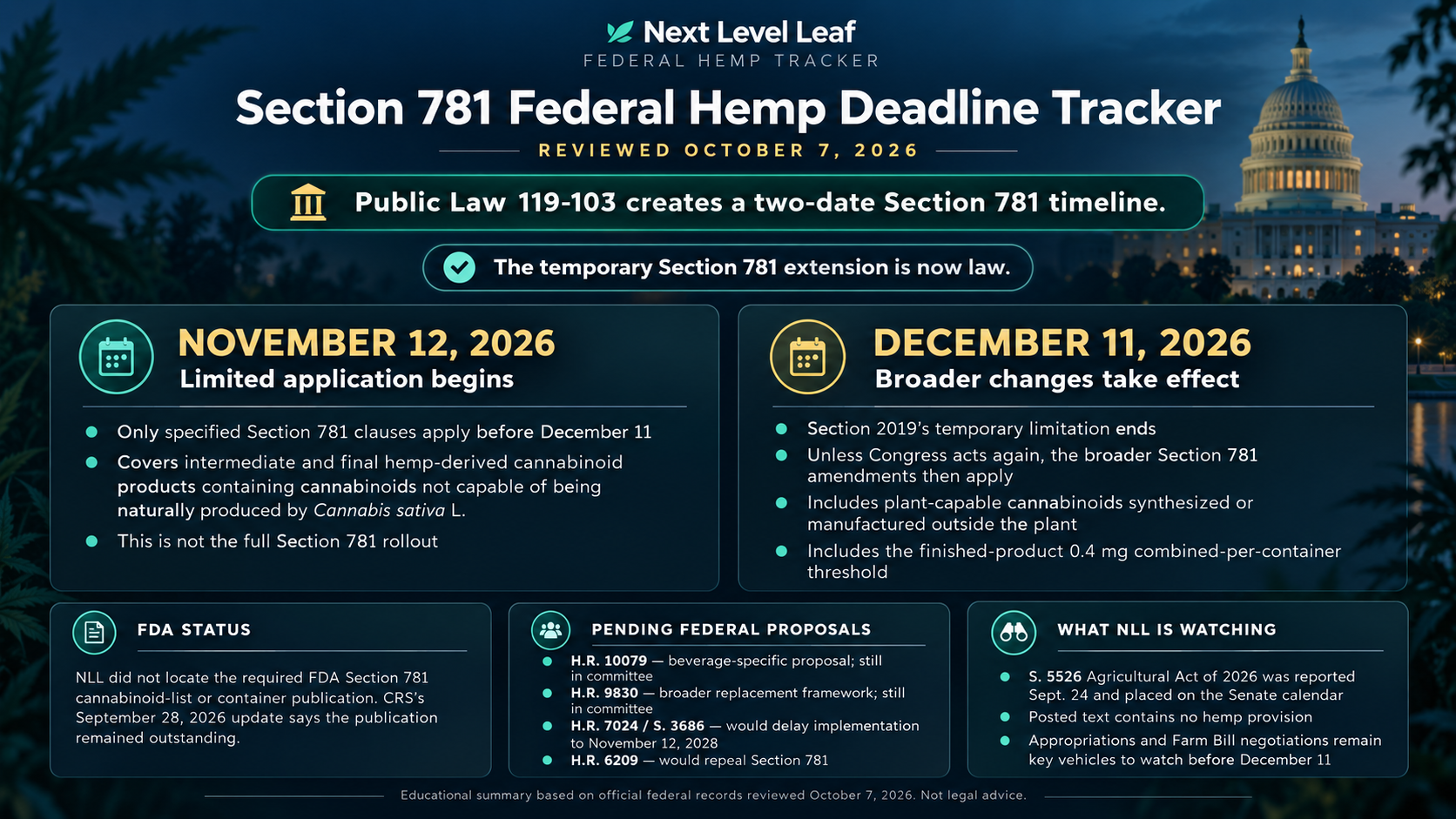
As of July 11, 2026: Section 781 remains scheduled to take effect on November 12, 2026. The four bills tracked below remain at the introduced-and-referred stage, and none has passed either chamber. On June 24, 2026, Office of Management and Budget Director Russell T. Vought transmitted an official Administration request asking Congress to revise federal hemp regulation in a manner consistent with Amendment #54 offered to H.R. 8646 or, at minimum, extend implementation of Section 781. That request is a documented Administration position; it did not change the law. NLL has not located on FDA's public website the cannabinoid lists and container information Section 781 directed FDA to publish within 90 days. NLL monitoring assessment—not a prediction of congressional action: the Administration's request makes federal revision or delay a live issue, but brands should treat November 12 as the operative date unless and until Congress enacts a change.

NLL adds legislative and administrative developments to this tracker only after locating and reviewing the corresponding primary government document.

Enacted law • Future effective

What Section 781 actually says

hemp beverage compliance testing and documentation planning for beverage brands
Section 781 changes the federal hemp definition; product-specific compliance still depends on formulation, derivation, FDA requirements, state law, and other applicable rules.

On November 12, 2025, the Continuing Appropriations, Agriculture, Legislative Branch, Military Construction and Veterans Affairs, and Extensions Act, 2026 was signed into law as Public Law 119-37. Section 781 of Division B amends the federal definition of hemp, effective 365 days after enactment.

1

Total THC enters the statutory definition

The amended definition uses total tetrahydrocannabinols and expressly includes THCA. USDA's separate hemp-production rules calculate potential total THC with the formula Total THC = (0.877 × THCA) + delta-9 THC, but Section 781 itself does not prescribe a finished-product conversion formula.

2

A per-container threshold applies

A final hemp-derived cannabinoid product is excluded when it contains more than 0.4 milligrams combined total per container of total tetrahydrocannabinols, including THCA, and other cannabinoids determined to have—or marketed as having—similar effects.

3

Production method matters

The amended definition excludes cannabinoids synthesized or manufactured outside the plant. This may include certain converted delta-8 THC and HHC products depending on how they were produced; the exclusion turns on production method, not only the cannabinoid name.

What counts as a container? Section 781 defines it as the innermost wrapping, packaging, or vessel in direct contact with the retail product. For a canned beverage, the can is the container. A 5 mg can exceeds 0.4 mg by 12.5 times.

How does this differ from the current total-THC production formula?

The USDA hemp-production rules in 7 CFR Part 990 use post-decarboxylation or similarly reliable testing and account for THCA when determining total THC in hemp production. Section 781 moves a total-tetrahydrocannabinols standard into the statutory definition and applies a separate milligram-per-container test to finished hemp-derived cannabinoid products.

What does falling outside the federal hemp definition mean?

A product that no longer qualifies as hemp loses the protections associated with treatment as hemp under federal law, including federal interstate-commerce protections applicable to hemp. The precise Controlled Substances Act and other federal consequences for a specific product after November 12 will depend on its composition and the scheduling, regulatory, and enforcement framework then in effect.

What did Congress direct FDA to publish?

Section 781 directed FDA, in consultation with other relevant federal agencies, to publish within 90 days lists addressing cannabinoids naturally produced by Cannabis sativa L., tetrahydrocannabinol-class cannabinoids, other cannabinoids with similar effects, and container-specific information. For the current public-search finding, see Current Federal Status.

Federal Legislation Tracker

Bills that could delay, repeal, or replace Section 781

Federal legislation last verified: July 11, 2026. A bill's introduction does not change enacted law. Each row links to the official Congress.gov record.

Bill What it would do Introduced Latest verified action
H.R. 7024 — Hemp Planting Predictability Act
Rep. Jim Baird
Would replace Section 781's 365-day implementation period with three years, moving the effective date to November 12, 2028. January 13, 2026 Introduced
Referred to the House Committee on Agriculture.
S. 3686 — Hemp Planting Predictability Act
Sen. Amy Klobuchar
Senate bill with the same three-year implementation change. January 15, 2026 Introduced
Read twice and referred to the Senate Committee on Agriculture, Nutrition, and Forestry.
S. 3474 — Cannabinoid Safety and Regulation Act
Sen. Ron Wyden
Would establish a federal cannabinoid regulatory framework. It authorizes standards that may include, for drinkable products in states without their own serving-size law, 5 mg THC per serving and 10 mg per container, and it would prohibit sales to people under 21. December 15, 2025 Introduced
Read twice and referred to the Senate Committee on Health, Education, Labor, and Pensions.
H.R. 6209 — American Hemp Protection Act of 2025
Rep. Nancy Mace
Would repeal Section 781 effective November 12, 2025. November 20, 2025 Introduced
Referred to the House Committee on Agriculture.
Planning implications

What Section 781 means for hemp beverage brands

If Section 781 takes effect unchanged, a finished beverage above the per-container threshold will no longer qualify as federal hemp on November 12, 2026. Brands should also monitor carriers, payment processors, insurers, lenders, distributors, and retail chains, which may set their own risk policies before the statutory date.

What brands should be doing now

  1. Audit the portfolio. Identify which SKUs exceed the per-container limit or depend on cannabinoids affected by the production-method exclusions.
  2. Document derivation. Keep supply-chain records, finished-product testing, lot traceability, and batch COAs current.
  3. Model more than one formulation path. Evaluate potentially sub-threshold products—subject to final federal interpretation and product-specific review—and non-cannabinoid functional lines that can support continuity under different outcomes.
  4. Review inventory and contracts. Consider production timing, shelf life, purchase commitments, and finished goods that could remain in the channel near the effective date.
  5. Track state law separately. A federal delay or amendment would not automatically undo state restrictions, licensing rules, dose limits, or retail-channel requirements.
  6. Plan with the manufacturer. A production partner able to evaluate multiple scenarios can help a brand respond faster than one committed to a single regulatory assumption.

For the state layer, use the Next Level Leaf state resources. For the broader federal and manufacturing framework, explore compliance resources and beverage manufacturing.

We are not attorneys, and this page is not legal advice. It is designed to help operators understand the verified federal record and plan manufacturing scenarios. Product-specific legal conclusions, contracts, and market-entry decisions should be reviewed with qualified counsel.

Frequently asked questions

Yes. Section 781 was enacted on November 12, 2025, as part of Public Law 119-37, with an effective date of November 12, 2026. It is enacted law, not a proposal. What remains open is whether Congress changes it before the effective date.
November 12, 2026—365 days after enactment—unless Congress enacts intervening legislation.
Under Section 781 as written, a finished hemp-derived cannabinoid product is excluded from the federal hemp definition when it contains more than 0.4 milligrams combined total per container of total tetrahydrocannabinols, including THCA, and other cannabinoids determined by the Secretary of Health and Human Services to have—or marketed as having—similar effects.
Unknown. Delay, repeal, and replacement proposals have been introduced, and the Administration has formally asked Congress to revise the framework or at least extend implementation. None of those actions has changed the law yet. See Current Federal Status for the latest verified position.
A 5 mg or 10 mg hemp-derived beverage may fit within the current federal hemp definition before November 12, 2026, depending on its formulation and derivation. Meeting the hemp definition does not by itself establish compliance with FDA requirements, state law, or every other applicable rule. Current legality is product-specific and state-specific.
It can. The per-container calculation includes total THC and similar-effect cannabinoids, which may affect full-spectrum CBD products containing THC above the threshold. A broad-spectrum or isolate-based product below the threshold would still need to satisfy the amended definition's other conditions and all other applicable federal and state requirements.
It loses the protections associated with treatment as hemp under federal law, including federal interstate-commerce protections applicable to hemp. The precise Controlled Substances Act and other federal consequences will depend on the product's composition and the legal and enforcement framework in effect at that time.
Yes—with scenario planning. A launch plan should account for multiple regulatory outcomes, inventory timing, state law, cannabinoid derivation, testing documentation, and potential formulation alternatives. Product-specific legal conclusions should be confirmed with qualified counsel.

Launching or reformulating a hemp beverage ahead of the deadline?

Next Level Leaf helps brands plan for multiple regulatory outcomes through product scoping, formulation scenario planning, testing documentation, low-MOQ production options, and state-by-state regulatory information.

Public Update Log

Verified tracker updates

  • July 11, 2026 — Page launched. Public Law 119-37, the four Congress.gov bill records, FDA public-site search findings, and the June 24 White House/OMB request were reviewed for the initial publication.
Primary documents

Official sources

The links below are the public primary-source record supporting the legal and legislative statements on this page.

Federal legislation and FDA public-site publication status last reviewed July 11, 2026.

Related Next Level Leaf resources