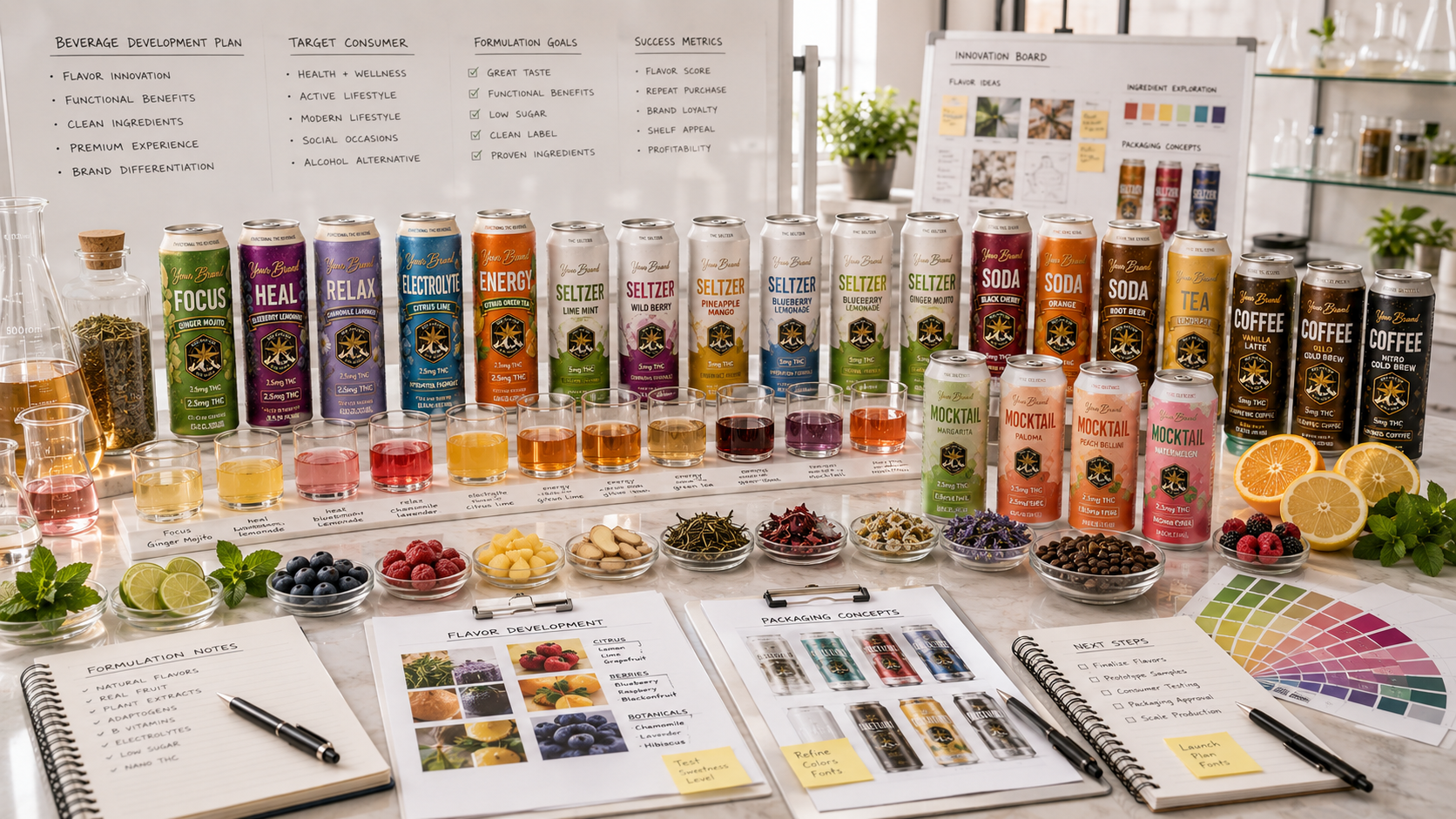
You can start with an established white-label formula or build a custom functional beverage. Focus and Relax give brands two non-cannabinoid options. Heal offers a CBD-forward formula, and custom development opens the door to additional flavors, formats, functional ingredients, and cannabinoid choices.
The standard first production run is 1,200 cans per SKU. A selective 360-can prototype can provide a smaller starting point for the right project.
Ready-to-label functional beverages
These established white-label formulas are available under your brand. Choose the product that fits your audience, then customize the label and prepare for production.
Daytime
Focus
Ginger Mojito Functional Mushroom Beverage
A crisp ginger mojito built for daytime routines, workdays, study sessions, workouts, and active occasions.
100 mg caffeine from guarana
Organic lion's mane, reishi, and cordyceps
Vitamins B12, D3, and K2
Capsaicin, electrolytes, and xylitol
Evening
Relax
Sparkling Lemonade Adaptogen Beverage
A bright sparkling lemonade created for evening routines, social occasions, and alcohol-alternative menus.
L-theanine
Ashwagandha
Magnesium L-threonate
Beta-carotene
CBD-forward
Heal
Blueberry Lemonade
A fruit-forward blueberry lemonade that gives beverage and hemp brands an established high-potency CBD option.
100 mg CBD per can
Ashwagandha
Lemon balm
Established blueberry lemonade formula
Build a custom functional beverage
Custom development starts with the kind of drink you want customers to pick up, enjoy, and understand. We help you bring the beverage format, flavor, sweetness, functional direction, cannabinoid preference, and packaging into one workable product plan.
1
Choose the beverage
Start with sparkling water, lemonade, soda, juice, tea, coffee, or another practical format.
2
Shape the flavor
Select the flavor profile, sweetness level, and ingredients that fit your brand and customer.
3
Define the function
Build around energy, an evening occasion, mushrooms, adaptogens, vitamins, minerals, nootropics, or another clear product direction.
Choose the product path that fits your brand
Your functional and cannabinoid products do not have to follow the same route. Keeping the options separate can give your brand more flexibility as the federal hemp market changes.
Functional beverage without cannabinoids
Launch Focus, Relax, or a custom beverage built around energy, adaptogens, mushrooms, vitamins, minerals, botanicals, or nootropics.
Best starting point: Review an existing formula or tell us the custom direction you want to build.
Trace-THC beverage
Explore a formula designed around the scheduled 0.4 mg combined-total-THC-per-container threshold while the final product and market requirements are evaluated.
Best starting point: Define the intended states, sales channels, finished formula, and testing plan.
CBD or higher-dose cannabinoid beverage
Launch Heal or develop a 5 mg, 10 mg, or other cannabinoid formula for a market with an appropriate pathway.
Best starting point: Choose the target markets first, then build the production and distribution plan around them.
Functional beverages are a growing opportunity
Consumers are increasingly choosing beverages around ingredients, routines, and occasions, creating room for both established beverage companies and new brands to offer something different.
4.3%Compound growth for plant-based energy drinks from Q1 2023 through Q4 2025, according to Circana.
$31.3BU.S. functional-beverage sales over the prior year, up nearly 11%, according to NielsenIQ figures reported by Axios.
Start with an established formula or bring us the functional beverage direction you want to create.
Where the 0.4 mg threshold fits
Public Law 119-37 is scheduled to change the federal definition of hemp on November 12, 2026. The new definition excludes a final hemp-derived cannabinoid product containing more than 0.4 milligrams combined total per container of total tetrahydrocannabinols, including THCA, and certain cannabinoids with similar effects.
The threshold is one part of the new definition, not a general compliance approval. The finished formula, cannabinoid source, testing, label, intended market, and sales channel still matter. A Senate-passed short extension remains pending and has not changed the current federal deadline.
You do not need a finished formula before reaching out. Tell us what you want to make, who it is for, and where you expect to sell it. We can help you identify the most practical next step.
Step 1
Choose your starting point
Select Focus, Relax, Heal, or a custom beverage direction.
Step 2
Share your brand goals
Tell us the flavor, ingredients, target markets, packaging status, and first-run goal.
Step 3
Plan the first run
The standard run is 1,200 cans per SKU. A selective 360-can prototype can be considered for the right project.
Continue planning your beverage
Explore the production, formulation, and launch resources that match your next decision.
Next Level Leaf currently offers Focus, a Ginger Mojito Functional Mushroom Beverage; Relax, a Sparkling Lemonade Adaptogen Beverage; and Heal, a Blueberry Lemonade with 100 mg of CBD. These established formulas can be produced under your brand.
Yes. Focus and Relax are functional beverage formulas that do not depend on a cannabinoid ingredient. We can also develop a custom non-cannabinoid beverage around your preferred format, flavor, sweetness, and functional ingredients.
The standard first production run is 1,200 cans per SKU. A selective 360-can prototype may also be available when a smaller test run is the right fit for the project.
No. The scheduled 0.4 mg combined-total-THC-per-container threshold is one part of the new federal hemp definition, not a general compliance approval. The complete formula, testing, intended market, label, and sales channel still need to be considered.
As of August 17, 2026, November 12, 2026 remains the operative federal effective date for the enacted Section 781 hemp-definition change. The Senate has passed a short extension as part of H.R. 6500, but House approval and presidential signature are still required before that extension would become law.
Yes, when the product has an appropriate market and legal pathway. We begin with the target states and sales channels, then plan the formula, production, testing, packaging, and distribution requirements around that market.
Sources and review date
Federal status and market evidence reviewed August 17, 2026.
Ready to add a functional beverage to your lineup?
Tell us whether you want to start with Focus, Relax, Heal, or a custom beverage. Include your target markets, packaging status, and first-run goal, and we will help you plan the next step.