Hemp-derived, infused and functional drink manufacturing
From focused first runs to recurring commercial production
THC Drinks • CBD Drinks • Functional Drinks • Commercial Production

Hemp Drink Manufacturer for Branded Products

Develop and manufacture hemp-derived THC, CBD, multi-cannabinoid, coffee, tea, soda, seltzer, lemonade, mocktail, and functional drinks under your brand.

Next Level Leaf helps founders, established beverage companies, retailers, distributors, hospitality operators, and CPG teams choose the right formula path, prepare the package, test the finished product, and scale from a focused first run into recurring production.

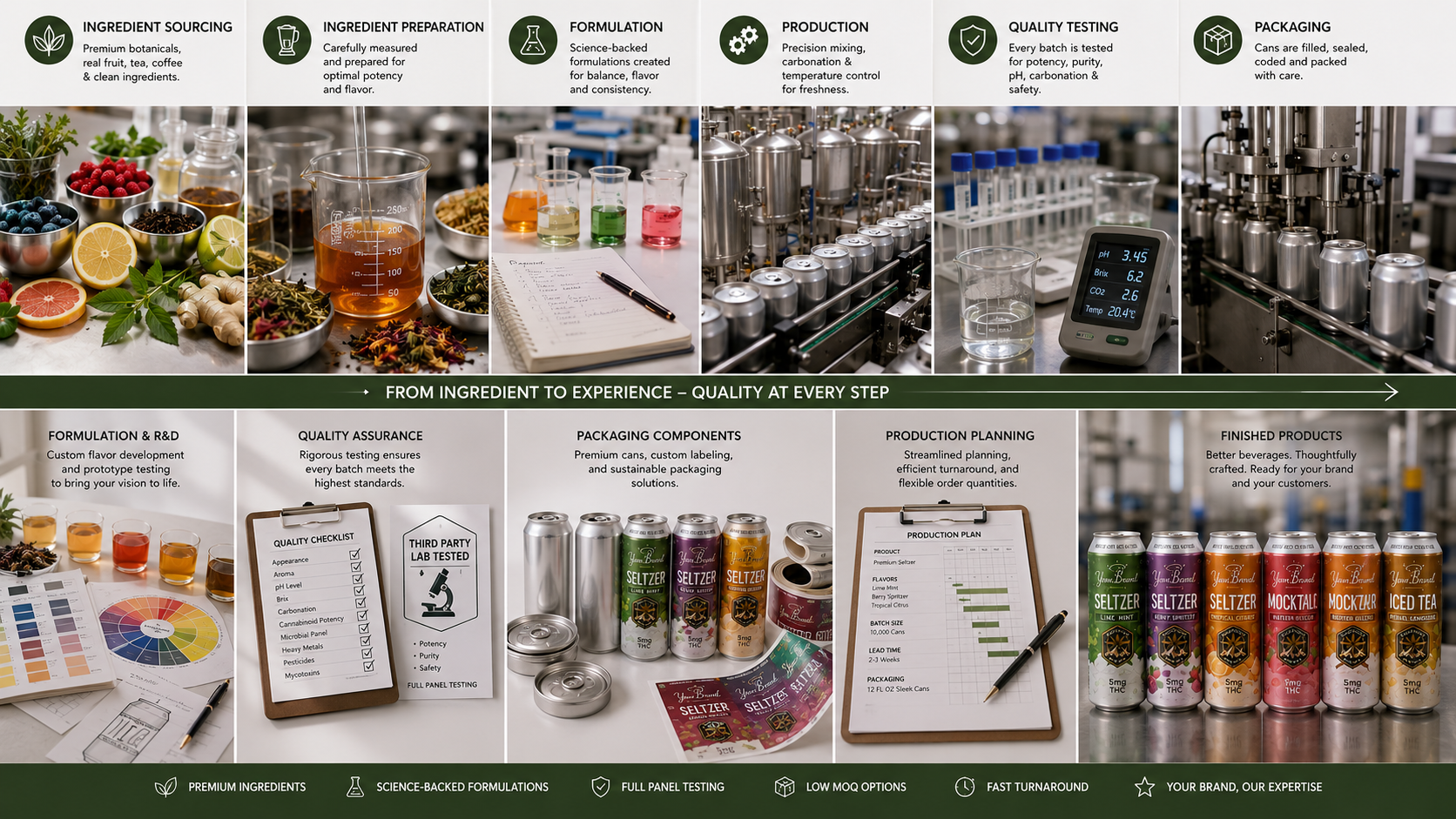
hemp drink manufacturing process for branded THC CBD and functional beverages

A hemp drink manufacturer helps a brand move from product idea or approved formula to finished, packaged, tested drinks that are ready for commercial sale. The right manufacturing partner should match the product to a realistic formula path, per-SKU MOQ, package, testing plan, production schedule, freight strategy, and scale requirement.

Multiple pathsWhite label, private label, custom formulation, and formula-transfer production.
360 cansPossible prototype production, approximately 15 cases, when the program supports it.
1,200 cansCommon first commercial run per SKU, approximately 50 cases.
Finished testingPotency testing and batch-specific COAs support commercial release and buyer review.
Commercial scaleMulti-pallet, truckload, recurring, multi-SKU, and established distribution programs.

Looking for a company to make your hemp drink?

Most buyers searching for a hemp drink manufacturer are trying to answer a practical question: who can take this product from its current stage and turn it into commercial inventory?

The answer depends on what is already complete. A brand with only a concept needs a different path than a brand with an approved formula, suppliers, specifications, labels, testing requirements, and purchase forecasts. The first step is identifying what work remains before production can be scheduled.

Your current stageWhat is still neededLikely manufacturing path
Brand and concept

The customer, occasion, format, flavor, dose, package, target market, and economics still need to be defined.

Start with product strategy and compare white label, private label, or custom development.

Clear product direction

The product has a defined format and audience, but the exact formula and production details are not complete.

Private label or custom formulation may be appropriate depending on the required differentiation.

Approved formula

The formula exists, but commercial suppliers, process instructions, package fit, specifications, testing, and scale-up may need review.

Formula-transfer and co-packing feasibility review.

Established sales program

The product is commercial and needs reliable production, inventory, testing, freight, warehousing, or additional capacity.

Recurring contract manufacturing with forecast and release planning.

What kinds of hemp drinks can be manufactured?

The best format is the one that fits the customer, use occasion, dose, flavor system, sales channel, target price, and intended market. A manufacturer should help determine whether the concept is technically and commercially realistic.

Social

Seltzers and spritzers

Light, carbonated drinks for alcohol-alternative, hospitality, retail, event, and social occasions.

Flavor-forward

Soda and lemonade

Familiar, bold formats that can support sweetness, stronger flavor systems, and broader dose strategies.

Ritual

Coffee and tea

Cold brew, nitro coffee, iced tea, herbal tea, and related products built around recognizable daily habits.

Differentiated

Mocktails and functional drinks

Cocktail-inspired, fruit-forward, focus, relaxation, energy, electrolyte, adaptogenic, and nootropic concepts.
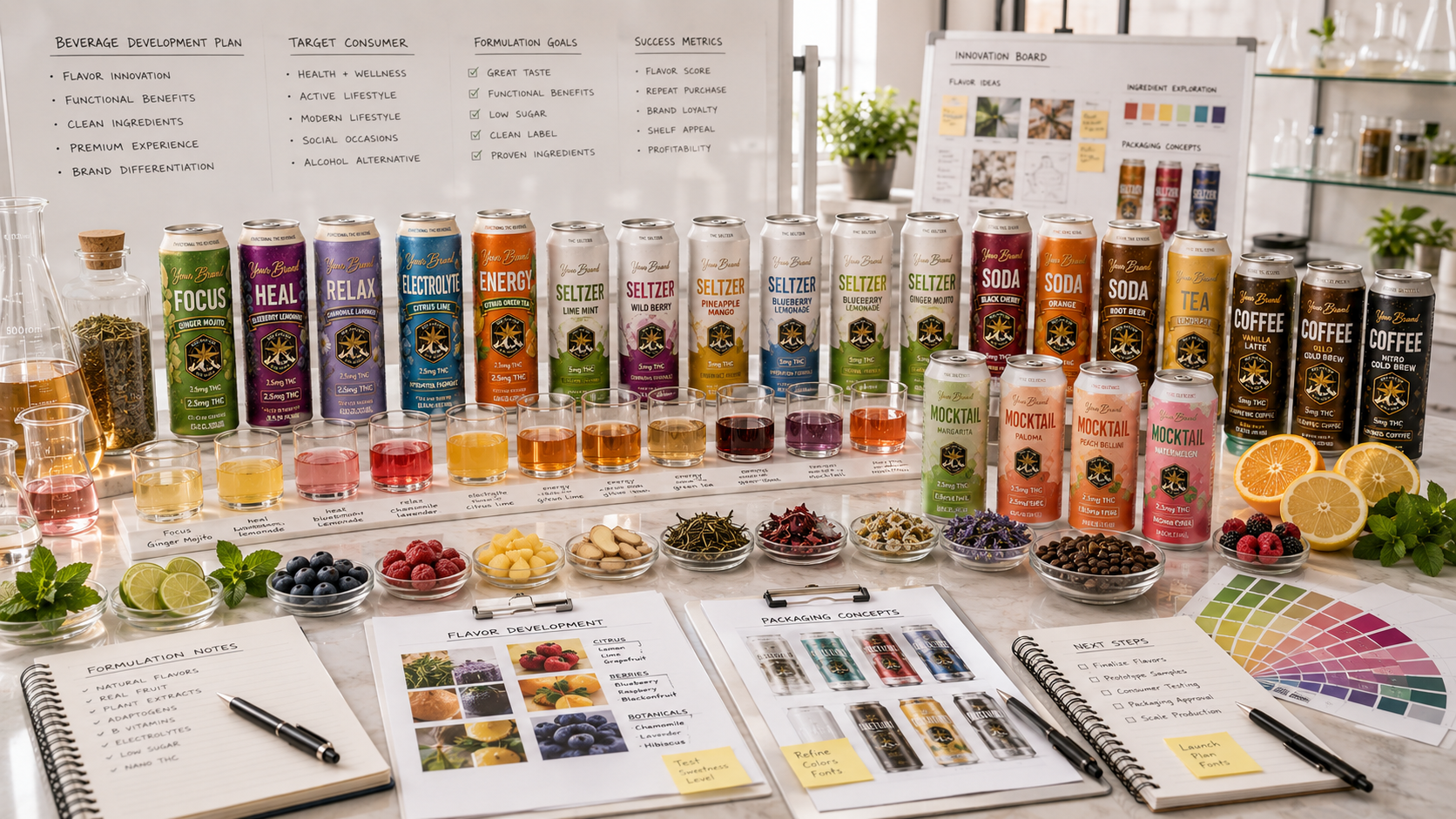
product development planning for hemp-derived branded drinks Product development

Match the drink to the customer

The format, dose, flavor, package, price, and occasion should tell one clear product story.
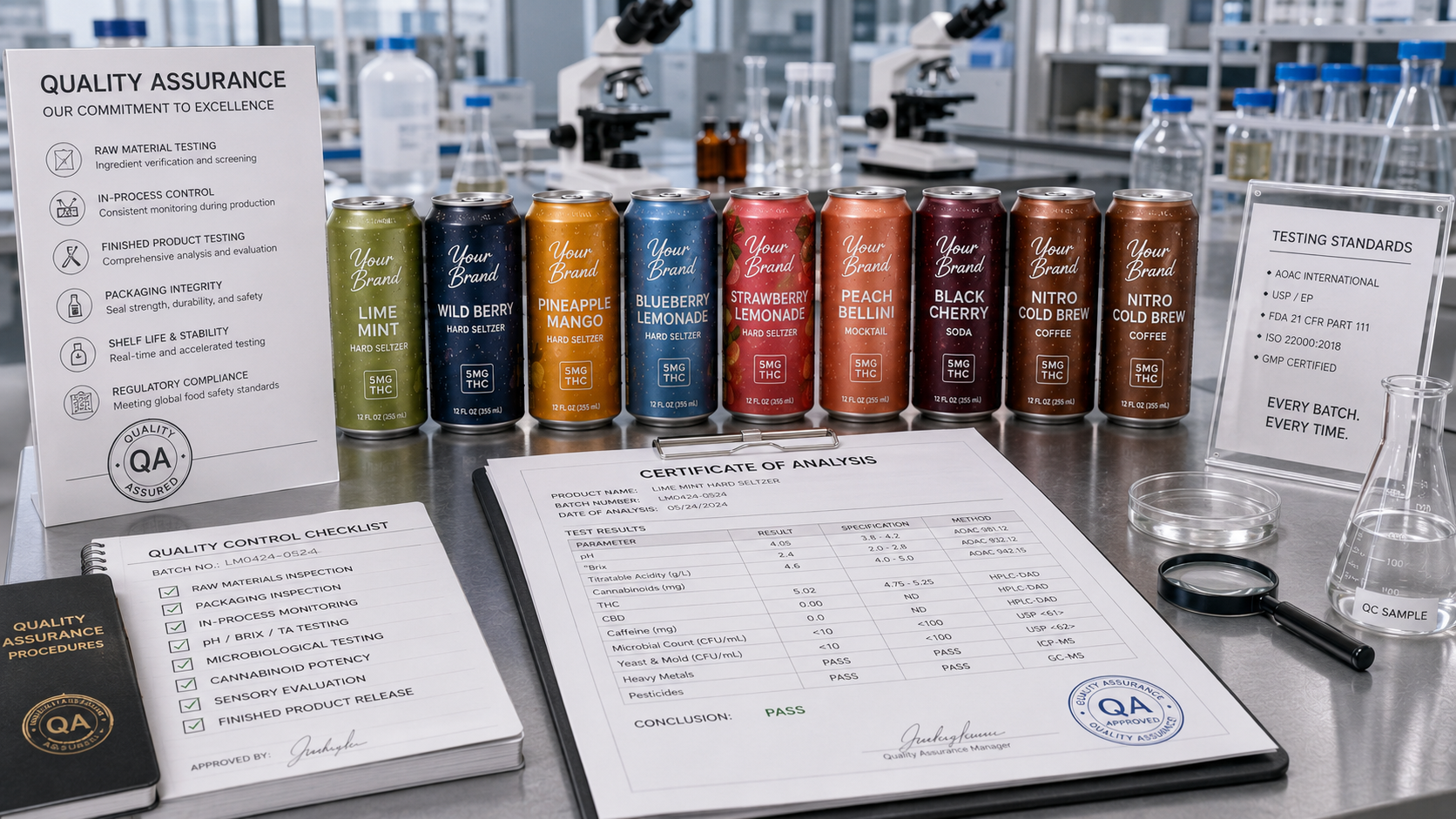
finished-product testing and COA planning for hemp drinks Commercial readiness

Plan testing before production

Testing scope, COAs, specifications, labels, target states, and buyer requirements should be defined before the run.

Which formula path fits the drink?

Formula pathWhat the brand controlsBest use
White label

Brand, label, positioning, package selections, available flavor, and supported dose options.

Fastest path when an established formula fits the product and customer.

Private label

More brand-specific flavor, dose, sweetener, ingredient, package, or positioning decisions within a workable platform.

More differentiation without a full build-from-zero development program.

Custom formulation

The formula, sensory profile, cannabinoid system, functional ingredients, specifications, and production method.

When the product formula itself is an important competitive advantage.

Formula transfer

The brand brings a production-ready formula, suppliers, process, package, specifications, and commercial documentation.

When the product already exists and needs manufacturing review or additional capacity.

How should the cannabinoid system be selected?

The cannabinoid decision should not be separated from flavor, beverage format, package, testing, cost, and intended market. More milligrams or more cannabinoids do not automatically create a better product.

Hemp-derived THC: define the dose, serving structure, emulsion, sensory impact, testing plan, and intended customer.
CBD: review dose, bitterness, haze, label positioning, ingredient documentation, and market strategy.
CBG, CBN and CBC: consider ingredient cost, sensory effect, claims, sourcing, and whether the customer understands the product.
THCV and specialty cannabinoids: evaluate technical feasibility, commercial rationale, availability, documentation, and target-market fit.
Emulsion or water-compatible input: verify dispersion, flavor, carrier system, processing, storage, dose consistency, and finished-product performance.
Format fit: lower-dose seltzers and stronger flavor-forward sodas, lemonades, juices, coffee, or tea have different sensory limits.

Each flavor, dose, and formula is a separate SKU

A second flavor, a second dose, or a different cannabinoid profile can require separate ingredients, setup, batching, labels, testing, inventory, and production planning. A focused first SKU often creates a stronger commercial test than dividing a small budget across too many products.

What should be ready before a manufacturer can quote accurately?

A serious quote needs enough information to define the production scope. The manufacturer should not have to guess what is being made, how it will be packaged, where it will be sold, or what volume the brand expects.

Product: drink format, still or carbonated, flavor, sweetness, acidity, body, color, clarity, and reference products.
Active system: cannabinoid profile, dose per can, functional ingredients, caffeine, claims, allergens, and certifications.
Formula status: white label, private label, custom development, or production-ready transfer.
Package: can size, label method, artwork status, case pack, cartons, multipacks, coding, and pallet expectations.
Market: target states, sales channels, retail or distributor requirements, testing expectations, and launch timing.
Operations: prototype or first-run goal, forecast, reorder cadence, freight destinations, receiving equipment, warehousing, and release plan.

Prototype, first-run, and scale pathways

Prototype

Possible 360 cans

Approximately 15 cases for buyer meetings, package review, samples, events, distributor conversations, or controlled market learning when feasible.

Commercial test

Common 1,200 cans

Approximately 50 cases per SKU for retail, wholesale, hospitality, regional sales, and early commercial validation.

Expansion

Multi-pallet production

Supports larger account groups, distributor warehouses, regional programs, and planned promotional or seasonal demand.

Volume

Recurring production

Uses forecasts, scheduled production windows, ingredient and packaging inventory, testing cadence, warehousing, releases, and reorder triggers.

What packaging choices affect hemp drink manufacturing?

Package optionCommercial advantagePlanning consideration
Pressure-sensitive labels

Flexible for prototypes, first runs, multiple designs, and lower package commitments.

Requires label artwork, print timing, application, roll specifications, and inventory planning.

Shrink sleeves

Full-can graphics and strong shelf presence.

Usually adds supplier coordination, minimums, application cost, and lead time.

Digital decoration

Can provide direct-to-can graphics at supported quantities.

Supplier minimums, can specifications, artwork, scheduling, and storage must align.

Printed cans

Efficient branded package for larger established programs.

Requires a larger can commitment and creates risk if formula, artwork, or demand changes.

Cartons and multipacks

Improves retail presentation, assortment, and take-home merchandising.

Adds materials, setup, assembly, minimums, inventory, and possible hand-packing or equipment requirements.

Testing, COAs, quality records, and change control

Low MOQ does not reduce the importance of testing or documentation. The finished drink should have defined release requirements that support the product, buyer, market, and quality program.

Finished-product potency: verifies cannabinoid concentration in the complete packaged drink.
Batch-specific COA: supports traceability, buyer review, inventory release, and product documentation.
Additional panels: microbiological, contaminant, nutritional, shelf-life, stability, or market-specific testing may apply.
Batch and lot records: document ingredients, cannabinoid input, production, coding, testing, release, and finished inventory.
Finished specifications: define acceptable potency, pH, fill, package, appearance, carbonation, sensory, and quality ranges.
Change control: requires review before suppliers, ingredients, formula, package, process, or specifications are changed.

How long can a hemp drink take to manufacture?

A production-ready white-label program may sometimes move in roughly three weeks after the formula, label, payment, materials, testing plan, and production slot are ready. That is not a universal promise. Custom development, specialty ingredients, printed cans, sleeves, cartons, registrations, stability work, supplier lead times, or complex logistics can extend the schedule.

The most useful timeline is a dependency-based schedule that shows what must be approved before the next step begins.

Product and formula approval

Confirm the drink format, flavor, cannabinoid system, ingredients, dose, specifications, and production path.

Package and artwork readiness

Finalize can size, label or decoration, required copy, barcode, QR code, case pack, proofs, and print files.

Materials, testing, and scheduling

Secure ingredients, cannabinoid inputs, packaging, testing plan, payment, and production slot.

Production, release, and freight

Batch, fill, package, test, review, release, palletize, and ship the completed inventory.

How should freight, receiving, and storage be planned?

Finished drinks are heavy. Freight and receiving conditions can materially affect landed cost, delivery success, and inventory timing.

Destination: provide the full commercial address, hours, contact, restrictions, and appointment requirements.
Receiving equipment: confirm dock, forklift, pallet jack, liftgate, limited-access, and inside-delivery needs.
Shipping plan: decide whether inventory ships at once, moves to a distributor, or is stored and released in stages.
Reorder trigger: define the sales, inventory, and lead-time point that should start the next production cycle.

How should hemp drink manufacturers be compared?

Compare the full manufacturing system, not only the lowest quoted price. A low number can become expensive if the scope excludes testing, labels, freight, unused package inventory, formulation work, quality records, storage, or commercial support.

Can the manufacturer support the required drink format, dose, ingredients, process, package, and intended market?
Is MOQ stated per SKU, and are prototype options clearly separated from commercial production?
Does the quote identify inclusions, exclusions, assumptions, client-supplied materials, testing, freight, storage, and payment timing?
Are finished-product testing, COAs, specifications, batch records, traceability, deviations, and change control defined?
Can the program scale into multi-pallet, recurring, multi-SKU, regional, or high-volume production without rebuilding the product?
Does the manufacturer ask practical questions about customer, channel, target price, target states, receiving, warehousing, and reorder planning?

Warning signs when selecting a manufacturer

One price with no defined scope

A quote should explain the formula, dose, package, quantity, testing, services, exclusions, freight, and client responsibilities.

MOQ is not stated per SKU

Five flavors usually do not share one production minimum. Each formula and package should be scoped clearly.

No finished-product testing plan

Testing should be discussed before production, not treated as an afterthought after the inventory is complete.

No path from first run to reorder

A commercial manufacturer should be able to discuss forecasting, materials, production windows, freight, storage, and recurring supply.

Bring the product details that determine manufacturer fit

Share the drink format, formula path, flavor, cannabinoid profile and dose, ingredients, SKU count, package, target states, testing expectations, prototype or first-run goal, forecast, freight destinations, receiving, storage, and launch timeline.

Request a Manufacturing Quote

Frequently asked questions

A hemp drink manufacturer helps turn a beverage concept or production-ready formula into finished, packaged drinks. Depending on the project, support may include formula selection or development, cannabinoid input planning, ingredient sourcing, batching, filling, labeling, testing, case packing, palletization, freight planning, and recurring production.
Potential formats include seltzers, spritzers, sodas, lemonades, still drinks, juice-style beverages, coffee, tea, mocktails, real-fruit drinks, energy or focus beverages, relaxation beverages, and other functional drink concepts.
Depending on feasibility and the intended market, a drink may be evaluated with hemp-derived THC, CBD, CBG, CBN, CBC, THCV, or a multi-cannabinoid system. Dose, flavor impact, ingredient documentation, cost, testing, and target-state requirements must be reviewed together.
A common first commercial production scope is approximately 1,200 cans, or 50 cases, per SKU. A possible prototype path may begin around 360 cans, or 15 cases, when the formula, packaging, materials, and production program support it.
Yes. A focused one-SKU launch is often the most efficient way to control inventory, simplify testing and packaging, concentrate sales activity, and learn what customers want before adding more flavors or doses.
White label starts from an established formula and usually offers the fastest path. Private label adds more brand-specific choices within an available platform. Custom formulation is appropriate when the flavor, dose, ingredient system, sensory experience, or process requires meaningful new development.
Timeline depends on formula readiness, ingredients, cannabinoid inputs, packaging, artwork, testing, production scheduling, and freight. A production-ready white-label program may sometimes move in roughly three weeks after all required approvals, materials, payment, testing plans, and production scheduling are complete. Custom development generally adds time.
Finished-product potency testing and batch-specific COAs are common commercial expectations. Additional microbiological, contaminant, stability, shelf-life, nutritional, or state-specific testing may apply depending on the formula, package, quality program, claims, buyer, and intended market.
Yes. In addition to prototypes and first commercial runs, projects can be evaluated for multi-pallet, truckload, recurring, multi-SKU, regional, and established distribution programs. Larger programs require forecasting, ingredient and package inventory, production windows, testing cadence, warehousing, freight, release schedules, and reorder planning.
Common options include pressure-sensitive labels, shrink sleeves, digital decoration, and printed cans. Pressure-sensitive labels are often the most flexible option for prototypes and early runs, while decorated or printed cans may require larger packaging commitments and longer lead times.
Ask about formula capabilities, MOQ per SKU, prototype options, supported drink formats, cannabinoid systems, testing, COAs, package formats, production lead time, scale-up, quality records, freight, storage, change control, recurring capacity, and exactly what is included or excluded from the quote.
Prepare the drink format, target customer, flavor direction, cannabinoid profile and dose, ingredient goals, SKU count, package size, label and artwork status, target states, testing expectations, first-run or forecasted volume, launch timeline, freight destinations, receiving capabilities, warehousing needs, and sales channels.

Ready to find the right manufacturing path for your hemp drink?

Share the drink format, formula status, cannabinoid profile and dose, flavor, ingredients, SKU count, package, target markets, testing needs, production volume, forecast, freight destinations, receiving requirements, and launch timeline.