

Low-Dose THC Drinks
Low-dose THC beverages can be an approachable entry into social, alcohol-alternative, hospitality, and retail occasions, but the strongest strategy also prepares for where regulation and shelf access may move next.
Founders should think beyond one state limit or one milligram number. The customer, occasion, serving structure, target markets, federal decision points, functional-product options, and first-run plan should all support a more resilient beverage portfolio.
Low-dose THC drinks are infused beverages designed around an approachable cannabinoid amount, most clearly represented by 2.5mg or 5mg THC per can. A 10mg can may be a familiar single-can product in some markets, but it is not automatically low dose or sessionable for every customer. Forward-looking brands may also consider an ultra-low contingency formula below the emerging federal 0.4mg-per-container threshold and a parallel non-THC functional line.
What counts as a low-dose THC drink?
There is no single national definition of “low dose” for THC beverages. In practical product planning, 2.5mg and 5mg per can are the clearest low-dose positions because they communicate approachability without requiring the brand to describe a moderate single-can experience as light.
A 10mg can may work well for experienced customers or a one-can occasion, but it should not be treated as universally low dose. The right description depends on the consumer, product format, onset expectations, serving structure, target states, and retail channel.
Contingency product
An ultra-low formulation that may be worth developing as a federal-definition hedge, not as the primary intoxicating product.
Approachable low dose
A clear option for cautious consumers, hospitality-style occasions, gradual sipping, and lighter product positioning.
Core low-dose lane
A practical middle ground for brands seeking an approachable but clearly infused beverage experience.
Moderate single-can dose
May fit experienced consumers, but it is not automatically low dose, sessionable, or permitted in every market.
Founder takeaway: The best dose is not simply the highest amount currently allowed in a state. It is the dose that fits the intended adult customer, occasion, market access, product experience, and long-term portfolio plan.
What is the difference between low dose and sessionable?
Low dose describes the cannabinoid amount. Sessionable describes how the drink is intended to fit into a longer social occasion. Those ideas can overlap, but they are not interchangeable.
A sessionable product should be designed around measured consumption, understandable onset expectations, a refreshing format, clear serving and package information, and a dose that fits the intended customer. Brands should avoid using the term in a way that encourages people to stack beverages before they understand the effects.
| Decision | Low-dose focus | Sessionable focus |
|---|---|---|
| Primary question | How much THC is in the serving or can? | How does the drink fit into the pace and duration of the occasion? |
| Design emphasis | Approachability, dose clarity, and reduced intensity. | Refreshment, can size, pace of consumption, onset expectations, and total package dose. |
| Main opportunity | Lower the barrier for THC-curious and moderate consumers. | Create a beverage-centered social occasion rather than an edible-style transaction. |
| Main risk | Treating one milligram number as the whole strategy. | Suggesting repeated consumption before the consumer understands the experience. |
Why low-dose THC drinks can be commercially attractive
A clearly designed 2.5mg or 5mg drink can reduce one of the largest barriers in the category: uncertainty about how intense the experience may be. That can make the product easier to explain to customers who are curious about THC but do not want a high-potency edible-style experience.
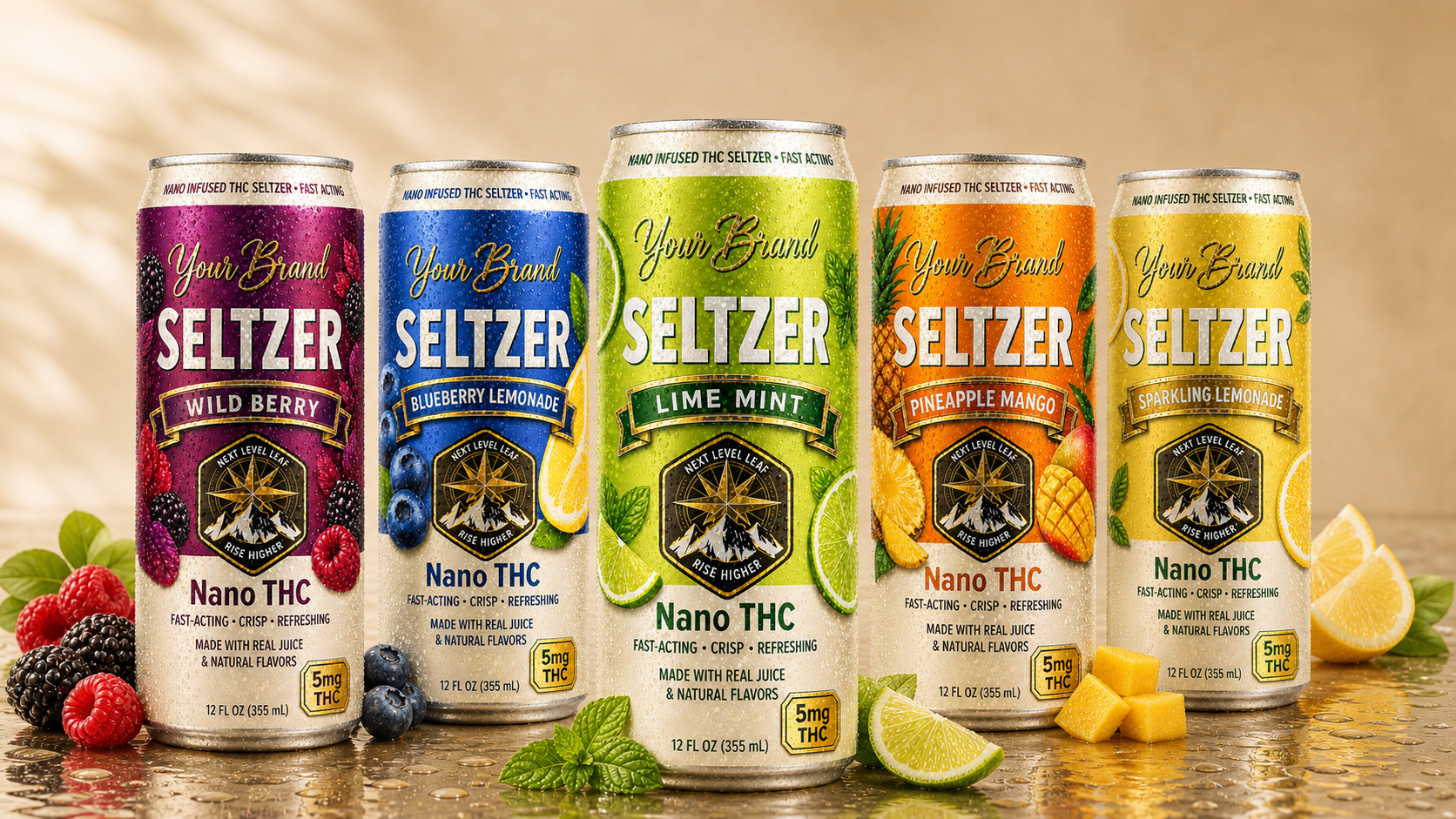
Seltzers are a natural fit because they are light, familiar, refreshing, and already connected to social and alcohol-alternative occasions. Low-dose strategy can also work in mocktails, teas, lemonades, spritzers, coffees, and other adult beverage formats.
Approachable first trial
A clear 2.5mg or 5mg can gives newer and moderate consumers a more understandable starting point.
Stronger shelf story
Buyers can understand the product more quickly when dose, format, flavor, occasion, and adult customer all align.
Room to expand
A brand can begin with one low-dose lane and later add a stronger, ultra-low, or functional product when the market justifies it.
How should a brand choose between 2.5mg, 5mg, and 10mg?
Start with the intended customer and occasion, then work backward through state rules, serving structure, delivery system, flavor, package size, testing, and sales channel.
- 2.5mg: useful for cautious, hospitality, gradual-sipping, or highly approachable concepts.
- 5mg: often the clearest low-dose product for social, retail, event, and alcohol-alternative positioning.
- 10mg: more appropriate for experienced customers or a one-can occasion than for universal low-dose positioning.
State limits remain part of the decision, but serious brands should not build only to the maximum currently permitted. Regulations, channels, and retailer standards can change faster than packaging and inventory.
Should brands consider a 0.4mg THC contingency beverage?
Yes, it is worth evaluating, but as a contingency lane rather than a replacement for the main low-dose product. Federal law enacted in November 2025 is scheduled to change the statutory hemp definition on November 12, 2026. Under that change, a final hemp-derived cannabinoid product containing more than 0.4mg combined total THC and other similar-effect cannabinoids per retail container would be excluded from the federal definition of hemp.
That creates a real strategic question: if most 2.5mg, 5mg, and 10mg hemp beverages lose their current federal hemp pathway, could a brand maintain a sub-threshold product that remains available while competitors have no prepared alternative?
What a sub-0.4mg hedge could, and could not, do
- It could preserve a cannabinoid-adjacent product option if the federal definition takes effect as written and higher-dose hemp beverages lose their existing pathway.
- It would not create a meaningful intoxicating dose for most consumers, so the product would need to win on flavor, ritual, refreshment, brand, or functional ingredients.
- It would not override state law. A state could prohibit, restrict, or differently regulate the product even when it falls below the federal container threshold.
- It would not resolve FDA food-law issues. Federal hemp status and FDA authorization for ingredients in conventional food are separate questions.
- It should not be formulated to sit exactly at 0.4mg. As a practical manufacturing inference, a commercial specification would likely need meaningful headroom below the threshold for ingredient variation, process variation, trace cannabinoids, and laboratory uncertainty.
A sub-threshold concept may ultimately function less like a THC experience and more like a premium adult beverage with a trace-cannabinoid story. That may not be the ideal product, but developing the formula, package language, testing method, and retailer story before a federal decision point could create an option that competitors do not have.
Why a non-THC functional line may be the strongest second hedge
The most resilient strategy may not be one cannabinoid dose. It may be a product family that can continue serving the same customer even when cannabinoid rules or shelf access change.
Commercial low-dose THC
A focused 2.5mg or 5mg product designed for current lawful markets, clear adult occasions, responsible labeling, and a strong retail story.
Ultra-low contingency
A formula materially below 0.4mg combined total per retail container, prepared as an option rather than improvised after regulations change.
Non-THC functional beverage
A mushroom, adaptogenic, nootropic, hydration, coffee, tea, or other functional product that can preserve the brand, flavor system, retailer relationships, and customer ritual without relying on THC.
Next Level Leaf can help develop and manufacture non-THC functional beverages as well as infused products. Brands exploring this lane can review functional mushrooms for beverages, adaptogens for functional beverages, or the mushroom coffee white-label pathway.
Forward-looking strategy: Do not wait for a rule change to decide what the brand becomes without its current THC product. Develop the alternate formula, claims discipline, package architecture, testing plan, and retailer explanation while the primary product is still selling.
Serving size, package dose, and target states still matter
Portfolio planning does not replace current compliance. Each launch market should still be evaluated for cannabinoid source, dose per serving, total package dose, labeling, age restrictions, testing, registration, channel, and distribution rules.
Some states may allow 5mg or 10mg beverage structures, others may impose lower limits, and some may prohibit the category or restrict where it can be sold. Use the State Resources hub to begin comparing markets, then confirm final decisions with qualified legal and regulatory professionals.
How onset and bioavailability affect low-dose strategy
The same labeled milligram amount can feel different depending on the delivery system, beverage matrix, food intake, metabolism, tolerance, and individual response. A water-compatible or nanoemulsified system may support earlier absorption, but no single onset time should be promised for every consumer.
Review How Fast-Onset THC Works, Bioavailability in THC Drinks, and Nano THC vs. Emulsion before finalizing the product experience.
Why low-dose seltzers still require serious formulation
A lower cannabinoid load can reduce some flavor-masking pressure, but it does not remove the need for disciplined formulation. Light seltzers can expose bitterness, aroma, haze, or mouthfeel problems because the flavor system has less sweetness and intensity to cover them.
- Cannabinoid delivery: the input must remain compatible with the water-based beverage.
- Potency uniformity: the intended dose has to remain distributed throughout the batch.
- Flavor balance: acids, sweeteners, carbonation, and aroma should support the product promise.
- Physical stability: the drink should resist ringing, sediment, separation, and appearance drift.
- Finished-product testing: the final can should confirm potency and required quality parameters.
What should a brand prepare before requesting a quote?
- Primary dose and whether the can is intended as one serving.
- Whether a sub-0.4mg contingency version should be scoped at the same time.
- Whether the portfolio should include a non-THC mushroom, adaptogenic, nootropic, hydration, coffee, tea, or other functional option.
- Beverage format, can size, carbonation preference, and flavor direction.
- Target customer, intended occasion, states, and sales channels.
- Number of SKUs, packaging status, and desired launch timing.
- White-label, production-ready, or custom formulation preference.
How does the concept move into production?
Depending on the product and program, a possible prototype pathway may begin around 360 cans. A common first production scope is around 1,200 cans per SKU, giving the brand enough inventory for a meaningful launch while keeping the initial commitment manageable.
As demand grows, production can move into multi-pallet and recurring programs. Enterprise programs may range from 50,000 to 300,000+ cans, with qualified monthly capacity of more than 1 million cans and growth toward approximately 1.5 million depending on product mix and scheduling.
Review THC seltzer manufacturing for the production pathway, or explore white-label THC beverage manufacturing when you are ready to scope the project.
Common low-dose and portfolio-planning mistakes
- Calling every 10mg can low dose: the dose may be moderate or full-strength for the intended customer.
- Confusing low dose with sessionable: pace, onset, serving information, and total package dose still matter.
- Building only to today’s maximum state limit: the product may become harder to distribute if rules tighten.
- Treating 0.4mg as a guaranteed safe harbor: state law, FDA food law, ingredient source, testing, and other federal provisions still matter.
- Waiting to develop a fallback product: formulation, packaging, testing, and retailer education take time.
- Ignoring non-THC brand continuity: functional products may preserve the customer relationship even if THC access changes.
Frequently asked questions
Related seltzer, formulation, and functional beverage guides
Infused Seltzers
Explore dose, flavor, MOQ, manufacturing, and business opportunities across the THC seltzer category.
Visit the seltzer hub →5mg THC Seltzer
Evaluate one of the clearest low-dose positions for social, retail, hospitality, and alcohol-alternative occasions.
Explore the 5mg strategy →THC Seltzer Manufacturing
Learn how dose, flavor, carbonation, packaging, testing, and production planning come together.
Explore manufacturing →THC Beverage Formulation
Understand cannabinoid delivery, onset, flavor, stability, testing, and the path into commercial production.
Explore formulation →Functional Mushrooms
Explore mushroom ingredient directions for non-THC functional beverages and brand-continuity products.
Explore mushroom beverages →Adaptogens for Beverages
Compare adaptogenic ingredient options for functional drinks that do not depend on a THC pathway.
Explore adaptogens →Build the product you can sell now, and the options you may need next
Share the primary dose, beverage format, flavor direction, target states, sales channels, and first-run goals. We can also help you evaluate an ultra-low contingency formula and a parallel mushroom, adaptogenic, or other functional beverage line.