

Wisconsin THC Beverage Laws
Wisconsin currently defines hemp by Delta-9 THC concentration on a dry-weight basis, and qualifying hemp may be sold, imported, and exported subject to state and federal law. Under that framework, Wisconsin presents a current opportunity for businesses considering professionally manufactured hemp-derived THC beverages.
This guide explains the current rule first, then turns it into practical beverage decisions: what you can private label, how to think about 2.5 mg, 5 mg, and 10 mg concepts, testing and COAs, food and labeling requirements, retail planning, and the 2025-26 bills that did not become law.
Updated September 24, 2026 • Published and maintained by Next Level Leaf
Are THC drinks legal in Wisconsin? A hemp-derived THC beverage can fit Wisconsin's current hemp framework when the finished product meets the state's hemp definition and the food, labeling, and other requirements that apply to the product and business. Wisconsin's current law is concentration-based rather than built around a separate statewide milligram-per-can limit, which can create meaningful formulation flexibility.
Not legal advice: This page provides general educational and business-planning information and is not legal advice. Hemp, food, labeling, licensing, retail, and federal requirements can change and can depend on the exact formula and business role. Confirm your specific product and sales plan with qualified counsel and the appropriate agencies before production, distribution, or sale.
What is the current Wisconsin hemp rule?
Wisconsin Statute 94.55 defines hemp as the cannabis plant and its derivatives, extracts, cannabinoids, isomers, acids, salts, and salts of isomers when the Delta-9 THC concentration is no more than 0.3% on a dry-weight basis, or the maximum concentration permitted under federal law up to 1%, whichever is greater.
The statute also states that, subject to Wisconsin law, a person may process, transport, transfer, possess, sell, import, and export hemp to the greatest extent allowed under federal law.
For a beverage business, that means Wisconsin's current starting point is the finished product's hemp status rather than a dedicated statewide THC-beverage statute with a fixed milligram-per-can limit.
Wisconsin THC beverage opportunity snapshot
Opportunity now
Qualifying hemp can move in Wisconsin commerce, and no separate enacted statewide hemp-beverage milligram cap was identified in this review.
0.3% Delta-9 THC
Wisconsin's hemp definition is based on Delta-9 THC concentration on a dry-weight basis, subject to the federal maximum language in the statute.
Flexible planning
2.5 mg, 5 mg, 10 mg, and other concepts can be evaluated as product decisions rather than Wisconsin-specific statutory serving categories.
No longer required
Wisconsin's former state hemp processor licensing program ended in 2022, although food and facility requirements can still apply.
Major proposals failed
Lawmakers considered detailed cannabinoid rules, but the major 2025-26 proposals did not become law.
Professional and adaptable
Use clear dose communication, finished-product testing, batch records, adult-oriented packaging, and a sales plan that can adapt if Wisconsin adopts more formal rules later.
Why Wisconsin is commercially interesting for THC beverages
Wisconsin is commercially interesting because the current framework does not force every qualifying hemp beverage into a cannabis-dispensary system or a dedicated beverage licensing structure. The hemp statute expressly addresses sale, import, export, transfer, and possession of qualifying hemp, while ordinary food and business rules still apply to the companies involved.
Wisconsin's Department of Revenue has also published a sales-tax example involving hemp-infused bottled tea moving from a manufacturer to a distributor, then to a grocer, and finally to the consumer. That example is a tax illustration, not blanket approval of every THC beverage, but it is useful evidence that Wisconsin recognizes hemp-infused beverages moving through conventional commercial transactions.
Wisconsin Department of Revenue hemp-infused beverage tax example
Business takeaway: Wisconsin gives a serious brand room to evaluate a conventional private-label beverage strategy today, while still requiring the finished formula, testing, label, food-law obligations, and actual sales setup to be confirmed before launch.
Can a Wisconsin business launch a private-label THC beverage?
Yes. A Wisconsin business can consider a white-label or private-label hemp-derived THC beverage when the finished product and sales plan fit the current Wisconsin requirements.
This can include an existing beverage company adding a THC line, a retailer developing a house brand, a distributor creating an owned product, a hemp business expanding into beverages, or a founder launching a new beverage concept.
What can you private label?
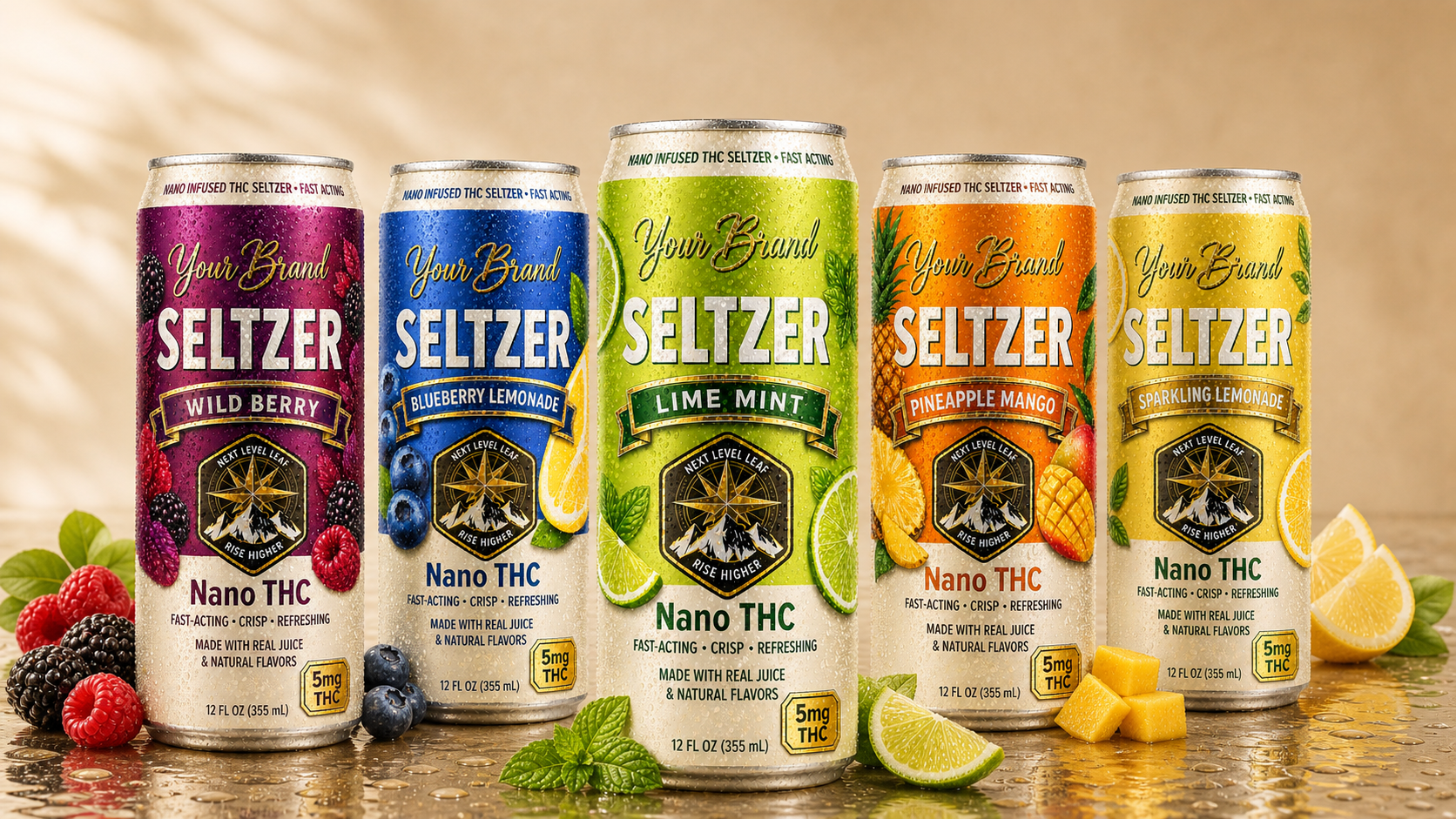
Depending on the project, options can include THC seltzers, sodas, lemonades, juice-style drinks, still beverages, coffee, cocktail-inspired sparkling drinks, and functional beverage concepts.
For projects we support, commercial production generally begins at approximately 1,200 cans per SKU. Selective smaller prototype runs may be available for qualified projects.
What THC dose should a Wisconsin beverage use?
Wisconsin does not currently have an enacted hemp-beverage rule creating a separate statewide 2.5 mg, 5 mg, or 10 mg serving category. Those amounts are better treated as commercial product-planning options, not Wisconsin legal limits.
2.5 mg
A lower-dose concept for brands that want a lighter, session-oriented social beverage.
5 mg
An approachable single-can concept that can work well for mainstream THC beverage positioning.
10 mg
A stronger single-can concept for brands targeting consumers who want a more pronounced serving.
A different dose may also make sense depending on the beverage, package size, customer, retailer expectations, and future expansion plans. Whatever dose is chosen, the finished product still needs to fit the hemp definition and other requirements that apply to it.
Which beverage formats make the most sense?
The best format should match the customer's drinking occasion and the brand's existing identity. Wisconsin's current framework gives brands room to evaluate several familiar beverage formats rather than forcing every concept into one narrow product type.
- THC seltzers: light, sparkling, and easy to position as an adult social beverage.
- THC sodas: flavor-forward products that can support classic and nostalgic profiles.
- Lemonades and juice-style drinks: fruit-forward formats that can support stronger flavor profiles.
- Still beverages: useful when the brand wants a noncarbonated option.
- THC coffee: nitro, cold-brew, and flavored concepts for coffee-oriented brands.
- Cocktail-inspired drinks: nonalcoholic beverage concepts built around familiar adult social occasions.
How should a Wisconsin brand think about retail and distribution?
The current Wisconsin framework does not create a single dedicated hemp-beverage distribution tier in the way a tightly regulated alcohol-style system would. That can make conventional retail and distribution planning relevant, but the actual channel still needs to be checked against the product, seller, facility, and local requirements involved.
For retailers and distributors, the strongest product story is simple: a professionally manufactured beverage with a clearly stated dose, finished-product documentation, an adult-oriented package, reliable lot traceability, and product information that can be provided quickly when requested.
NLL recommends confirming the exact channel before commercial production rather than assuming that one retailer's current practice establishes a statewide rule.
What testing and COA documentation should the product have?
Finished-product testing should be part of the launch plan, not an afterthought. A serious Wisconsin beverage brand should be able to connect the finished product to its cannabinoid inputs, production lot, potency results, and supporting certificate of analysis.
- Finished-product potency: confirm the cannabinoid content in the beverage that will actually be sold.
- Batch-specific COA: connect the applicable test results to the production lot.
- Lot traceability: maintain clear batch and production records.
- Cannabinoid-source records: document the inputs used in the formula.
- Retail documentation: make relevant product information easy to provide to distributors and retailers.
These are responsible product and retail practices. They should not be described as Wisconsin-specific legal requirements unless the applicable law, license, or agency rule expressly requires them.
What food and labeling requirements should a Wisconsin beverage brand plan for?
Wisconsin DATCP regulates the food chain from processing and storage through retail. Packaged foods generally need a product name, ingredient list, net quantity statement, manufacturer, packer or distributor identification, and nutrition information unless an exemption applies.
For a hemp-derived THC beverage, ordinary food requirements sit alongside the cannabinoid questions. Confirm the licenses or registrations that apply to the manufacturing, warehousing, distribution, and retail roles involved in the actual project.
From a brand and retailer standpoint, NLL also recommends making the THC amount easy to understand, keeping packaging adult-oriented, avoiding disease or therapeutic claims, and maintaining batch-specific documentation that supports the finished product.
Wisconsin DATCP General Food Labeling
Does Wisconsin require a special hemp processor license?
Wisconsin's former Department of Agriculture, Trade and Consumer Protection hemp program ended on January 1, 2022. Hemp growers moved to the USDA program, and DATCP states that hemp processors no longer require a Wisconsin hemp processor license.
That does not mean a beverage business has no licensing obligations. Food processing, storage, retail food, labeling, and other requirements can still apply depending on what each business is doing.
Wisconsin DATCP Hemp Resources
What happened to Wisconsin's proposed 2025-26 cannabinoid rules?
Wisconsin lawmakers considered several bills that would have created much more detailed rules for hemp-derived cannabinoid products. Those proposals are useful for understanding the direction policymakers considered, but they are not current law.
SB 682 and AB 747
These companion bills proposed 21+ sales, independent testing, certificates of analysis, labeling and packaging requirements, and beverage potency rules. The introduced proposal included a 10 mg total THC per serving limit and no more than two servings in a nonresealable beverage container.
SB 681 and AB 606
These companion bills proposed a broader intoxicating-hemp system involving licensing, taxation, distribution, and additional regulatory oversight. They also failed and are not current Wisconsin operating requirements.
The practical strategy is to use the current opportunity without pretending future regulation will never arrive. A professionally tested, clearly labeled, adult-oriented product should be easier to adapt if Wisconsin adopts more formal cannabinoid rules later.
What should a Wisconsin brand decide before requesting a quote?
A useful quote starts with a clearly defined product. Before requesting production pricing, decide:
- Beverage type: seltzer, soda, lemonade, juice-style drink, coffee, still beverage, or another format.
- THC amount per can: the intended dose and whether other cannabinoids are part of the formula.
- Cannabinoid blend: identify the cannabinoids you want included.
- Flavor or flavors: production-ready options or a custom concept that may require R&D.
- Quantity per flavor: commercial production generally begins around 1,200 cans per SKU for projects we support.
- Packaging: can size, label status, artwork, multipack, and any retailer requirements.
- Sales plan: where and how the product is expected to be sold.
- Shipping destination: freight affects the delivered economics of the project.
How can Next Level Leaf help with a Wisconsin THC beverage?
Next Level Leaf helps businesses move from an initial beverage idea to a production-ready white-label or private-label product. We can help with beverage type, flavor, THC amount per can, cannabinoid blend, packaging, testing coordination, production planning, and the information needed to prepare a quote.
For projects we support, commercial runs generally begin at approximately 1,200 cans per SKU. If you already know what you want to make, the fastest next step is to send us the beverage type, THC amount per can, quantity per flavor, packaging status, and shipping destination.
Request a quote for a Wisconsin THC beverage project.
Primary Wisconsin sources
- Wisconsin Statute 94.55 - hemp definition and state authority concerning processing, transport, sale, import, and export.
- Wisconsin DATCP Hemp Resources - current program status and the 2022 transition to USDA grower licensing.
- Wisconsin DATCP General Food Labeling - general packaged-food labeling requirements.
- Wisconsin DATCP Food, Dairy and Retail Food Licenses - food licensing resources for regulated Wisconsin facilities.
- Wisconsin Department of Revenue tax bulletin - official tax example involving a hemp-infused bottled beverage moving through manufacturer, distributor, grocer, and consumer transactions.
- Wisconsin SB 682 and AB 747 - failed 2025-26 hemp-derived cannabinoid product proposals.
- Wisconsin SB 681 and AB 606 - failed broader intoxicating-hemp regulatory proposals.
Federal hemp rules are tracked separately
Federal law can affect whether a hemp-derived beverage remains eligible for the hemp pathway. To avoid duplicating a moving federal timeline on each state page, follow the Next Level Leaf Section 781 Tracker for current federal developments.
Before launch: confirm the finished formula, Delta-9 THC calculation, testing, food and labeling requirements, business roles, sales plan, and current Wisconsin and federal rules before committing commercial inventory.
Related Next Level Leaf resources
THC Seltzers
Explore seltzer flavors, dose planning, packaging, and white-label options.
Explore seltzers →Low-Dose THC Drinks
Explore how lower-dose THC beverage concepts can be positioned and planned.
Explore low-dose →THC Beverage Manufacturing
Review beverage types, cannabinoids, packaging, production planning, and MOQ.
Explore beverages →Frequently asked questions about Wisconsin THC beverages
Want to launch a THC beverage in Wisconsin?
Wisconsin currently gives brands room to evaluate professionally manufactured hemp-derived THC beverages. Tell us the beverage type, THC amount per can, cannabinoid blend, flavors, quantity per flavor, packaging status, and shipping destination, and we can help turn the concept into a production-ready white-label or private-label beverage.