

Indiana THC Drink Laws & Beverage Compliance
Indiana THC drink laws currently allow hemp-derived Delta-9 beverages when the finished product meets the state's THC, testing, COA, packaging, and food-label requirements.
If you are a retailer, distributor, hemp business, beverage company, or existing brand considering your own THC beverage, this guide explains the current rules, what Indiana requires on the package, and what to plan before production.
Updated September 24, 2026 • Published and maintained by Next Level Leaf
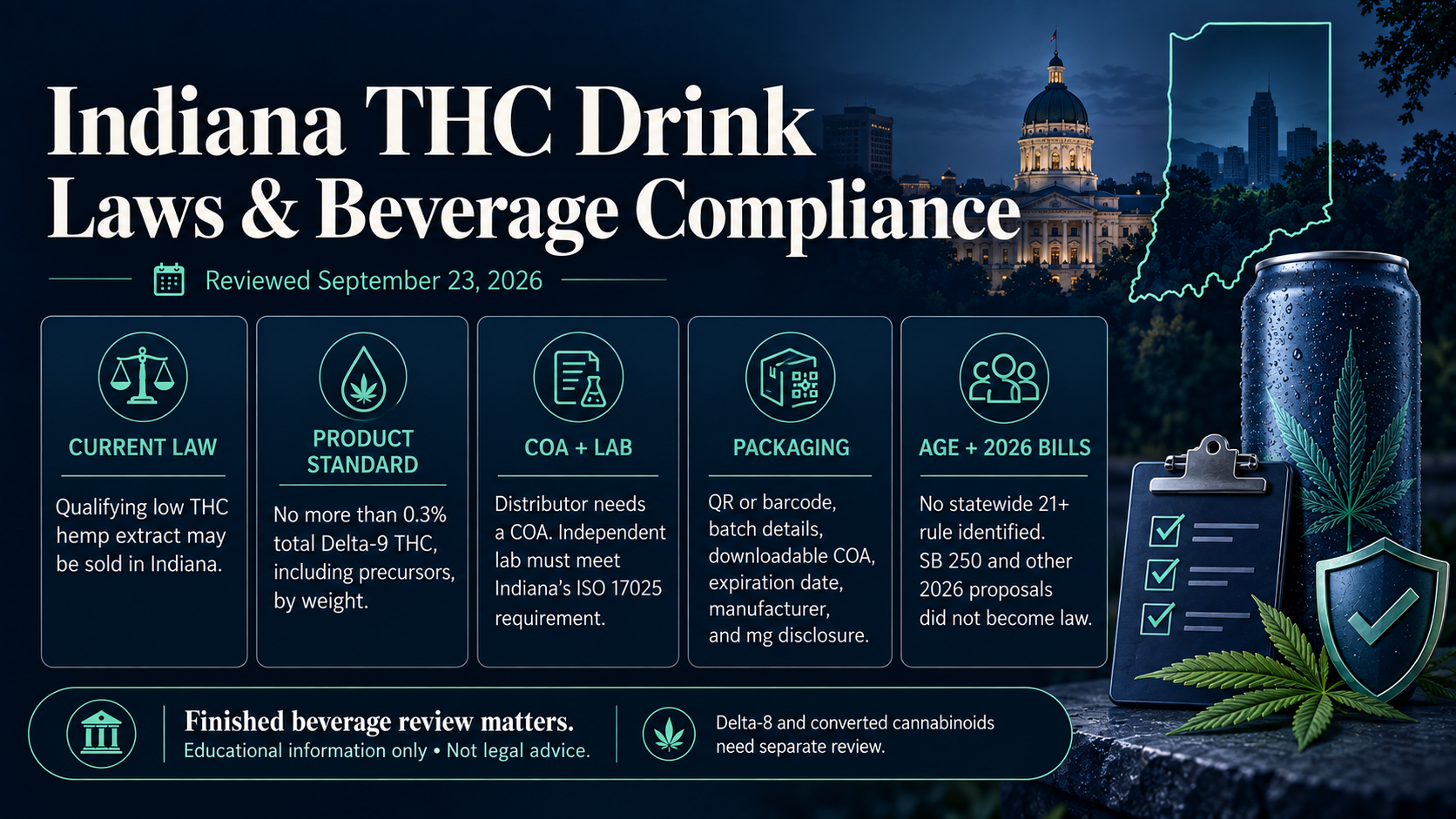
Indiana has a workable set of rules for hemp-derived Delta-9 beverages, but the finished product needs to meet the state's THC limit and its testing, COA, packaging, and food requirements.
Indiana law uses the term “low THC hemp extract.” That is a legal definition, not a beverage type or a description of how the product is manufactured. The definition is explained below so the rest of the page can stay focused on finished beverages.
Planning your own Indiana THC beverage? Indiana has a workable pathway for compliant hemp-derived Delta-9 beverages. For projects we support, commercial production generally begins at approximately 1,200 cans per SKU.
What are the current Indiana THC drink laws?
Indiana does not have a separate statute written only for THC beverages. Instead, finished hemp-derived products are evaluated under the state's hemp and low THC hemp extract laws, along with the food rules that apply to packaged beverages.
For a business that wants to sell a hemp-derived Delta-9 drink in Indiana, the main questions are straightforward: does the finished product meet the THC limit, is the required testing and COA in place, does the package contain the required information, and do the manufacturer, distributor, and retailer meet the rules that apply to their roles?
What does “low THC hemp extract” mean?
Indiana Code § 35-48-1.1-27 uses this term for a hemp-derived substance or compound that contains no more than 0.3% total Delta-9 THC, including precursors, by weight and contains no other controlled substances. A product above that THC threshold does not meet this definition.
For this page, think of “low THC hemp extract” as Indiana's legal term for products covered by these rules. It is not a separate beverage style, and it is not a manufacturing instruction.
Indiana Code Title 35 • See IC 35-48-1.1-27
Can an Indiana business launch a white-label or private-label THC beverage?
Yes. An Indiana retailer, distributor, hemp business, beverage company, or existing brand can consider launching a white-label or private-label hemp-derived Delta-9 beverage when the finished product and sales plan meet Indiana's applicable THC, testing, COA, packaging, food-label, and distribution requirements.
The practical starting point is to decide what you want to sell, then confirm the finished formula, dose, package, testing, label, and sales channel before production.
Choose the drink format
Depending on the project, options can include seltzers, sodas, lemonades, tea, coffee, juice-style drinks, still beverages, mocktail-style drinks, and other ready-to-drink formats.
Choose the dose intentionally
Indiana does not currently set a separate state milligram cap per serving or container, but the finished beverage still needs to remain within the state's total Delta-9 THC percentage-by-weight limit.
Approximately 1,200 cans per SKU
For projects supported by Next Level Leaf, commercial production generally begins at approximately 1,200 cans per SKU. Selective smaller prototype runs may be available for qualified projects.
What should you decide before requesting a quote?
Beverage type and flavor
Choose the beverage format, flavor or flavors, and whether you want a production-ready option or a custom formulation path.
THC amount and blend
Decide the intended THC amount per can and whether CBD, CBG, CBC, or another permitted cannabinoid is part of the formula.
Quantity, packaging, and destination
Provide the quantity per flavor, can size, artwork or label status, shipping destination, and any delivery constraints.
Ready to price an Indiana project? Request a quote with the beverage type, THC amount per can, cannabinoid blend, flavors, quantity per flavor, packaging status, and shipping destination.
Are hemp-derived Delta-9 beverages legal in Indiana?
Hemp-derived Delta-9 beverages can be sold in Indiana when the finished product meets the applicable state requirements. Indiana's distribution statute allows products covered by the low THC hemp extract chapter to be distributed when they meet that chapter's requirements.
For a beverage brand or retailer, this means the finished drink needs to be evaluated as the product that will actually be sold. Meeting the THC percentage is only one part of the job. The COA, laboratory, package, batch information, food label, and sales setup also matter.
Indiana Code Title 24 • See IC 24-4-21 and IC 24-4-22
What THC limit applies to an Indiana beverage?
The current low THC hemp extract definition uses a limit of no more than 0.3% total Delta-9 THC, including precursors, by weight.
No separate enacted Indiana THC milligram cap per serving or per can was identified in the current low THC hemp extract statutes as of September 24, 2026. Indiana's current statute is written around concentration by weight rather than a separate beverage-dose tier.
A stated milligram dose does not replace compliance review. The finished product still needs to meet the percentage limit and the other rules that apply to it.
Does Indiana require a COA?
Yes. Indiana Code § 24-4-21-3 requires a distributor of low THC hemp extract to have a certificate of analysis prepared by an independent testing laboratory.
The COA must show that the batch was tested, that the tested batch contained no more than 0.3% total Delta-9 THC including precursors by weight, and the cannabidiol percentage present in the product.
What laboratory does Indiana require?
Indiana Code § 24-4-21-1 requires the independent testing laboratory used under this chapter to meet the state's independence requirements and be accredited to ISO 17025 by a third-party accrediting body.
For a brand preparing a product for Indiana, the practical takeaway is simple: make sure the lab used for the required COA fits Indiana's definition of an independent testing laboratory.
What has to be on the Indiana package?
Indiana Code § 24-4-21-4 contains detailed packaging requirements. Rather than treating these as optional best practices, a brand should build them into the label and batch-documentation process before the product goes to market.
Link to batch information
The package needs a scannable barcode or QR code linked to the manufacturing information required by the statute.
Downloadable test results
The linked batch information must include access to the certificate of analysis.
Traceability information
The required information includes batch identification, product name, batch date, expiration date, batch size, quantity produced, and specified ingredient and lot information.
Required product details
The package must include the batch number, website for batch information, expiration date, milligrams of low THC hemp extract, manufacturer, and the required THC concentration statement.
The finished beverage may also need the normal packaged-food information that applies to the product, including product identity, net quantity, ingredients, manufacturer or distributor information, allergen disclosures, and Nutrition Facts when required.
Indiana Code Title 24 • See IC 24-4-21-4
Do customers have to be 21 to buy THC drinks in Indiana?
No statewide 21-and-older rule applying generally to low THC hemp extract was identified in current Indiana law as of September 24, 2026.
Several 2026 bills proposed age restrictions, but those proposals did not become law. Retailers can still use their own age policies, and a particular store, sales channel, or business may have additional requirements.
What happened with Indiana's 2026 hemp bills?
Indiana lawmakers considered several bills that would have changed how hemp-derived THC products are regulated. Those proposals matter because they show what legislators considered, but they should not be presented as current law.
Indiana General Assembly 2026 bill list
What about Delta-8 and converted cannabinoids?
Indiana should not be treated as though every hemp-derived cannabinoid has the same legal status. Indiana Attorney General Opinion 2023-1 concludes that Delta-8 THC and several similar THC variants are Schedule I controlled substances under Indiana law.
An Attorney General opinion is not the same thing as a final court ruling, and later litigation did not settle every possible classification question. For an Indiana beverage project, confirm the exact cannabinoid source and production method instead of assuming a converted cannabinoid is treated the same way as hemp-derived Delta-9.
Read Indiana Attorney General Opinion 2023-1
What food rules should an Indiana business consider?
General food rules still apply to a packaged beverage. The Indiana Department of Health says manufacturers, processors, repackagers, and wholesale distributors of food that maintain a place of business in Indiana must register with the Department.
An Indiana business can use an out-of-state production partner. Indiana's wholesale food registration applies to covered businesses that maintain a place of business in Indiana, while the Indiana-side retailer, distributor, or other business should confirm the food and local requirements that apply to its role.
Indiana Department of Health: Wholesale Manufactured Foods Program
If Indiana is one part of a broader launch, identify the other destination states before finalizing dose, packaging, and labels. Different states can use different THC limits, age rules, testing standards, label requirements, and distribution structures. Compare markets in the State Resources hub and review the intended sales geography before committing commercial inventory.
Planning an Indiana-only or multi-state beverage?
Federal hemp rules are changing separately
Federal hemp changes affect the national market and should not be mixed into Indiana's current state-law summary. Follow the Section 781 Hemp Deadline Tracker for federal developments. This page stays focused on Indiana.
Primary Indiana sources
- Indiana Code Title 35 • IC 35-48-1.1-27, low THC hemp extract definition
- Indiana Code Title 24 • IC 24-4-21 and IC 24-4-22, distribution, COA, packaging, and retail-sale rules
- Indiana General Assembly 2026 legislation
- Indiana Attorney General Opinion 2023-1
- Indiana Department of Health Wholesale Manufactured Foods Program
Important: This page is educational and is not legal advice. Indiana's treatment of a finished beverage can depend on the complete formula, cannabinoid source, testing, package, business roles, and sales plan. Have qualified counsel review the final product before launch.
Related Next Level Leaf resources
State Resources
Review other state-specific hemp beverage pages without mixing their rules into Indiana's requirements.
Explore states →Compliance Resources
Review testing, COAs, labeling, documentation, and beverage-production considerations.
Explore compliance →Beverage Manufacturing
Explore beverage formats, flavor, cannabinoid options, packaging, MOQ, and commercial production.
Explore manufacturing →Frequently asked questions about Indiana THC drink laws
Want to launch your own THC beverage in Indiana?
Tell us the beverage type, THC amount per can, cannabinoid blend, flavors, quantity per flavor, packaging status, and shipping destination. For projects we support, commercial production generally begins at approximately 1,200 cans per SKU, with selective smaller prototype runs available for qualified projects.