

Oklahoma THC Beverage Laws
Oklahoma currently presents an opportunity for hemp-derived THC beverages when the finished product, cannabinoid source, testing, label, and sales plan fit the state's applicable hemp requirements. The Oklahoma Department of Agriculture, Food and Forestry says products marketed as hemp must test no more than 0.3% Total THC.
This guide covers Oklahoma's current Total THC standard, the November 1, 2026 statutory update, 2026 hemp-beverage bills that did not become law, private-label planning, testing, cannabinoid source, labeling, and the information to prepare before requesting a production quote.
Updated September 24, 2026 • Published and maintained by Next Level Leaf
Are THC drinks legal in Oklahoma? Oklahoma currently regulates hemp products through its general hemp and controlled-substance framework rather than a dedicated THC-beverage statute. ODAFF says hemp products marketed as hemp are restricted to no more than 0.3% Total THC. This review did not identify a separate enacted milligram-per-can limit for hemp beverages.
Not legal advice: This page provides general educational and business-planning information and is not legal advice. Hemp, food, cannabinoid, labeling, licensing, and retail requirements can change and can depend on the exact product and business role. Brands, manufacturers, distributors, and retailers should confirm their specific product and sales model with qualified counsel and the appropriate agencies before production, distribution, or sale.
Are THC drinks legal in Oklahoma?
Oklahoma's current framework does not create a separate statutory category for conventional hemp-derived THC beverages. Instead, the starting point is whether the product qualifies as hemp under the applicable Oklahoma requirements.
The Oklahoma Department of Agriculture, Food and Forestry states that hemp products marketed as hemp are restricted to test no more than 0.3% Total THC. ODAFF describes Total THC as measured THC plus 87.7% of THCA.
For a beverage business, that means a stated dose such as 5 mg or 10 mg per can does not by itself establish compliance. The finished product, testing method, cannabinoid source, food-law requirements, label, and intended sales setup should be reviewed together.
Oklahoma Department of Agriculture, Food and Forestry: Industrial Hemp
What does Oklahoma mean by Total THC?
ODAFF's January 16, 2026 hemp clarification says the state's current hemp-product restriction is based on Total THC, calculated as measured THC plus 87.7% of THCA. The agency explains that this calculation accounts for the potential conversion of THCA to THC when certain testing methods are used.
That distinction matters for beverage planning because the state is not simply asking what number appears on the front of the can. A finished beverage should be evaluated using appropriate testing and a method that can support the legal classification being claimed for the product.
Practical point: treat the intended milligram dose as a formulation and positioning decision, then separately confirm how the finished liquid beverage will be evaluated against Oklahoma's Total THC standard.
What changes on November 1, 2026?
Oklahoma's controlled-substance definition becomes more explicit about Delta-9 THC plus THCA.
An enacted 2026 amendment, SB 1257, takes effect November 1, 2026. It updates the industrial-hemp exception in Oklahoma's Uniform Controlled Dangerous Substances Act to refer to a combined Delta-9 THC and THCA concentration of no more than 0.3% on a dry-weight basis, tested using post-decarboxylation or another similarly reliable method.
This change does not create a separate hemp-beverage milligram limit, a dedicated beverage license, or a new ABLE distribution tier. It does reinforce Oklahoma's movement toward a Total THC approach that accounts for THCA.
Oklahoma 2026 SB 1257 session law
Can an Oklahoma business launch a private-label THC beverage?
Yes, an Oklahoma business can consider a white-label or private-label hemp-derived THC beverage when the finished product and sales plan fit the state's current requirements. Oklahoma is an opportunity market, but it is also an emerging-regulation market. Product-specific testing, cannabinoid source, ordinary food-law requirements, and the intended retail or distribution setup should be confirmed before commercial inventory is committed.
This can include retailers developing a house brand, distributors adding an owned beverage line, hemp businesses expanding into drinks, existing cannabis or wellness brands adding a beverage SKU, or entrepreneurs launching a new beverage brand.
What can you private label?
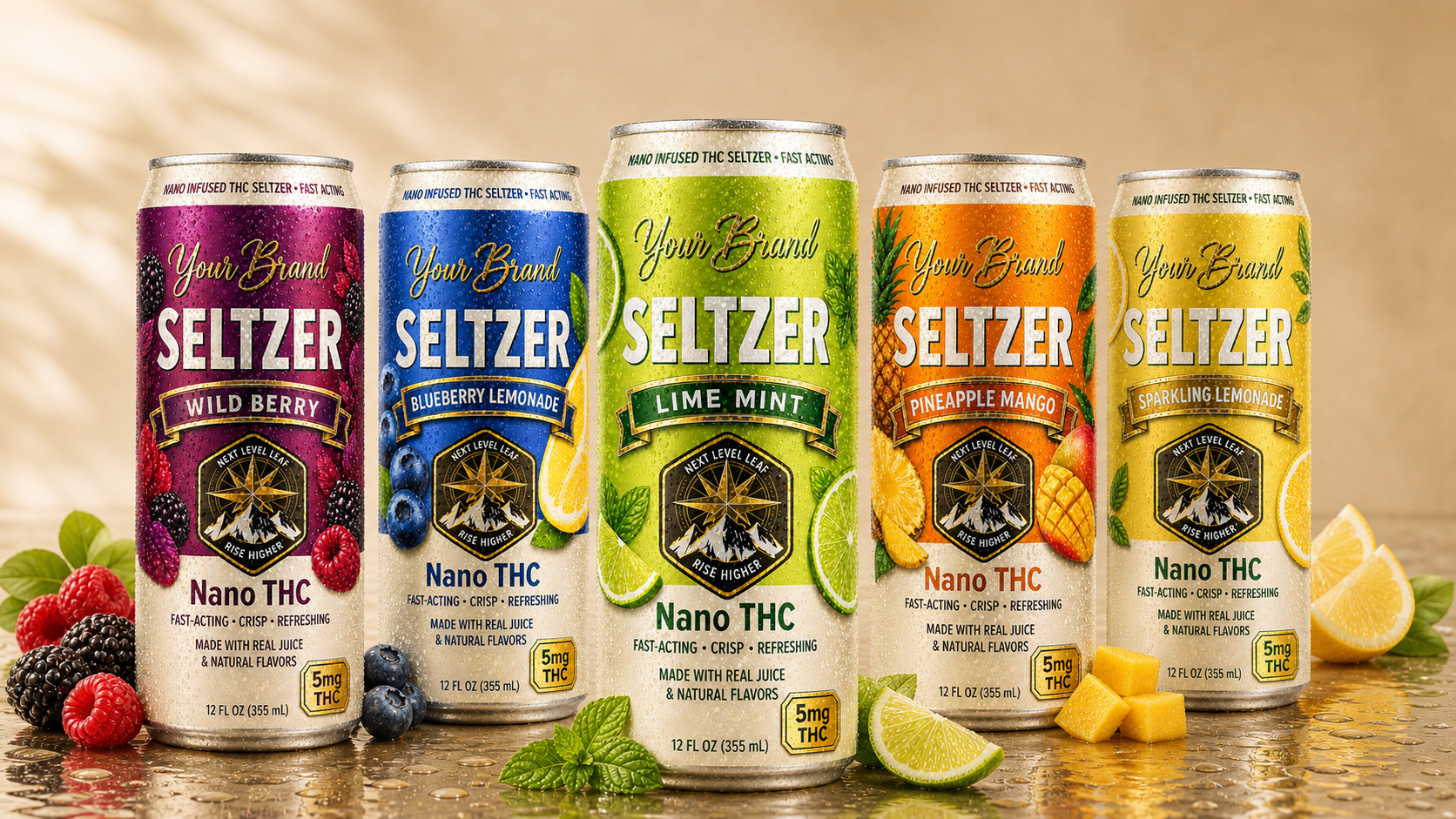
Depending on the project, options can include infused seltzers, sodas, lemonades, juice-style drinks, still beverages, coffee, and other beverage formats. The right starting point depends on flavor, THC amount per can, cannabinoid blend, package size, target customer, and where the product will be sold.
For projects we support, commercial production generally begins at approximately 1,200 cans per SKU. Selective smaller prototype runs may be available for qualified projects.
Why do we call Oklahoma an emerging-regulation market?
Oklahoma lawmakers considered two separate hemp-beverage proposals in 2026. Neither became law, but both show that the state is actively considering beverage-specific rules rather than leaving the category permanently under the general hemp framework.
Proposed 21+ sales rule
HB 4248 would have prohibited the sale of beverages containing hemp to people under 21. It passed the House and Senate, but on May 6, 2026 the House recalled the measure from enrollment and rescinded the fourth reading and signing. It did not become law.
Proposed ABLE hemp-beverage framework
SB 2092 proposed giving the ABLE Commission authority over hemp beverages, allowing certain licensed retailers to sell them, and adding a 21+ sales rule. It was referred to the Senate Rules Committee in February 2026 and received no votes.
The useful business conclusion is not that either proposal applies today. The useful conclusion is that Oklahoma's framework is still developing, so brands entering the market should monitor changes and avoid building an inflexible product or channel strategy around assumptions that could change.
Does cannabinoid source matter in Oklahoma?
Yes. In April 2025, Governor Kevin Stitt directed multiple state agencies to coordinate enforcement and regulatory review involving psychoactive cannabinoid products that were described as synthesized or chemically altered from hemp-derived CBD. The announcement identified several alternative cannabinoids as areas of concern.
That does not mean every cannabinoid product is treated the same way. It does mean the exact cannabinoid, how it was produced, its source documentation, and the finished-product test results are important parts of an Oklahoma beverage review.
For a straightforward hemp-derived Delta-9 beverage project, keep the cannabinoid source and batch documentation clear and avoid assuming that rules or enforcement positions for one cannabinoid automatically apply to another.
Governor's April 28, 2025 cannabinoid enforcement announcement
How much THC should an Oklahoma beverage contain?
The target dose is a product and business decision, not simply the highest amount that might fit a percentage calculation. Brands commonly consider target customer, drinking occasion, flavor, package size, serving expectations, retailer preference, price point, and whether the same SKU may eventually be sold in other states.
Because Oklahoma's current hemp framework focuses on Total THC concentration rather than an enacted beverage-specific milligram cap, the finished product and testing approach should be reviewed before production. A 5 mg, 10 mg, or other stated dose should not be treated as a stand-alone legal conclusion.
What should an Oklahoma brand decide before requesting a quote?
A useful quote starts with a clearly defined product. Before requesting production pricing, it helps to know:
- Beverage type: seltzer, soda, lemonade, juice-style drink, coffee, still beverage, or another format.
- THC amount per can: the intended dose and whether other cannabinoids are part of the formula.
- Cannabinoid source: identify the cannabinoid ingredients and make sure the source and production method can be documented.
- Flavor or flavors: production-ready flavor options or a custom concept that may require R&D.
- Quantity per flavor: commercial production generally begins around 1,200 cans per SKU for projects we support.
- Packaging: can size, label status, artwork, multipack, and any retailer packaging requirements.
- Where it will be sold: Oklahoma only or a broader multi-state launch.
- Shipping destination: freight affects the delivered economics of the project.
What testing and documentation should a beverage brand plan for?
Testing should be planned before launch rather than added after the beverage is already produced. A brand should be able to connect the finished product to batch records, cannabinoid source documentation, potency testing, and an appropriate certificate of analysis.
For Oklahoma, the central state-specific issue is the Total THC calculation. ODAFF's current clarification describes Total THC as THC plus 87.7% of THCA. The testing plan should be able to support the finished product's claimed status under the applicable Oklahoma standard.
Recommended business practice: maintain finished-product potency results, relevant contaminant testing, batch-specific COAs, lot traceability, cannabinoid-source records, formula records, and the documentation a retailer or distributor may reasonably request.
What food and retail requirements should be considered?
Hemp status is only one layer of a beverage launch. Oklahoma's general food laws require a food establishment license for establishments offering food or drink for sale to the public, subject to statutory exemptions and role-specific rules. ODAFF also directs businesses manufacturing food products containing hemp to applicable Oklahoma food-safety and good-manufacturing-practice resources.
The specific requirements can differ depending on whether the business is manufacturing in Oklahoma, warehousing, distributing, operating a retail food establishment, or simply owning a brand whose product is manufactured elsewhere. Confirm the requirements that apply to the actual business role.
Oklahoma food establishment licensing statute
What should the label communicate?
A strong THC beverage label should make it easy for the customer and retailer to understand what the product is, how much THC it contains, how many servings are in the container, what ingredients and allergens are present, and how to find supporting product information such as a COA when applicable.
Confirm the food-label elements, cannabinoid disclosures, warnings, business identification, claims, serving information, and other statements required for the exact product and sales channel. Keep branding adult-oriented and avoid presentation that creates unnecessary retailer or regulatory concerns.
Should you build an Oklahoma-only SKU or a multi-state SKU?
That depends on where you intend to sell. An Oklahoma-only beverage can be evaluated against Oklahoma's current rules, while a multi-state product may need a lower dose, different package, different label, or separate SKU to work across several states.
If Oklahoma is the first market but expansion is part of the plan, identify those future states early. It is much easier to make those decisions before labels are printed and commercial inventory is produced.
How can Next Level Leaf help with an Oklahoma THC beverage?
Next Level Leaf helps businesses move from an initial beverage idea to a production-ready white-label or private-label product. We can help with beverage type, flavor, THC amount per can, cannabinoid blend, packaging, testing coordination, production planning, and the information needed to prepare a quote.
For projects we support, commercial runs generally begin at approximately 1,200 cans per SKU. If you already know what you want to make, the fastest next step is to send us the beverage type, THC amount per can, quantity per flavor, packaging status, and shipping destination.
Request a quote for an Oklahoma THC beverage project.
Primary Oklahoma sources
- Oklahoma Department of Agriculture, Food and Forestry: Industrial Hemp - current state hemp program information and Total THC statement.
- ODAFF 2026 Hemp Clarification Letter - agency explanation of Oklahoma's 0.3% Total THC position and Total THC calculation.
- 2026 SB 1257 session law - enacted November 1, 2026 update to Oklahoma's industrial-hemp exception in the controlled-substance definitions.
- HB 4248 official bill history - proposed 21+ hemp-beverage bill that was recalled from enrollment and did not become law.
- SB 2092 official bill history - proposed ABLE hemp-beverage framework that remained in the Senate Rules Committee.
- April 2025 cannabinoid enforcement announcement - state executive-branch statement concerning synthesized or chemically altered psychoactive cannabinoid products.
Federal hemp rules are tracked separately
ODAFF's January 2026 clarification letter also discussed the federal framework that existed when the letter was issued. Federal law changed again on September 2, 2026. To avoid duplicating a moving federal timeline on every state page, use the Next Level Leaf Section 781 Tracker for current federal developments. This Oklahoma guide uses the ODAFF letter for its Oklahoma-specific Total THC guidance.
Before launch: confirm the finished formula, cannabinoid source, Total THC testing method, food-law requirements, label, retailer or distributor role, and current Oklahoma and federal rules before committing commercial inventory. Oklahoma is a current opportunity, but its hemp-beverage regulatory framework is still developing.
Related Next Level Leaf resources
THC Seltzers
Explore seltzer flavors, dose planning, packaging, and white-label options.
Explore seltzers →THC Beverage Options
Review beverage types, cannabinoids, packaging, production planning, and MOQ.
Explore beverages →Pricing & MOQ
Understand the main decisions that affect beverage pricing and commercial production.
Explore pricing →Frequently asked questions about Oklahoma THC beverages
Want to launch your own THC beverage in Oklahoma?
Tell us what you want to make, including the beverage type, THC amount per can, cannabinoid blend, flavors, quantity per flavor, packaging status, and shipping destination. We can help turn the idea into a production-ready white-label or private-label beverage while you confirm the Oklahoma requirements that apply to your product and sales plan.