

Texas THC Beverage Rules and Delta-9 Compliance
Compliant hemp-derived Delta-9 beverages can still be sold in Texas. This guide covers the current THC limits, 21+ sales rules, testing, labeling, packaging, licensing, and what changed on July 31.
See what the July 31 changes mean now, which rules apply to Delta-9 beverages, what the current lawsuits do and do not change, and how the federal Section 781 timing has moved for beverage brands and retailers.
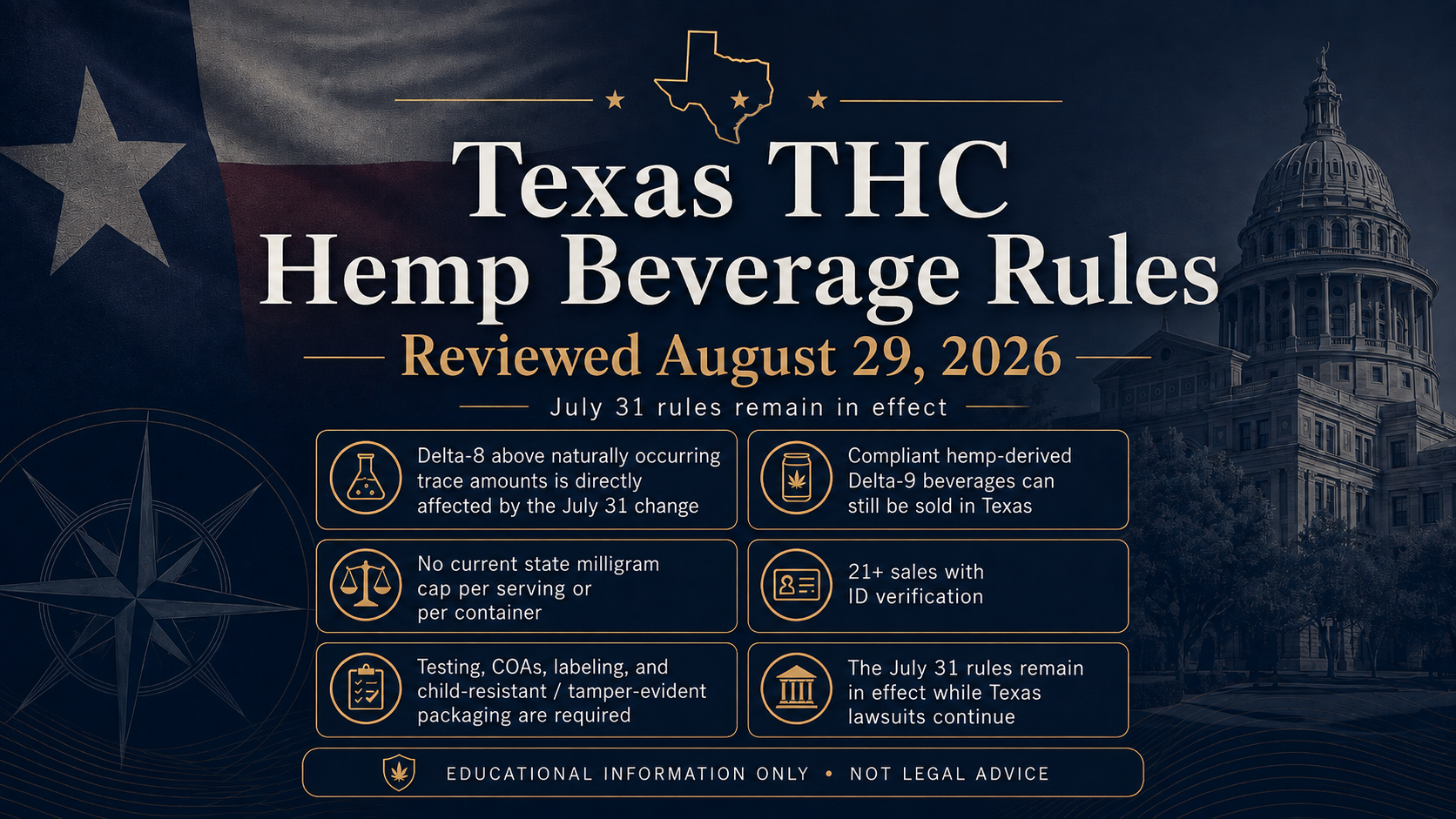
Yes. Compliant hemp-derived Delta-9 THC beverages can still be sold in Texas after the July 31, 2026 controlled-substance update.
Texas also requires the applicable finished-product testing, labeling, child-resistant and tamper-evident packaging, and business licensing or registration. Federal timing changed after the prior review: H.R. 6500 was signed on September 2, 2026, and public congressional summaries describe it as delaying the broader federal hemp-definition change through December 11, 2026 while addressing synthetic hemp derivatives separately.
Texas THC beverage rules at a glance
Texas regulates these drinks as consumable hemp products. Businesses selling them need to follow the state’s 21+ sales rules, finished-product testing requirements, label and packaging rules, and the licensing or registration requirements that apply to what the business actually does.
Litigation and federal update: the July 31 Texas schedule is still in effect
The federal case Monti et al. v. Garcia, No. 3:26-cv-254, was filed July 31, 2026 in the U.S. District Court for the Southern District of Texas. On August 9, the federal judge denied the plaintiffs’ request for an emergency temporary restraining order. The lawsuit continues, including a request for preliminary injunctive relief, but the July 31 Texas schedule was not blocked.
A separate Travis County case, SS Distro USA LLC et al. v. Texas Department of State Health Services, Cause No. D-1-GN-26-007113, was filed August 19. Public reports describe the case as challenging DSHS’s post-July enforcement and testing approach, including the agency’s use of an undefined “trace amount” standard. Judge Maya Guerra Gamble heard arguments on a temporary restraining order on August 28. As of this review, no signed public order has been identified changing the rules currently in force.
The federal timing also changed after the prior review. H.R. 6500 was signed on September 2, 2026. Public congressional summaries describe it as delaying the broader federal hemp-definition change through December 11, 2026 while addressing synthetic hemp derivatives separately. Texas operators still need to track both Texas law and federal law because they are separate requirements.
Delta-9 beverages can still be sold
Compliant hemp-derived Delta-9 beverages remain legal to sell under the Texas consumable-hemp rules when they meet the applicable requirements.
No current state mg cap
Texas has not adopted a beverage-specific milligram limit per serving or package.
21+ with ID
Every purchaser must be verified as 21 or older using valid government-issued identification.
Manufactured Delta-8 clearly affected
DSHS states that only naturally occurring trace amounts of Delta-8 are permissible. Products labeled with Delta-8 or testing above trace amounts may be detained and referred to law enforcement.
Testing is required
Representative finished-product samples must be tested before sale, distribution, or introduction into Texas commerce.
Child-resistant and tamper-evident
The package used for retail sale must meet Texas child-resistant and tamper-evident requirements.
$10,300 per location
DSHS currently lists the one-year Consumable Hemp Product License at $10,300 per location, including the Texas Online fee.
$5,150 per location
DSHS currently lists the one-year Retail Hemp Registration at $5,150 per location, including the Texas Online fee.
How this page is checked: We review Texas statutes, adopted rules, current DSHS and TABC guidance, official rulemaking notices, and court decisions. Proposed or failed legislation is kept separate from the rules that are actually in force.
Are THC drinks legal in Texas in 2026?
Hemp-derived Delta-9 beverages can currently be sold in Texas when they qualify as consumable hemp products and remain within the applicable total Delta-9 THC limit. Texas’s current formula includes THCA when calculating total Delta-9 THC: total Delta-9 THC = (0.877 × THCA) + Delta-9 THC.
Texas does not currently impose a separate 2.5mg, 5mg, or 10mg beverage ceiling. DSHS considered comments asking it to align with a 0.4-milligram federal standard but declined to adopt that limit in the March 2026 rulemaking. The THC amount still matters to the customer and retailer. A clearly labeled 2.5mg, 5mg, or 10mg single-serving beverage is generally easier to understand than a high-dose novelty product.
Texas rules in one paragraph
As of September 3, 2026, compliant hemp-derived Delta-9 THC beverages can still be sold in Texas after the July 31 controlled-substance update. The state has no beverage-specific milligram cap per serving or package, but it requires 21+ ID verification, a finished product at or below 0.3% total Delta-9 THC by dry weight, finished-product testing, COA-linked labeling, child-resistant and tamper-evident packaging, and the license or registration required for the business activity. The July 31 change clearly affects Delta-8 above naturally occurring trace amounts and can affect other THC isomers, but it did not ban compliant hemp-derived Delta-9 beverages. Federal timing has moved, but Texas operators still need to track the separate federal Section 781 issue.
Why Texas remains an important hemp beverage market
Texas already has a large consumable-hemp retail system. In a July 2026 presentation, DSHS reported 14,170 consumable-hemp retail locations and 778 manufacturers as of June 18, 2026. Those numbers cover all consumable hemp products, not just beverages, but they show how large the existing Texas market is.
For hemp retailers, smoke shops, convenience stores, liquor retailers, restaurants, beverage companies, and existing cannabis brands, low-dose beverages offer a familiar ready-to-drink format that customers already understand. For beverage brands, products are easier to place when the dose is clear, the packaging is adult-focused, the testing is complete, and the retailer can quickly review the documentation.
What changed in Texas on July 31, 2026?
Keep the cannabinoid source well documented. The Texas Supreme Court did not decide that every CBD-to-Delta-9 conversion is prohibited. However, the July 31 schedule uses language that can make chemically converted or synthetic-equivalent cannabinoids more complicated to evaluate. For a Delta-9 beverage, keep clear records showing the ingredient source, how it was produced, and the finished-product test results.
What lawsuits are active in Texas now?
Texas has several different hemp cases in progress. They challenge different rules or enforcement actions, so one case should not be treated as changing every Texas hemp requirement.
What this means right now: filing a lawsuit does not by itself stop a rule. Until a court enters an order that changes enforcement, businesses should follow the Texas rules currently in force and continue watching the cases for new orders.
What do the Texas rules say about THCA and trace Delta-8?
Two different Texas rules can come into play here: whether a finished product meets the DSHS consumable-hemp requirements, and whether a particular cannabinoid is treated as a controlled substance. Those are not always the same question.
THCA counts toward the THC limit
Texas’s March 2026 consumable-hemp rules expressly include THCA in total Delta-9 THC and the acceptable-hemp-THC calculation. For manufacturers, distributors, and retailers, THCA therefore cannot be ignored when determining whether a finished product fits the DSHS consumable-hemp rules.
A separate legal question remains
The July 31 schedule reinstates definitions of tetrahydrocannabinols and marihuana extract, but Sky Marketing centered on manufactured Delta-8 and did not resolve every possible criminal-law question involving THCA. That means it would be inaccurate to say that THCA has a blanket exemption under Texas law.
Naturally occurring trace Delta-8 is different
The Texas Supreme Court expressly recognized that naturally occurring Delta-8 THC isomers present in trace amounts in hemp were decontrolled by statute, and noted the commissioner’s representation that such naturally occurring amounts are tolerable under the current regime.
Trace Delta-8 means trace amounts: the Court was discussing the very small amounts that occur naturally in hemp. It contrasted those trace amounts with manufactured Delta-8 products whose concentrations “substantially, dramatically exceed” what occurs naturally in hemp. This does not mean a beverage can be formulated with added Delta-8 above naturally occurring trace amounts.
What this means for a beverage formula
A Delta-9, CBD, or CBG beverage whose finished-product COA shows only incidental trace Delta-8 is different from a product intentionally formulated with added or converted Delta-8. That distinction is supported by the Texas Supreme Court’s discussion in Sky Marketing. Keep records showing where the cannabinoid came from, how it was produced, and what the finished-product COA shows.
Can a Texas business launch a white-label THC beverage?
Yes, but Texas treats private labeling as a manufacturing activity for licensing purposes. A Texas retailer that simply sells a finished consumable-hemp beverage without changing the product, package, or company name generally needs the Retail Hemp Registration. DSHS treats activities such as preparing, processing, packaging, repackaging, labeling, relabeling, and placing a company’s own name or address on a product as manufacturing activities.
That is important for private-label beverages. DSHS specifically says a business that places its own label, name, and address on a product made by another company needs the Consumable Hemp Product License. The fact that an outside co-packer physically makes the beverage does not automatically place the Texas brand in the retail-registration category.
Retail registration
A seller offering a finished product unchanged generally needs a DSHS retail registration for each applicable location, including qualifying online retail operations.
DSHS treats this as manufacturing
Adding your company name, applying your own label, relabeling, or repackaging generally requires the Consumable Hemp Product License.
Out-of-state manufacturing can work
An out-of-state manufacturer does not need Texas registration solely because the facility is outside Texas, but the product and Texas-side businesses must satisfy applicable requirements.
If you want to launch a private-label beverage
Choose the cannabinoid and dose
Use a clearly documented hemp-derived Delta-9 ingredient and choose a THC amount that makes sense for the customer and where you expect to sell the beverage.
Choose the beverage format
Texas brands can consider seltzers, sodas, teas, lemonades, mocktails, juice drinks, coffee, and other ready-to-drink formats.
Confirm what your company will do
Confirm who owns the brand, whose name will appear on the label, who will distribute the beverage, and who will sell it.
Confirm the testing, label, and packaging before production
Before approving the can artwork, confirm the finished-product COA requirements, visible COA URL, required warnings, and how the child-resistant packaging requirement will be met.
Confirm the first order
Once the formula and Texas requirements are clear, confirm the flavor, THC dose, packaging, testing, order quantity, freight, and production timing.
Exploring a Texas white-label or private-label beverage? Review our THC beverage manufacturing capabilities or request a quote with the beverage type, THC amount per can, how many cans you want to start with, and where the order needs to ship.
Texas manufacturer, retailer, and distribution requirements
| Texas manufacturer or private-labeler | A DSHS Consumable Hemp Product License is required for activities Texas treats as manufacturing, including processing, packaging, repackaging, labeling, and relabeling. DSHS currently lists the one-year total at $10,300 per location, including the Texas Online fee. |
|---|---|
| Texas retailer | A seller offering finished consumable-hemp products without changing the product or package generally needs a Retail Hemp Registration. DSHS currently lists the one-year total at approximately $5,150 per location, including the Texas Online fee. |
| Online seller | DSHS states that online retailers selling into Texas need the retail registration even when based outside Texas. |
| Out-of-state manufacturer | An out-of-state manufacturing facility does not need a Texas manufacturing license solely because it is located outside Texas. The beverage still needs to meet the applicable Texas testing, labeling, packaging, and sales requirements. |
| Distributor or wholesaler | A distributor may need a Consumable Hemp Product License and may also be subject to Texas wholesale food requirements. The exact requirement depends on what the distributor does with the product. |
What must appear on a Texas hemp beverage label?
A Texas hemp beverage label needs more than the THC amount. Each product intended for individual retail sale must carry the required label information so a buyer, retailer, or inspector can identify the manufacturer, batch, serving information, and matching COA.
Product, batch, and company information
- Product name
- Batch identification or lot number
- Batch or lot date
- Manufacturer or processor name
- Manufacturer or processor phone number and email
Visible COA link and serving information
- A conspicuously marked URL that reaches the applicable COA in three or fewer steps
- Cannabinoid amount per serving or unit through the linked COA
- Total THC and total Delta-9 THC information
- Recommended serving size in milligrams
- Servings per container
Texas requires a printed URL. A QR code may be added for convenience, but it does not replace the visible URL. The COA itself must include a QR code that verifies the authenticity of testing conducted by an accredited laboratory.
Required warning statements
- Keep out of reach of children.
- The product may contain THC and can cause a user to fail a drug test.
- All THCs have psychoactive properties.
- Pregnant or nursing women should consult a healthcare provider before use.
- The product has not been evaluated by the FDA.
A beverage must also satisfy the food-label requirements that apply to its product category, including product identity, net quantity, ingredient statement, allergens, responsible-party information, and nutrition labeling where required.
Do THC beverage cans need child-resistant packaging in Texas?
Texas requires consumable hemp products to be sold in packaging that is tamper-evident and child-resistant. A package with multiple servings must also be resealable while keeping the child-resistant feature intact. DSHS also states that certain canned or bottled packages may qualify as child resistant, but a standard can should not be assumed compliant without reviewing the actual package.
Texas does not say that every standard pull-tab beverage can is automatically compliant, and it does not require one specific type of child-resistant can end. Do not assume a standard pull-tab can automatically satisfies the rule. Review the can and any outer packaging together to make sure the retail package meets the child-resistant and tamper-evident requirements.
Check the actual package you plan to sell
Do not assume a standard pull-tab can automatically meets the Texas child-resistant requirement. Check the can and any outer packaging you plan to use.
Do not separate cans unless they comply on their own
If the child-resistant requirement is met by an outer multipack, do not sell the individual cans separately unless each can also meets the applicable packaging requirement.
Keep the presentation adult-oriented
Clear cannabinoid disclosure, professional design, and avoidance of youth-oriented imagery support retailer confidence and responsible placement.
What testing and COAs are required?
Before a consumable hemp product is sold at retail, distributed, or otherwise introduced into Texas commerce, a representative sample must be tested by an accredited laboratory. Texas defines an accredited laboratory around ISO/IEC 17025 or a comparable or successor standard.
Finished-product testing
- Cannabinoid identity and concentration
- Delta-9 THC
- Total Delta-9 THC
- Total THC
- Residual solvents
- Heavy metals
- Pesticides
- Harmful pathogens
- Other current DSHS analytes
Keep the COA tied to the correct batch
- Finished-product COA linked to the applicable batch
- Lot identification and sample dates
- Methods, instruments, limits of detection, and limits of quantitation
- Measurement-of-uncertainty information
- COA expiration date
- Laboratory-authentication QR code on the COA
- Retention of testing records for at least three years
Expired COAs are not valid. A generic ingredient COA should not be treated as a substitute for the finished beverage’s batch documentation. For retailer or distributor review, keep the finished-product COA, batch records, ingredient-source documentation, approved label, packaging specifications, and recall information together.
Where can hemp-derived THC beverages be sold in Texas?
Texas does not restrict consumable hemp products to cannabis dispensaries. Compliant products can be sold outside cannabis dispensaries. Depending on the business and its permits, relevant channels can include hemp retailers, smoke shops, convenience stores, liquor stores, online sellers, and some restaurant or bar settings. Each seller still needs the DSHS license or registration and any other requirements that apply to that business.
TABC-licensed businesses
A TABC license by itself is not enough to sell consumable hemp products. The business also needs the applicable DSHS license or registration. TABC licensees must verify that each CHP customer is at least 21, and specified off-premise alcohol permit holders may not allow consumable hemp products to be consumed on the premises.
The TABC guidance reviewed for this update does not say that every business selling alcohol is prohibited from selling hemp THC beverages. Restaurants, bars, and package stores should check the rules for their specific TABC permit and how they plan to sell or serve the product.
What should Texas beverage brands watch next?
If you are developing a beverage now, focus on the rules that are already in force: use a clearly documented cannabinoid source, complete finished-product testing, adult-focused packaging, and the correct Texas license or registration. Continue watching both the Texas litigation and the federal Section 781 change, including the December 11 federal timing and the separate synthetic-derivative issue.
What this means for Texas beverage brands and retailers
Texas remains a large market for retailers, hemp businesses, beverage brands, distributors, restaurants, and other businesses considering low-dose THC beverages. Products with clear dosing, complete documentation, professional adult-focused packaging, and straightforward retailer information are easier to evaluate and sell than novelty products with weak records.
Start with who will own and sell the product
Confirm who owns the brand, whose name will appear on the label, who distributes the beverage, and who will sell it.
Choose the THC amount
Choose a THC amount that makes sense for the customer and the type of retailer where you expect the beverage to be sold.
Keep the product records together
Before production, confirm the cannabinoid source, finished-product testing, COA requirements, label, packaging, and batch records.
Confirm the production details
Once those details are clear, confirm the formula, flavor, THC dose, order quantity, packaging, testing, freight, and timeline.
Planning the beverage itself
Texas compliance is only one part of developing the beverage. You also need to decide the beverage type, THC amount, flavor, emulsion, shelf life, packaging, order quantity, freight, and where you expect to sell it. Explore our hemp-derived THC beverage manufacturing capabilities, review the broader beverage compliance framework, or compare markets through the state hemp beverage resource hub.
For brands moving away from Delta-8 or another product affected by the July 31 update, a low-dose Delta-9 seltzer, soda, tea, lemonade, mocktail, juice drink, or coffee can provide a clearer ready-to-drink alternative, provided the product is designed around the current Texas rules and the separate federal Section 781 issue.
Texas sources used for this guide
These sources were used to review and verify this page through September 3, 2026. Government guidance and court orders can change, so the review date is shown prominently and the current rules are separated from pending litigation.
Consumable Hemp Program
Program notices, current program and enforcement information, licensing, and registration resources.
View the DSHS program pageMarch 31, 2026 adopted rules
Current requirements for total Delta-9 THC, testing, labeling, packaging, recordkeeping, age verification, and fees.
Read the adopted rulesControlled-substance schedule notice
DSHS notice reinstating the 2021 definitions effective July 31, 2026.
View the DSHS schedule pageTexas Hemp Business Council resources
Industry lawsuit documents and status notes for the state-court challenge to the 2026 DSHS consumable-hemp rules.
View THBC lawsuit resourcesSS Distro USA LLC et al. v. DSHS
Public reporting on the Travis County case, Cause No. D-1-GN-26-007113, filed by four Texas hemp businesses challenging DSHS’s post-July enforcement approach, including the undefined “trace amount” standard.
Read the lawsuit reportDSHS v. Sky Marketing Corp.
The May 1, 2026 opinion underlying reinstatement of the controlled-substance definitions.
Read the court opinionLicensing, registration, and labeling
Current application totals, private-label treatment, online retail guidance, and label requirements.
View licensing guidanceConsumable hemp rules for alcohol licensees
Age verification, DSHS licensing or registration, and off-premise consumption rules.
View TABC guidanceJuly 2026 program update
Official retailer and manufacturer counts and DSHS statements about current rules and enforcement.
View the Senate committee presentationTHBC lawsuit resources and enforcement status
THBC’s document library and current rules statements for the March 2026 consumable-hemp rule challenge, including the appellate case and June 26 rehearing denial.
View THBC litigation resourcesMonti et al. v. Garcia
Federal case No. 3:26-cv-254 challenging the July 31 scheduling action. The court denied the emergency TRO request on August 9, while the case continues.
View the federal docket referenceFederal TRO denied
Texas Tribune reporting on the August 9 federal order denying emergency relief and leaving the July 31 schedule in effect while the lawsuit continues.
Read the court updateH.R. 6500 signed into law
White House statement that H.R. 6500, the Continuing Appropriations and Extensions Act, 2027, was signed on September 2, 2026 and funds federal agencies through December 11, 2026.
View the White House statementHemp ban delay summary
Congressional summary describing the bill as delaying the broader federal hemp ban through December 11, 2026 while banning synthetic hemp derivatives.
Read the congressional summaryMedia and research contact
Journalists, trade groups, businesses, and researchers can contact Next Level Leaf with source questions or primary documents we should review.
Email brad@nextlevelleaf.comFrequently asked questions about Texas THC beverage rules
Developing a hemp-derived THC beverage for Texas?
Tell us what type of beverage you want, the THC amount per can, how many cans you want to start with, where it needs to ship, and whether you want to use one of our existing formulas, develop something custom, or bring your own production-ready formula. We can help with formulation, flavor, packaging, testing coordination, production, freight, and larger repeat orders as the brand grows.
Want to see more Next Level Leaf Texas hemp updates in Google?
Add Next Level Leaf as a Preferred Source so our newest Texas hemp beverage, compliance, and rule updates are easier to find in supported Google Search and AI experiences.
Your Google source preferences stay under your control and can be changed at any time.