

North Carolina THC Hemp Beverage Rules
North Carolina has an active hemp-derived THC beverage market while lawmakers and the North Carolina Advisory Council on Cannabis continue working through possible future rules.
Current state law still uses the 0.3% delta-9 THC dry-weight definition of hemp. HB 328 remains pending in the House Rules Committee and has not become law. During August, the North Carolina Advisory Council on Cannabis continued meeting on market, public-safety, legal, revenue, and testing issues. This page separates what applies now from proposals and recommendations that are still being considered.
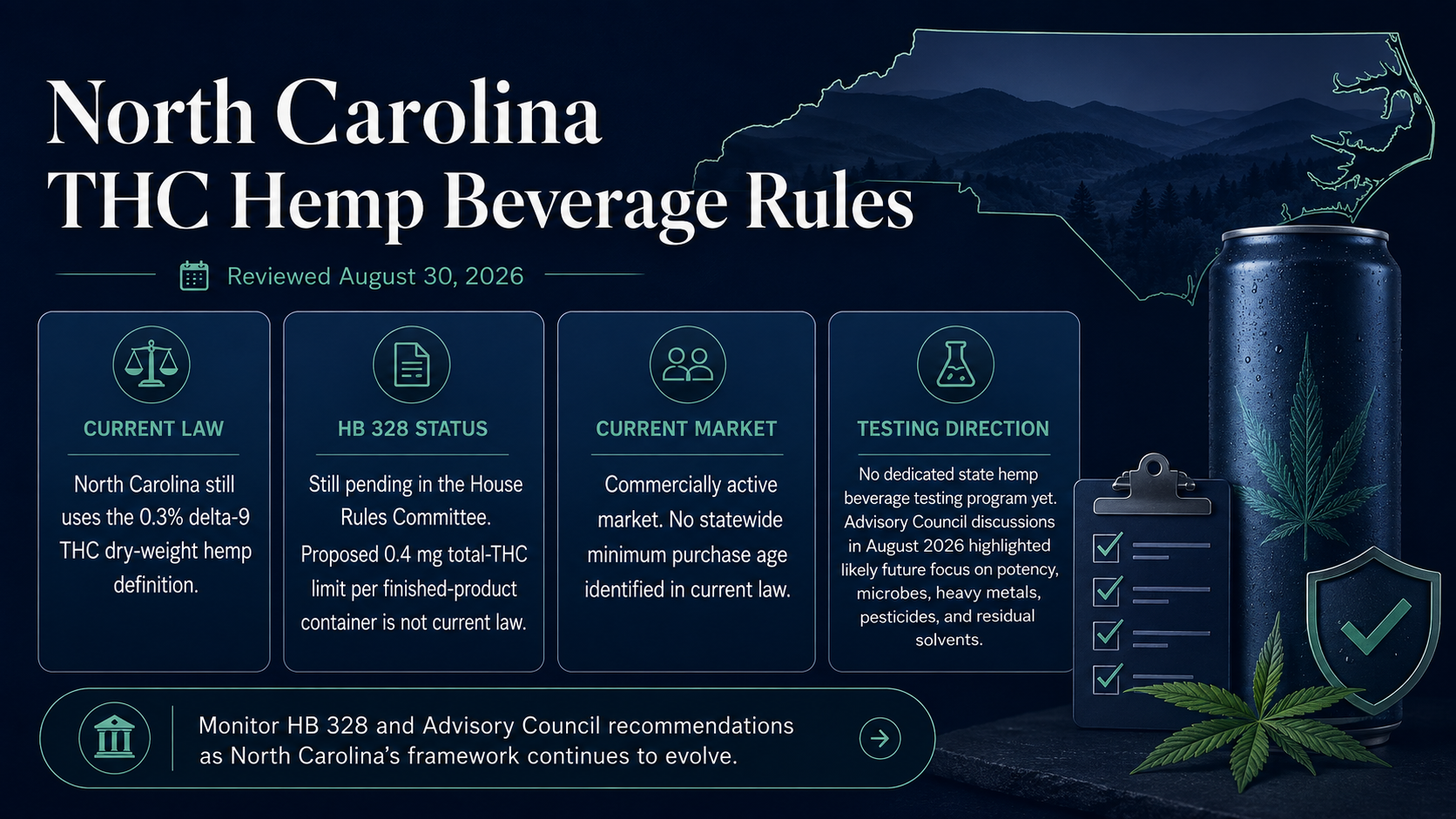
North Carolina still uses the 0.3% delta-9 THC dry-weight hemp definition, and HB 328 is still pending.
North Carolina does not yet have a comprehensive hemp-beverage licensing, testing, labeling, packaging, or retail framework. The Advisory Council is actively discussing what a future system could include.
State beverage snapshot
North Carolina is best understood as an active market with a regulatory framework still taking shape. Current statutes establish the hemp baseline, while the pending HB 328 conference report and the state advisory process point toward possible future age limits, testing, labeling, packaging, cannabinoid limits, and stronger oversight.
Commercially active
Hemp-derived THC beverages are available through several North Carolina retail and hospitality channels, although market availability should not be confused with formal agency approval.
No statewide minimum today
The state advisory council reports no statewide minimum purchase age for intoxicating hemp products. Responsible operators can voluntarily restrict sales to adults 21 and older.
No enacted state mg cap
The current state controlled-substance baseline is 0.3% delta-9 THC on a dry-weight basis, not a per-serving or per-container milligram limit.
HB 328 remains pending
The Senate adopted the conference report on July 2. The House reported and referred it to the House Rules Committee on July 30, but has not adopted it. The proposed restrictions are not current law.
Important note: We are not attorneys, and this page is not legal advice. It is an operating guide to the current market, pending state developments, and practical beverage-planning decisions. Confirm final legal conclusions for your product and channel with qualified counsel.
Current state of the market
North Carolina’s hemp-derived cannabinoid market is economically meaningful and already connected to agriculture, manufacturing, retail, and hospitality. The state’s 2026 Advisory Council on Cannabis interim report cites an estimate of approximately $1 billion for the existing intoxicating hemp-derived cannabinoid industry. It also reports that North Carolina ranked eighth nationally in hemp acreage planted and harvested and tenth in floral-hemp production as of April 2025.
Beverages are only one part of that larger market, so the $1 billion estimate should not be described as beverage revenue. Still, the presence of North Carolina breweries, beverage companies, retailers, and hospitality operators in the category is strong evidence that this is not a hypothetical market.
For a beverage brand or existing business, the opportunity is to learn what customers want, establish retail relationships, and build quality systems before the market becomes more defined. The category’s current size also explains why the policy debate includes farmers, manufacturers, retailers, brewers, public-health officials, and law enforcement, not just hemp brands.
August 30, 2026 update: The official General Assembly record still shows July 30 as the latest HB 328 action, when the House conference report was referred to the House Rules Committee. The bill has not been enacted. Meanwhile, the North Carolina Advisory Council on Cannabis held additional August meetings as it continues developing recommendations.
What the North Carolina Advisory Council is discussing
The North Carolina Advisory Council on Cannabis continued meeting in August 2026. The Market and Regulatory Subcommittee met August 21, the full Council met August 25, Public Safety met August 26, and Revenue and Legal met August 27. These meetings are part of the state's ongoing work on possible future cannabis and intoxicating-hemp policy.
Testing was a major topic at the August 25 meeting
A lab-testing presentation to the Council recommended starting with testing for cannabinoids, yeast and mold, bacteria, heavy metals, pesticides, and residual solvents in concentrates. It also discussed ISO/IEC 17025 lab accreditation, validated methods, state access to testing data, market surveillance, and stronger testing oversight.
This is not current North Carolina law. It is a recommendation presented during the Council's policy-development process. It is useful because it shows the kinds of testing and oversight North Carolina is actively considering.
Current North Carolina rules
North Carolina’s current controlled-substance framework is anchored in the legal distinction between hemp and marijuana. G.S. 90-87 and G.S. 90-94 use a 0.3% delta-9 THC dry-weight standard and exclude qualifying tetrahydrocannabinols in qualifying products from Schedule VI.
The statute does not explain a state-approved dry-weight testing method for a finished liquid beverage. Because the research reports used different calculation methods, this page does not claim that a particular 2 mg, 5 mg, or 10 mg beverage is compliant merely because of the can’s total liquid weight. Product-specific conclusions require reliable testing and review of the complete formula and sales pathway.
North Carolina also prohibits the manufacture, sale, or delivery of adulterated or misbranded food under Article 12 of Chapter 106. At the federal level, the FDA maintains that THC and CBD cannot lawfully be added to conventional food introduced into interstate commerce. In other words, being outside the state controlled-substance definition does not, by itself, settle every food-law or interstate-commerce question.
Labeling considerations
North Carolina has not enacted a dedicated hemp THC beverage label code comparable to regulated adult-use cannabis states. That does not make label design an afterthought. General food-labeling and misbranding rules still apply, and clear cannabinoid information can help retailers and consumers understand what the product contains.
Clear THC content
List hemp-derived Delta-9 THC content per serving and per container in plain language so retailers and consumers understand the product.
Batch traceability
Use lot codes, batch numbers, QR-linked COAs, and documentation that can be quickly matched to finished product inventory.
Adult-oriented warnings
Include practical impairment, driving, pregnancy, age, and “keep out of reach of children” language, even before a dedicated state hemp label rule is enacted.
Practical advantage: Clear dose disclosure, batch identification, COA access, required food-label elements, and adult-oriented warnings can make a product easier for a retailer or distributor to evaluate. These systems also remain useful if North Carolina later adopts more specific rules.
North Carolina hemp beverage label review checklist
Use this planning checklist before approving artwork. It separates North Carolina’s current packaged-food baseline from voluntary quality practices and questions that depend on the final formulation, claims, package, or sales model.
-
Required now
Build the conventional packaged-food label
Include the product’s common or usual name, net quantity of contents, ingredients in descending order, the responsible manufacturer or distributor’s name and address, and Nutrition Facts unless an exemption applies. Required information must be readable and conspicuous.
-
Required now
Keep the label and claims accurate
Do not use false or misleading labeling or advertising. Confirm that the ingredient statement, quantity, nutrition information, allergen disclosures, product identity, and any claims accurately describe the finished beverage.
-
Recommended practice
Make cannabinoid and batch information easy to find
Consider clear THC and other cannabinoid amounts per serving and per container, serving information, a lot or batch code, and access to a batch-specific finished-product COA.
-
Recommended practice
Use adult-oriented warnings and presentation
Consider a readable 21+ statement, impairment and driving warnings, pregnancy and medication cautions, “keep out of reach of children” language, and design that cannot be confused with a conventional children’s beverage.
-
Confirm for your product
Resolve formula-, claim-, and channel-specific fields
Confirm whether Nutrition Facts exemptions, allergen statements, flavor or preservative disclosures, storage directions, product coding, structure/function claims, retailer requirements, or federal cannabinoid-food issues affect the final label.
Official North Carolina labeling tools and review resources
No current state-issued label template specifically for hemp THC beverages was identified as of August 16, 2026. North Carolina does provide official food-label review resources, but they should not be treated as approval of a cannabinoid formula or finished hemp beverage label:
- NCDA&CS Food Program and Food Label Review — explains the packaged-food label baseline and the Division’s label-review role.
- NCDA&CS commercial food-manufacturing guidance — outlines facility, inspection, and packaged-food labeling considerations and provides the Food Compliance contact.
- North Carolina Food, Drug and Cosmetic Act, Article 12 — the state statute governing adulterated or misbranded foods and false advertising.
Packaging considerations
North Carolina’s current statutes do not create a cannabis-specific child-resistant package, universal THC symbol, or exit-bag requirement for hemp-derived THC beverages. The state advisory council has identified that gap and is considering child-safety and youth-protection guardrails.
A responsible beverage should still look unmistakably adult-oriented. Avoid cartoon characters, candy imitation, trademark-copycat design, or other presentation that could make an intoxicating product easy to confuse with a conventional drink intended for children.
- What is clearly in force: General food, consumer protection, and misbranding principles still matter, and products must remain within the hemp definition.
- What is not currently required or still evolving: Dedicated child-resistant hemp beverage packaging, exit packaging, and cannabis-style universal symbols are not yet enacted as statewide hemp beverage requirements.
- What is good practice even without a specific state mandate: Use premium, adult-oriented beverage design, avoid child-appealing imagery, avoid copycat packaging, and prepare for child-resistant or exit-package rules if North Carolina adopts a formal hemp consumables framework.
Strong packaging can protect the consumer and the brand at the same time. Tamper evidence, clear warnings, readable dose information, and a serious visual system can support retailer confidence even before a state-specific package rule exists.
Testing and COA expectations
North Carolina has not enacted a dedicated finished-product hemp beverage testing program with approved-lab, contaminant-panel, or QR-linked COA requirements. General food-safety rules still prohibit adulterated products, and the absence of a specialized mandate does not make untested product a sound business choice.
An input or emulsion COA does not prove that the finished beverage has the intended potency, uniformity, or contaminant profile. Finished-product testing provides more useful evidence about the product the customer will actually drink.
Document the hemp standard
Keep source records and well-supported test documentation showing how the product and cannabinoid inputs relate to North Carolina’s current hemp definition.
Use full-panel documentation and batch traceability
Batch-specific COAs, strong contaminant testing, and retailer-ready documentation may do more than reduce risk. They can improve sell-in quality and make the brand easier to trust.
For a premium beverage launch, the better standard is full-panel finished-product testing, cannabinoid potency confirmation, contaminant screening, lot-level traceability, a scannable COA, and internal records that connect ingredients, production batch, finished inventory, and shipped product.
Sales and distribution realities
North Carolina does not have a broad adult-use cannabis dispensary system, and hemp-derived THC beverages are sold in practice through hemp retailers, bottle shops, convenience and grocery settings, direct-to-consumer channels, and some hospitality businesses.
The best channel depends on the product, retailer policies, local conditions, carrier rules, payment processing, and the brand’s ability to provide reliable documentation. Market presence is evidence of commercial activity, not a guarantee that every online, wholesale, delivery, or on-premise model has been affirmatively approved by a state agency.
Hospitality requires extra care. North Carolina has not published a comprehensive rule for nonalcoholic hemp-derived THC beverages on ABC-permitted premises. Do not assume that selling a sealed nonalcoholic can, serving it on-premise, running a tasting, or combining cannabinoids with alcohol are legally interchangeable activities.
Practical takeaway: Start with a channel you can document and support. A reliable local retailer or distributor relationship can help a brand validate demand now and adapt if North Carolina later formalizes age verification, licensing, or sales-channel rules.
Pending legislation and future direction
Federal rules are changing separately. We keep that analysis on the Section 781 Hemp Deadline Tracker so this North Carolina page can stay focused on state-specific rules and developments.
Our perspective: We do not believe adult interest in THC beverages simply disappears because regulation becomes more defined. We expect stronger expectations around age restrictions, testing, packaging, labeling, and sales channels. In our view, that transition can favor businesses that build trusted products, quality systems, and real customer demand. That is an opinion about the market, not a guarantee of any particular legal outcome.
What should a brand confirm before launching a hemp beverage in North Carolina?
Use this checklist to connect the finished product to North Carolina’s current hemp and food-law baseline, the responsible business roles, and the intended sales channels before implementation.
-
Required now
Classify and document the finished beverage as hemp
Confirm that the final product remains within North Carolina’s current hemp definition, including the 0.3% delta-9 THC dry-weight standard. Use well-supported product-specific documentation rather than assuming that an input COA or a stated milligram dose resolves classification.
-
Confirm for your product
Match each business role to the applicable food pathway
Confirm facility inspection, manufacturing, warehousing, wholesale, retail, local permitting, sanitation, and any other general food-business requirements for the manufacturer, brand, distributor, and seller. North Carolina’s lack of a hemp-specific retail license does not remove those obligations.
-
Confirm for your product
Verify every sales and service model separately
Review sealed retail, wholesale, events, online sales, delivery, direct-to-consumer shipping, restaurant or brewery service, and activity on ABC-permitted premises as distinct pathways. Market activity does not establish blanket authorization for every channel.
-
Recommended practice
Use voluntary 21+ controls
North Carolina has not enacted a statewide minimum purchase age for these products, but a brand can use a 21+ policy, documented ID checks, staff training, controlled placement, and channel-appropriate online or delivery controls.
-
Required now
Complete the food-label and packaging review
Apply the conventional packaged-food label baseline, keep all statements accurate and non-misleading, and confirm that the packaging protects the beverage. Treat adult-oriented warnings, tamper evidence, and non-copycat design as responsible practices rather than current cannabis-specific mandates.
-
Recommended practice
Build finished-product testing and traceability
Use batch-specific potency and formulation-appropriate contaminant testing, lot records, input-to-finished-product traceability, and buyer-accessible COA documentation even though North Carolina has not enacted a dedicated finished-product hemp beverage testing program.
-
Confirm for your product
Recheck pending North Carolina changes before committing inventory
Confirm the current status and final text of HB 328, SB 59, agency guidance, and any local requirements before finalizing formulation, ordering labels, or beginning distribution. Proposed age, cannabinoid, dose, licensing, and packaging rules are not current law unless enacted.
-
Confirm for your product
Resolve tax, federal, destination-state, and final legal questions
Confirm taxes, registrations, record retention, carrier and payment rules, federal food-law implications, and the law of every destination state. Have qualified legal counsel review the final formulation, label, packaging, licenses, and sales plan before launch.
Important: This checklist is provided for educational and planning purposes only. It is not legal advice and does not determine whether a particular product or operating plan complies with applicable law. Requirements may vary based on the formulation, cannabinoid content, packaging, business roles, and intended sales channels. Have qualified legal counsel review the final formulation, label, packaging, licenses, and sales plan before printing labels, beginning distribution, or offering the product for sale.
What this means for North Carolina operators
North Carolina is a meaningful market for hemp retailers, beverage companies, breweries, distributors, hospitality operators, and businesses considering an adult-use beverage. The strongest starting point is not a generic “North Carolina-compliant” formula. It is a clear customer, product concept, sales channel, target dose, documentation plan, and contingency for rule changes.
Define the customer and channel
A hemp retailer, grocery buyer, brewery partner, and direct-to-consumer brand may need different product, documentation, and launch plans.
Choose an adaptable format
Select dose, flavor, packaging, and cannabinoid inputs around today’s customer while retaining options if the state changes its product rules.
Build retailer-ready proof
Finished-product COAs, lot traceability, accurate labels, adult-oriented packaging, and clear records make the product easier to evaluate and trust.
Confirm the production details
Once the concept and channel are clear, request a quote to evaluate formulation, MOQ, pricing, packaging, testing, and production timing.
Some adults are choosing THC beverages as an alternative to alcohol, but the two categories have different risks and should not be described as interchangeable or harmless. The stronger opportunity is a familiar beverage format with measured dosing, serious quality control, and responsible adult positioning.
Keep the broader strategy in view
If you are evaluating North Carolina as one part of a broader launch, compare other markets in the State Resources hub, review our broader compliance guidance, explore THC beverage formulation, and see how production planning works on our beverage manufacturing page. Pricing, MOQ, flavor, packaging, and testing decisions can then be scoped through a quote request.
Primary sources and monitoring links
- North Carolina Controlled Substances Act, Article 5
- North Carolina Food, Drug and Cosmetic Act, Article 12
- North Carolina Advisory Council on Cannabis interim report
- HB 328 official status and history
- HB 328 conference report text
- SB 59 official status and history
- FDA regulation of cannabis and cannabis-derived products
- North Carolina Advisory Council on Cannabis — meetings, agendas, slides, and recordings
- August 25, 2026 Advisory Council lab-testing presentation
Frequently asked questions
Planning a hemp beverage for North Carolina?
We can help with beverage type, dose, packaging, testing coordination, production, and scaling while you work through the North Carolina requirements that apply to your launch.