

Minnesota THC Hemp Beverage Rules
Minnesota has one of the most established hemp-derived THC beverage markets in the country. The state allows lower-potency hemp edible beverages with up to 10 mg of hemp-derived Delta-9 THC in a single container.
This guide explains the current Minnesota LPHE rules, 21+ sales requirements, OCM licensing, labeling, packaging, testing, and the important 2026 updates businesses should know before launching or selling a beverage in the state.
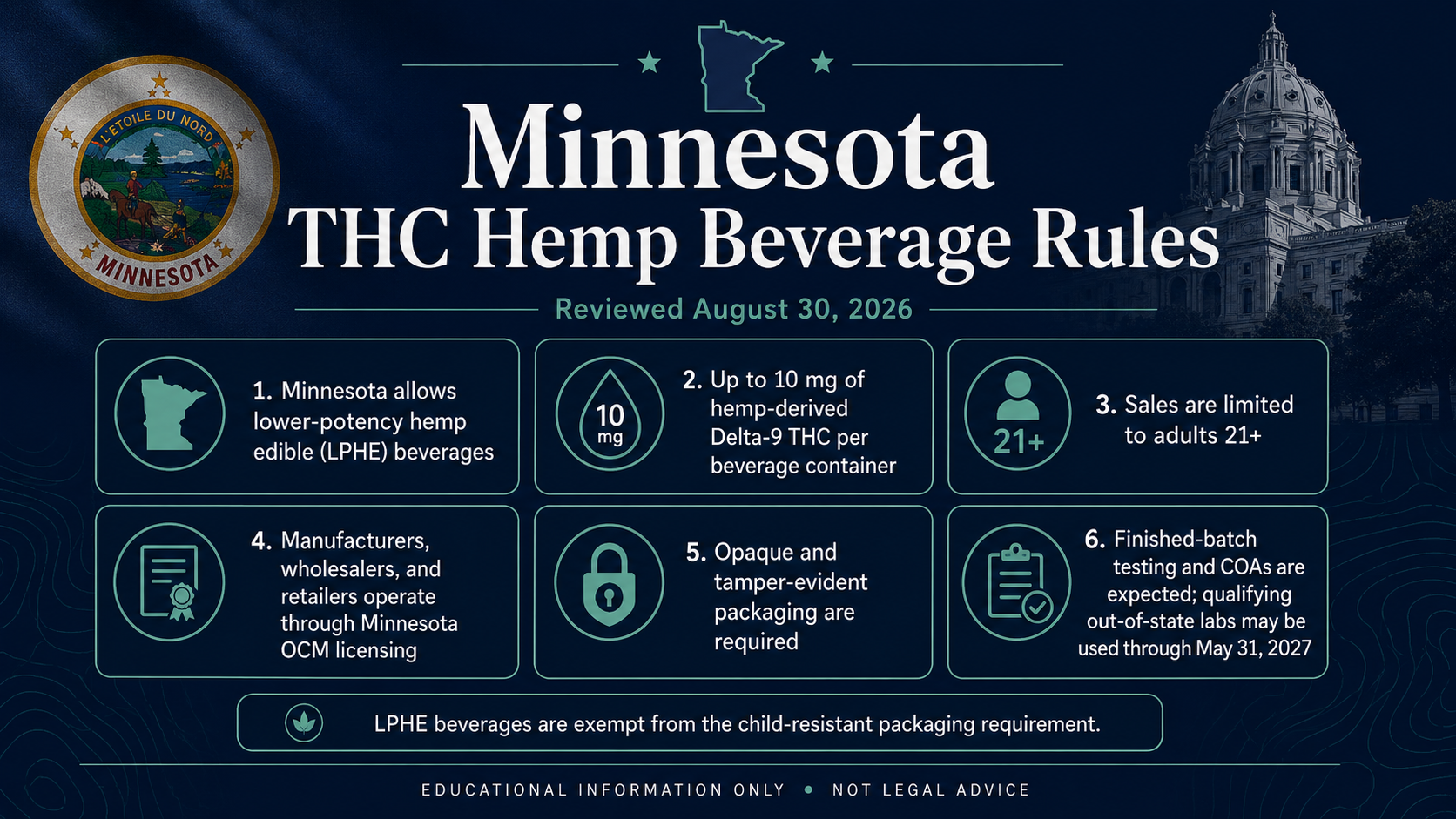
Minnesota currently allows hemp-derived THC beverages through its lower-potency hemp edible framework.
LPHE beverage businesses should also plan for batch testing, current packaging and labeling rules, and local retail registration where required.
Minnesota at a glance
Minnesota is one of the clearest examples of a mainstream low-dose hemp beverage market. The state treats these products as lower-potency hemp edibles (LPHEs) and regulates them through the Office of Cannabis Management (OCM).
Active LPHE beverage market
Minnesota has an established market for compliant hemp-derived THC beverages sold through licensed businesses.
10 mg per beverage container
Minnesota allows up to 10 mg of hemp-derived Delta-9 THC in a single beverage container.
21+ sales only
Lower-potency hemp edible products, including beverages, are limited to adult sales.
OCM licensing and compliance
Manufacturers, wholesalers, and retailers work through Minnesota's OCM licensing and product-compliance system.
Important note: This page is an educational summary of Minnesota's current LPHE beverage framework. It is not legal advice. Final legal conclusions should be confirmed with qualified counsel.
Important 2026 Minnesota updates
Minnesota's basic LPHE beverage framework remains in place, but several 2026 developments are important for businesses selling or launching beverages in the state.
Ongoing OCM licensing is now in effect
The transition period from the older registration system ended March 31, 2026. Since April 1, OCM has accepted ongoing license applications for lower-potency hemp edible manufacturers, wholesalers, and retailers.
Out-of-state labs may continue through May 31, 2027
Minnesota enacted a 2026 change allowing qualifying out-of-state labs to continue testing LPHE products through May 31, 2027, subject to OCM requirements.
Updated OCM guidance was published August 1
OCM released an updated LPHE packaging and labeling quick guide incorporating 2026 legislative changes. The current page should follow that more recent framework.
Hemp and cannabis licenses can now coexist
As of August 1, 2026, Minnesota allows a business to hold both a hemp license and a cannabis license at the same time when the ownership requirements are met.
What Minnesota allows now
Minnesota regulates hemp-derived THC beverages as lower-potency hemp edibles. For beverages, the most important practical rule is simple: a single beverage container may contain up to 10 mg of hemp-derived Delta-9 THC.
That has helped create a mature low-dose beverage market built around formats customers already understand, including 2.5 mg, 5 mg, and 10 mg beverages. Minnesota is not a dispensary-only market, but it is a licensed market with real compliance expectations.
Labeling rules
Minnesota labeling should be handled carefully. The label needs to clearly identify the product as a lower-potency hemp edible and include the information Minnesota requires.
Show the THC amount clearly
Labels should clearly show the cannabinoid content, serving information, total container potency, net contents, ingredients, and other required product details.
Use required symbols and warnings
Minnesota requires adult-use warnings and the applicable product symbol and labeling language for lower-potency hemp edibles.
Avoid disease or treatment claims
Labels and marketing should not make medical, disease, cure, treatment, or prevention claims.
Helpful distinction: Minnesota expects current test results to be available for review, but the state does not simply say that a beverage must use a QR-linked COA. Do not turn a helpful documentation practice into a claimed legal requirement unless the rule actually says it.
Packaging rules
Minnesota's packaging rules are more specific than many states. For beverages, the main points are clear and workable.
- Opaque packaging is required. The package should not allow the product to be seen through the container in a way that conflicts with Minnesota's LPHE packaging rules.
- Tamper-evident packaging is required. The product must show evidence if it has been opened or altered.
- LPHE beverages are exempt from the child-resistant packaging requirement. That exemption applies to beverages, but the other packaging and labeling rules still apply.
- The branding should be adult-oriented. Avoid packaging that is designed to appeal to children or that closely imitates familiar non-THC candy, snack, or beverage products.
Testing and COAs
Minnesota expects real finished-batch testing. Beverage brands should be prepared to support each product with testing documentation that matches the finished product actually being sold.
OCM's current technical authority addresses potency and safety testing and includes standards involving contaminants, homogeneity, and stability. Beverage sampling requirements were also updated in 2026.
Finished-product batch testing
The finished beverage should be supported by current testing that matches the actual SKU and batch being sold.
Keep batch records organized
Keep the COA, formula, lot records, and packaging details together so retailers and regulators can review a complete product file quickly.
Sales, licensing, and local registration
Minnesota is broader than a dispensary-only market, but that does not mean anyone can sell these products without the proper approvals. Manufacturers, wholesalers, and retailers operate through Minnesota's lower-potency hemp edible licensing system.
Retail businesses also need to pay attention to local requirements. OCM's licensing system is one layer, and local retail registration requirements can be another layer before sales begin.
Out-of-state brands should work carefully with Minnesota-ready partners so the imported beverage, documentation, and supply chain match current Minnesota rules.
Business takeaway: Minnesota is a real market for low-dose THC beverages. Brands that do well here usually show a clear THC amount, adult-oriented packaging, finished-batch testing, and a supply chain that is already set up for Minnesota's rules.
What this means for beverage brands
Minnesota is attractive because the rules are more developed than in many states. A business can look at the market and understand the basic limits, the licensing structure, and how compliant beverages are already being sold.
Stay within the 10 mg container limit
Build the beverage around a THC amount that clearly fits Minnesota's LPHE beverage rules.
Use Minnesota-ready labels
Use the current Minnesota packaging and labeling framework rather than assuming another state's approach will transfer cleanly.
Keep current testing on file
Make sure the finished-product testing and batch records are easy to review and share.
Work with the right partners
Manufacturing, distribution, and retail partners should understand Minnesota's LPHE framework before the product goes to market.
If you are evaluating Minnesota as part of a broader launch, you can also explore our compliance page, compare other states in our state resources hub, or learn more about production options on our beverage manufacturing page.
Minnesota sources used for this guide
- Minnesota OCM — Lower-Potency Hemp Edible Products
- Minnesota Statutes Chapter 342
- Minnesota Statutes 342.01 definitions
- Minnesota OCM — Hemp Business FAQ
- Minnesota OCM — Product Testing Technical Authority
- Minnesota OCM — LPHE Packaging and Labeling Quick Guide v2.0
- Minnesota OCM — March 27, 2026 lab-testing update
- Minnesota OCM — April 1, 2026 ongoing licensing announcement
Frequently asked questions
Planning a hemp beverage for Minnesota?
We can help with beverage type, THC amount, packaging, testing coordination, production, and scaling while you work through the Minnesota rules that apply to your launch.