

Maine THC Hemp Beverage Rules
Maine has one of the clearer state-law pathways for hemp-derived THC beverages, with an active in-state market and a defined 21+ rule for potentially intoxicating hemp products.
Maine treats qualifying hemp beverages separately from the state's adult-use and medical cannabis systems. Potentially intoxicating hemp products may not be sold to anyone under 21. Businesses making, selling, offering for sale, or serving ingestible hemp products still need the right food, eating-establishment, or liquor licensing. This page explains what is in force now, what Maine's 2025 state report says about the beverage market, and what the 2026 legislative session did and did not change.
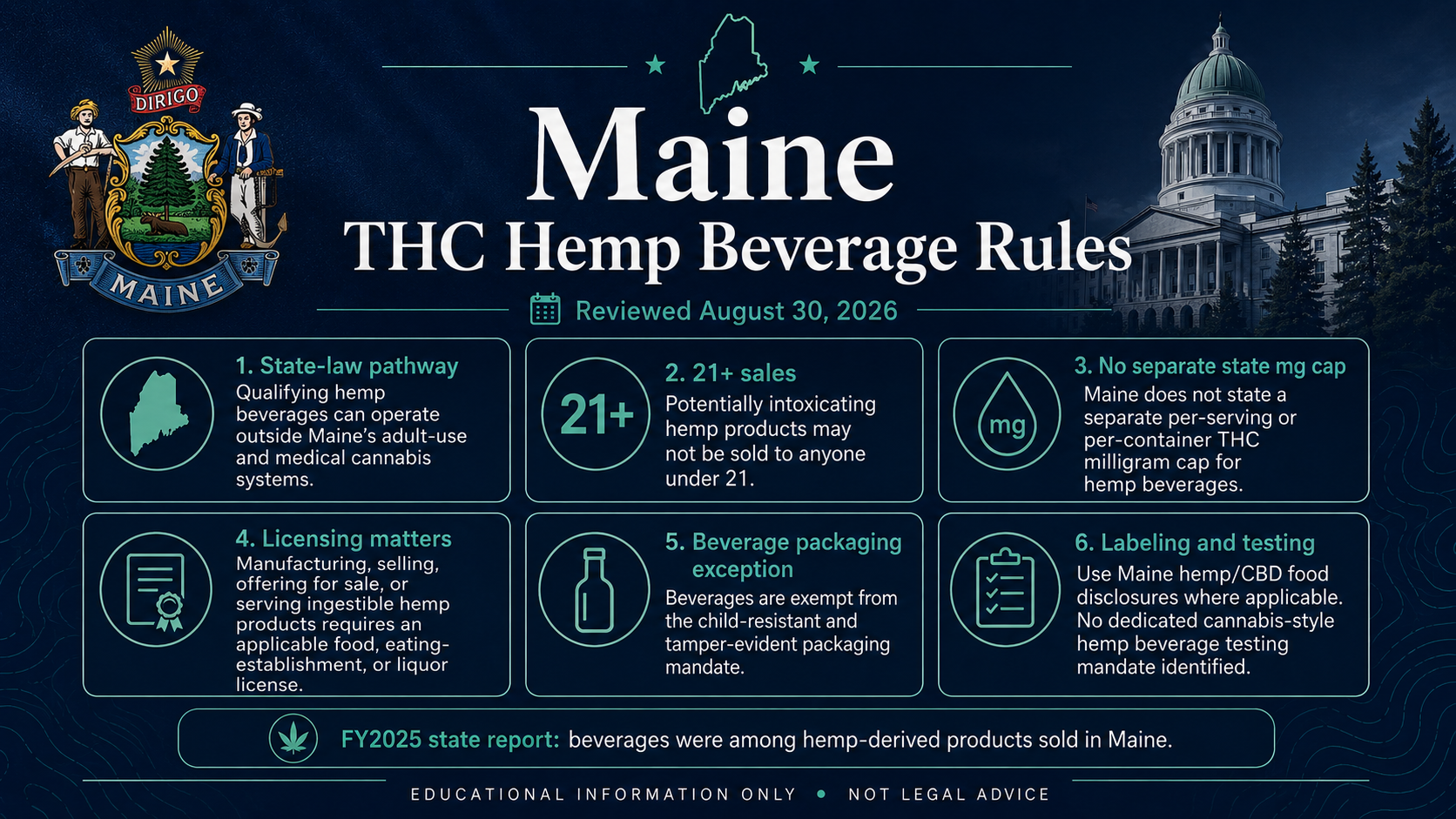
Maine allows qualifying hemp-derived THC beverages under state hemp law, separate from the adult-use and medical cannabis systems, but sales of potentially intoxicating hemp products are limited to adults 21+.
Maine's labeling rules still deserve product-specific review, especially because the food misbranding section is hemp/CBD oriented and not written as a simple universal THC beverage label template.
State beverage snapshot
Maine is best understood as an active, licensed-channel hemp beverage market with clearer adult-access and packaging rules than it had a year ago. The pathway is commercially useful, but the product and each business role still need to fit Maine’s hemp, food, and licensing framework.
State-law pathway
Qualifying hemp beverages can operate outside Maine’s adult-use and medical cannabis systems through applicable conventional licenses.
21+ for intoxicating products
A potentially intoxicating hemp product may not be sold to a person under 21.
No separate state mg cap
Maine does not state a hemp beverage milligram cap, but concentration and cannabinoid-ratio rules still shape classification.
License and label matter
Food, eating-establishment, or liquor licensing and Maine-specific food-label disclosures are part of the operating pathway.
Important note: We are not attorneys, and this page is not legal advice. It is an educational operating guide to Maine’s current market, product considerations, and commercial opportunity. Confirm final conclusions for your formula, license, and sales channel with qualified counsel and the relevant agency.
Current state of the market
Hemp beverages are part of Maine’s operating market, not merely a theoretical product category. The Maine State Hemp Program’s Fiscal Year 2024 report lists beverages among the hemp-derived products manufactured or sold within the state. Maine’s statute also expressly recognizes food, eating-establishment, and liquor-license pathways for businesses that manufacture, sell, offer, or serve ingestible hemp products.
That evidence supports a real commercial pathway, but it does not prove that Maine is one of the region’s largest markets or that every product found on a shelf is compliant. The same state report describes Maine’s broader hemp-growing market as relatively flat, with a small number of licensed growers. The strongest opportunity claim is therefore not market size. It is that Maine has an established legal structure, real beverage activity, and access to conventional retail and hospitality channels when the product and operator are properly configured.
For Maine retailers, breweries, restaurants, distributors, beverage companies, and founders, that creates room to test customer demand and establish accounts while the category is still developing. The advantage comes from building a product that buyers can understand and trust, not from treating the current framework as a loophole.
Current law and current operator reality
Maine’s hemp framework begins with 7 M.R.S. § 2231. The statute defines hemp to include qualifying final-form ingestible consumer products and separates hemp products from Maine’s medical and adult-use cannabis systems. It also says hemp and hemp-derived products may not be tracked as part of either cannabis program.
Public Law 2025, Chapter 416 added lists of “nonintoxicating cannabinoids” and “potentially intoxicating cannabinoids.” The potentially intoxicating list reaches beyond delta-9 THC to delta-8, delta-10, several THC isomers, hydrogenated cannabinoids such as HHC, synthetic forms, THC-O acetates, and certain analogs. Maine then defines a “potentially intoxicating hemp product” using both a final-form cannabinoid concentration test and a ratio of nonintoxicating to potentially intoxicating cannabinoids.
The definition is written as a negative two-part test: it addresses products that do not contain both less than 0.3% potentially intoxicating cannabinoids and a ratio greater than 10:1 of nonintoxicating to potentially intoxicating cannabinoids. The state has not published a beverage-specific measurement method or clear interpretive guidance explaining every application of that wording. A THC-forward drink should therefore not be treated as outside the 21+ rule merely because its delta-9 THC concentration appears below 0.3%.
Milligrams are not the whole test
A 2.5 mg, 5 mg, 10 mg, or 25 mg statement does not by itself establish compliance or determine product classification.
Treat intoxicating beverages as 21+
Maine prohibits sale of potentially intoxicating hemp products to people under 21. Use a serious ID-check process across applicable channels.
Use the correct license
Manufacturing, selling, offering, or serving ingestible hemp products requires an applicable food, eating-establishment, or liquor license.
Maine’s food-law protection for hemp foods is also important. It says food containing hemp may not be treated as adulterated, or prohibited within the state-based solely on the inclusion of hemp. That is meaningful state-law support for an intrastate food and beverage pathway. It is not blanket approval of every dose, ingredient, claim, manufacturing method, or interstate sale.
Labeling considerations
Maine’s label rules are more specific than the current page previously suggested. The general misbranding statute requires packaged foods to carry basics such as the responsible business, quantity of contents, common or usual product name, and ingredients. 22 M.R.S. § 2157(15) adds disclosures for foods containing hemp or hemp-derived CBD.
Depending on the product, the state-specific disclosures include a conspicuous statement that the product contains hemp or hemp-derived CBD, CBD content, the source of the hemp from which CBD was derived, and a statement that the product has not been tested or evaluated for safety. Extracts and tinctures have an additional batch-number provision. Because some of these requirements are written around CBD while the broader subsection also references hemp, a product-specific label review is important for a THC-forward beverage with little or no CBD.
Address Maine’s hemp disclosures
Do not rely on a generic national label. Review the Maine hemp-food disclosure language against the complete cannabinoid formula.
Include the conventional basics
Product identity, ingredients, net contents, and the responsible manufacturer, packer, or distributor remain part of the food-label baseline.
Avoid disease claims
Maine law does not allow food establishments to claim hemp foods diagnose, treat, cure, or prevent disease without federal approval.
Commercial advantage: Clear per-serving and per-container cannabinoid disclosure, a readable 21+ statement, lot identification, and easy access to a batch-specific COA can make a label easier for retailers and distributors to evaluate. Those voluntary elements should complement, not replace, the disclosures Maine actually requires.
Packaging considerations
Maine’s beverage packaging rule is unusually clear. Under Public Law 2025, Chapter 416, potentially intoxicating hemp products generally require child-resistant and tamper-evident packaging, but beverages, salves, and topical products are expressly excluded from that mandate.
The beverage exception does not eliminate all packaging duties. Every hemp product is prohibited from using labeling or packaging that violates federal trademark law or could cause a reasonable consumer to confuse it with a different trademarked product. A brand should avoid copycat soda, candy, snack, or children’s-product design even when a beverage can itself does not have to be child-resistant under this provision.
- Required by Chapter 416: Avoid trademark infringement and packaging likely to create reasonable consumer confusion.
- Express beverage exception: The chapter’s child-resistant and tamper-evident packaging mandate does not apply to beverages.
- Responsible brand practice: Use adult-oriented design, readable dose information, a 21+ statement, and clear visual separation from conventional drinks marketed to children.
This is a good example of regulation creating design clarity. A premium adult beverage can communicate what it is without mimicking familiar products or relying on youth-attractive imagery.
Testing and COA expectations
Maine has hemp-crop testing and a fully regulated testing structure for adult-use cannabis, but no dedicated cannabis-style finished-product batch-testing and tracking mandate was identified for hemp beverages sold through the general retail pathway. Those systems should not be blended together.
The absence of a dedicated hemp beverage testing program does not make an input COA enough. An emulsion or raw-material certificate cannot confirm the potency, homogeneity, contaminant profile, or stability of the finished beverage a customer will drink.
No general-retail cannabis testing system
Maine does not apply adult-use seed-to-sale tracking and mandatory cannabis-product testing to general-retail hemp beverages.
Test the finished beverage
Use batch-specific potency, cannabinoid-profile, heavy-metal, pesticide, microbial, and formulation-appropriate testing with lot traceability.
A strong documentation package connects cannabinoid inputs, formulation records, production lot, finished-product results, packaged inventory, and shipped product. A QR code or batch lookup is not identified as a Maine hemp beverage mandate, but it can reduce buyer friction and make quality information easier to access.
Sales and distribution realities
Maine law requires a person that manufactures, sells, offers for sale, or serves an ingestible hemp product to be licensed under one of several food, eating-establishment, or liquor statutes. That creates several possible commercial lanes, but it does not mean every license authorizes every activity.
Fit the food pathway
Confirm the facility license, ingredient records, formula, label, production controls, and finished-product documentation.
Train for 21+ sales
Use reliable ID checks, controlled product placement, staff training, and a process for reviewing labels and COAs.
Confirm the service privilege
Title 7 recognizes eating-establishment and liquor-license routes, but the precise license, premises, and service model still matter.
Do not assume blanket approval
Maine’s intrastate framework does not settle carrier rules, age verification, destination-state law, or federal interstate food-law issues.
A restaurant or bar should not assume that selling a sealed nonalcoholic hemp beverage, serving it by the glass, operating a tasting, and mixing THC into an alcoholic drink are legally interchangeable. Maine recognizes Title 28-A licensure as one possible route for ingestible hemp products, but the exact privilege and premises rules should be confirmed for the proposed service model.
Maine’s hemp, adult-use cannabis, and medical cannabis pathways also remain separate. A business with a cannabis license should not assume that hemp inventory can be placed into cannabis tracking or that cannabis-program privileges automatically control a general-retail hemp beverage.
Practical commercial read: Start with the business role and sales channel, then work backward into formula, dose, label, packaging, testing, and production. A product designed for a licensed retailer may need a different operating plan from one intended for restaurant service or a multi-state online launch.
Legislative status and future direction
Federal rules are also evolving. A pending federal effective date could materially change how hemp products are defined, while implementation questions, legislative activity, and industry advocacy remain active. Rather than repeat that changing analysis on every state page, we maintain current developments in the Section 781 Hemp Deadline Tracker.
Our perspective: Maine’s current structure gives responsible operators an opportunity to build customer demand and retailer relationships through established beverage channels. We expect regulation to become more defined around adult access, testing, labeling, packaging, and distribution. In our view, brands that build credible quality systems now may be better positioned as the category matures. That is a market perspective, not a guarantee of any future legal outcome.
What this means for Maine operators
Maine can be workable for a hemp-derived THC beverage, but the strongest starting point is not simply choosing a dose and ordering cans. The practical path is to connect the customer, product classification, license, label, testing plan, and sales channel before production begins.
Define the customer and channel
A retailer, brewery, restaurant, distributor, and online brand may require different license, service, and documentation decisions.
Classify the complete formula
Review all potentially intoxicating and nonintoxicating cannabinoids. Do not use milligrams alone as the compliance test.
Build a Maine-ready label
Combine general food-label requirements, state hemp disclosures, adult positioning, and accurate dose information.
Scope production and proof
Evaluate formulation, MOQ, packaging, finished-product testing, COAs, pricing, and production timing through a quote request.
A moderate dose may be commercially useful for a social beverage, but Maine does not make a universal 5 mg or 10 mg format “future-proof.” The right product depends on the intended customer, complete cannabinoid profile, business license, channel, and broader state plan.
Keep the broader strategy in view
If Maine is one part of a regional launch, compare other markets in the State Resources hub, review our broader compliance guidance, explore THC beverage formulation, and see how production planning works on our beverage manufacturing page. Once the customer, channel, and product direction are clear, a quote request can help scope the production path.
Primary sources and monitoring links
- 7 M.R.S. § 2231 — Maine hemp definitions, licensing, age, packaging, and tracking separation
- LD 1920 / Public Law 2025, Chapter 416 — official status and enacted chapter
- 22 M.R.S. § 2157 — Maine food-misbranding and hemp-label disclosures
- 22 M.R.S. § 2158-A — foods containing hemp not adulterated solely because of hemp
- Maine State Hemp Program Fiscal Year 2024 annual report
- LD 1983 official status — Leave to Withdraw
- LD 1942 official status — Died on Adjournment
- FDA regulation of cannabis and cannabis-derived products
- Maine State Hemp Program Annual Report — Fiscal Year 2025 (April 2026)
- Maine hemp statute — current definitions, 21+ sales rule, and licensing references
- Maine food misbranding statute — hemp/CBD disclosure requirements
Frequently asked questions
Planning a hemp beverage for Maine?
We can help with beverage type, dose, packaging, testing coordination, production, and scaling while you work through the Maine requirements that apply to your launch.