

Florida THC beverage laws for hemp-derived Delta-9 drinks
Florida remains one of the larger U.S. markets where compliant hemp-derived Delta-9 beverages can currently be sold, especially low-dose drinks with clear testing, labeling, and adult-focused packaging.
Florida measures total Delta-9 THC using the finished product’s wet weight and does not currently set a state milligram cap per can. Brands still need to pay close attention to COAs, QR-code access, child-resistant packaging, color additives, 21+ sales, and rules against products that are attractive to children.
Research reviewed and verified August 29, 2026.
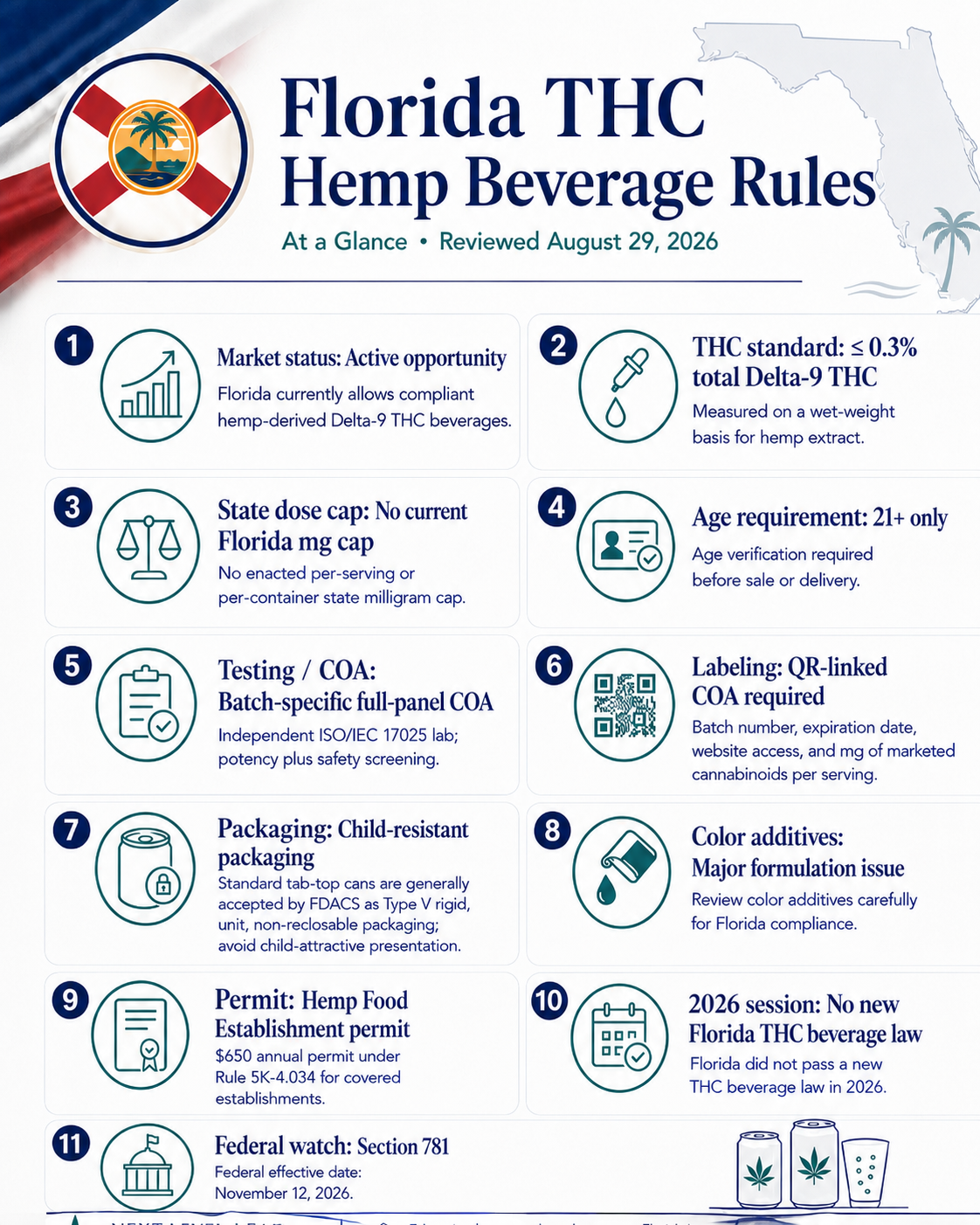
Yes. Hemp-derived Delta-9 THC beverages can currently be sold in Florida if they meet the state’s hemp extract rules. The finished beverage must stay at or below 0.3% total Delta-9 THC on a wet-weight basis, have the required batch-specific COA and QR or barcode access, use compliant packaging, avoid prohibited color additives and child-attractive presentation, and be sold only to adults 21 and older. Florida does not currently set a state milligram cap per can.
State beverage snapshot
Florida is an active market for hemp-derived THC beverages, but enforcement is also active. Products should be handled like other regulated food-and-beverage products, with complete testing, clear labels, compliant packaging, and adult-focused branding.
Active opportunity
Florida remains a meaningful market for hemp-derived Delta-9 beverages when products meet the state’s hemp extract, food, age, COA, and packaging rules.
Wet-weight advantage
Florida measures hemp extract at 0.3% total Delta-9 THC on a wet-weight basis, which is generally favorable for finished beverages.
No state mg cap
Florida does not currently set a state-specific milligram cap per serving or container for hemp-derived THC beverages.
Packaging, COAs, and age controls
The biggest practical issues are batch-specific COAs, working QR-code access, accurate labels, child-resistant packaging, color additives, and 21+ sales.
Important note: We are not attorneys, and this page is not legal advice. This is a practical guide for beverage brands, retailers, distributors, and other businesses evaluating hemp-derived THC beverages in Florida. Final legal conclusions should be confirmed with qualified counsel.
Current state of the Florida THC beverage market
Florida is one of the most commercially relevant hemp-derived THC beverage markets in the Southeast. It has a large adult consumer base, strong tourism, a developed hemp retail ecosystem, and a meaningful adult-beverage culture. That makes Florida attractive for low-dose THC seltzers, teas, sodas, lemonades, coffees, mocktail-style beverages, and other alcohol-alternative formats.
Florida is also an enforcement-active market. The Florida Department of Agriculture and Consumer Services has focused heavily on hemp products that mimic candy, target minors, use child-attractive presentation, fail labeling standards, or lack proper COA access. FDACS reported that it had uncovered more than 726,000 packages of hemp products targeting children since July 1, 2023, and its earlier statewide sweeps covered more than 700 businesses in all 67 counties.
For beverage brands, the takeaway is straightforward: use adult-focused branding, keep the required documentation complete, and avoid novelty presentation that could attract children.
What Florida law currently requires
Florida regulates hemp extract through Florida Statutes section 581.217 and FDACS Rule 5K-4.034. Hemp extract includes ingestible cannabinoid-containing substances derived from or containing hemp, and products intended for people to consume are also subject to Florida’s food rules.
For beverages, the key THC rule is the finished-product concentration limit. Hemp extract may not exceed 0.3% total Delta-9 THC on a wet-weight basis. Rule 5K-4.034 defines total Delta-9 THC as Delta-9 THC plus 0.877 times THCA.
Florida does not currently impose a state-specific THC milligram cap per beverage, per serving, or per package. Proposed caps and beverage restrictions have been introduced in recent sessions, but they should not be treated as current law unless enacted.
2026 Florida session note: Florida did not pass a new THC beverage law in the 2026 session. Federal Section 781 is a separate change to watch. It is discussed below and tracked on our Section 781 Hemp Deadline Tracker.
Why Florida’s wet-weight rule matters for beverages
Florida bases the 0.3% calculation on the weight of the finished product, including the liquid. Because a beverage contains hundreds of grams of liquid, a typical 5mg or 10mg dose represents a very small percentage of the finished product’s total weight.
A typical 5mg or 10mg beverage sits far below Florida’s 0.3% wet-weight threshold when properly formulated and tested. That does not mean higher-dose products are automatically appropriate. It simply means the 0.3% concentration limit is not usually the main issue for ordinary low-dose beverages.
For most beverage brands, the THC percentage is not the difficult part. The practical work is making sure the COA, label, QR-code access, packaging, color ingredients, source documentation, and 21+ sales requirements are handled correctly.
Labeling considerations
Florida labels need to do more than show the THC dose. The package should make it easy for a consumer, retailer, or inspector to identify the batch and reach the matching certificate of analysis.
The package must include a scannable barcode or QR code linked to the certificate of analysis for the hemp extract batch.
The package must include the batch number and the internet address of a website where batch information may be obtained.
The package must include the expiration date, and QR or barcode access must remain operational for at least 90 days after expiration.
The label must state the number of milligrams of each marketed cannabinoid per serving when cannabinoids are marketed.
Rule 5K-4.034 requires serving size, servings per container, and net contents in both SI and U.S. customary units.
The label must conspicuously identify the name and place of business of the processor, packer, or distributor.
Make the required information easy to find: Dose, serving size, batch number, COA access, expiration date, net contents, and business information should be clear on the package and easy to match to the correct product batch.
Packaging and color-additive considerations
Packaging is one of the most important Florida-specific issues for THC beverages. Florida requires hemp extract products to be sold in containers suitable for human consumption, designed to minimize light exposure, able to mitigate exposure to high temperatures, not attractive to children, and compliant with the Poison Prevention Packaging Act.
FDACS has also clarified an important beverage question: standard aluminum beverage cans with tab tops generally meet ASTM D3475-20 as Type V rigid, unit, non-reclosable packaging. However, modifications that make cans easier to open may affect compliance and should be reviewed before production.
FDACS uses the term “immediate packaging” for the package that directly contains the product. For a beverage, that is typically the can or bottle itself. In a July 29, 2025 notice, FDACS said a business cannot take a non-compliant container and fix the problem simply by placing it inside a child-resistant bag, box, or other outer package at the point of sale. The primary container itself must meet the applicable packaging standard.
Standard cans generally work
FDACS has said ordinary tab-top cans generally satisfy the relevant Type V non-reclosable classification, but the final retail package should still be reviewed.
The can or bottle has to comply
If the can or bottle itself does not meet Florida’s packaging requirements, putting it inside a child-resistant outer package does not fix the problem.
Keep it clearly adult
Avoid cartoons, candy mimicry, youth-oriented names, copycat snack cues, and packaging that could be viewed as attractive to children.
Color additives are a real Florida formulation issue
Florida defines “attractive to children” to include products containing any color additives. Rule 5K-4.034 also prohibits many substances when used as color additives in hemp or hemp extract intended for human consumption, including both synthetic dyes and several natural colorants.
This is especially important for sodas, lemonades, juices, mocktails, and brightly colored functional beverages. A color ingredient is not automatically acceptable in Florida simply because it is described as natural. Clear seltzers, coffees, teas, and beverages where the color comes incidentally from the base ingredient may be easier to evaluate, but every Florida-bound formula should still be reviewed before production.
Testing and COA expectations
A potency result alone is not enough in Florida. Hemp extract sold or distributed in the state must be supported by a certificate of analysis from an independent ISO/IEC 17025-accredited laboratory. The COA should match the tested batch and include the information Florida requires for total Delta-9 THC, contaminants, laboratory details, and required pathogen testing.
Match the COA to the product
The batch number on the beverage should connect clearly to the correct COA and lab results reached through the QR code or barcode.
Show the THC calculation clearly
For Florida-bound products, the COA should make it easy to confirm compliance with the 0.3% wet-weight standard, such as by reporting percent by weight, mg/g, or both.
The COA link also needs to work in practice. Florida requires the QR code or scannable barcode to reach the required COA within three or fewer steps and to remain operational for at least 90 days after the product expiration date.
Permits, approved sources, and out-of-state manufacturing
Rule 5K-4.034 requires establishments distributing products consisting of or containing hemp or hemp extract intended for human consumption to be permitted as Hemp Food Establishments, and it lists a $650 annual Hemp Food Establishment permit fee.
For ingestion products, the product must be processed or manufactured by an approved source. The hemp food establishment must be able to provide a valid food license or permit and the most recent food safety or health inspection report from the approved source to FDACS upon request.
A hemp beverage can be manufactured outside Florida, but the product still needs to meet Florida requirements for labels, COAs, packaging, source documentation, and facility records. Florida businesses that sell, hold, distribute, or retail the product should confirm which permits apply to their specific business and regulatory agency.
Where Florida hemp THC beverages can be sold
Florida does not currently require compliant hemp-derived THC beverages to be sold through medical marijuana dispensaries. Marijuana-derived products remain in the medical marijuana system, while hemp-derived beverages are regulated under the state’s hemp extract and food rules.
Florida also did not adopt a liquor-license-only THC beverage model in 2026. HB 801 would have created a special Division of Alcoholic Beverages and Tobacco license for retail sale of THC-infused beverages, and SB 1678 would have limited qualifying sales to certain alcoholic-beverage license holders. Both died in committee on March 13, 2026.
That leaves room for sales outside dispensaries when the seller is properly permitted and the product meets Florida requirements. Depending on the business and permit structure, relevant channels may include hemp retailers, smoke shops, convenience stores, specialty beverage stores, liquor-adjacent retail, and online sales. Sellers still need the applicable age-verification, COA, documentation, and establishment requirements.
Selling sealed cans or bottles at retail is a clearer use case under Florida’s current hemp rules. Bars, restaurants, and alcohol-licensed venues should get Florida-specific legal guidance before mixing THC beverages, serving them on premise, or allowing on-premise consumption.
Delta-8, converted cannabinoids, and minor cannabinoids
Florida did not enact the broad Delta-8 or minor-cannabinoid bans proposed in recent bills. However, it would be too broad to say that every Delta-8, Delta-10, HHC, THC-O, THCP, or converted cannabinoid product is clearly legal in Florida.
Florida hemp extract may not contain controlled substances, and Rule 5K-4.034 defines synthetic cannabinoid by reference to Florida’s controlled-substance schedule. Legality can depend on the specific compound, source, manufacturing process, chemical classification, and whether the product contains a controlled substance or prohibited synthetic cannabinoid.
For most beverage brands, the simpler Florida approach is a straightforward hemp-derived Delta-9 THC beverage with clear sourcing records, adult-focused packaging, and complete finished-product testing.
What could change next
The possibility of future changes does not remove the need to follow Florida’s current rules. If you are developing a beverage now, focus on the requirements that already apply and keep watching both Florida and federal developments.
What this means if you are launching or selling in Florida
If you want to launch or sell a hemp-derived THC beverage in Florida, start with the requirements the state is already enforcing: COAs, working QR-code access, compliant packaging, rules against child-attractive products, color additives, age verification, and clear adult-focused presentation.
Low-dose Delta-9 is a straightforward starting point
5mg and 10mg hemp-derived Delta-9 beverages are far below Florida’s wet-weight concentration ceiling when formulated and tested correctly.
Review color early
Florida’s color-additive rules can affect sodas, lemonades, juices, and mocktails before the label is even designed.
Make COAs easy
The QR path, batch number, expiration date, and COA should line up cleanly for retailers, consumers, and inspectors.
Keep the product clearly adult-focused
Use clear THC disclosure and responsible packaging that does not rely on cartoons, candy mimicry, or other child-attractive cues.
A stronger approach is to build a professional adult beverage with complete documentation, clear labeling, careful ingredient choices, and packaging that can stand up to retailer and regulatory review.
More resources for a Florida beverage launch
If Florida is one part of a larger launch, you can review our compliance resources, compare other markets in our state resources hub, follow the Section 781 Hemp Deadline Tracker, or learn more about developing and producing a beverage on our beverage manufacturing page.
Primary sources reviewed
We built this guide from Florida’s statute, FDACS rule language, FDACS enforcement guidance, and Florida Senate bill records. These links are provided so you can review the source material directly and see how the information on this page was verified.
State Hemp Program statute covering wet-weight hemp extract, COAs, labels, packaging, age limits, and stop-sale authority.
Official Florida Administrative Code rule for hemp extract intended for human consumption, including the latest adopted version and rule history.
FDACS enforcement notice covering amended rule enforcement, can packaging clarification, color additives, and enforcement history.
Notice to Hemp Food Establishments explaining that a non-compliant primary container cannot be corrected simply by adding child-resistant outer packaging.
2026 THC-infused beverage proposal and related House bill records showing the alcohol-channel model did not become law.
Public Law 119-37 containing the federal hemp-definition changes that take effect 365 days after enactment.
Frequently asked questions
Developing a hemp-derived THC beverage for Florida?
We can help with the beverage itself, including formula selection or development, THC dose, flavor, packaging choices, testing and COA coordination, production, and scaling. Florida-specific legal review should be handled by qualified counsel.
Want to see more Next Level Leaf Florida hemp updates in Google?
Add Next Level Leaf as a Preferred Source so our newest Florida hemp beverage, compliance, and market updates are easier to find in supported Google Search and AI experiences.
Your Google source preferences stay under your control and can be changed at any time.