White-label infused & functional beverage manufacturing
Built for brands, visionaries, and industry leaders.
Federal hemp law • Verified tracker • Updated August 16, 2026

The November 12, 2026 Federal Hemp Definition Deadline Tracker

Section 781 takes effect November 12, 2026.
August 16 tracker update: H.R. 10079, the Beverage Regulatory Parity Act, was introduced August 10 by Reps. Beth Van Duyne and Greg Landsman and referred to the House Energy and Commerce and Ways and Means Committees. It remains proposed legislation while November 12 remains current law. The Senate has passed a one-month extension in H.R. 6500, supported by OMB as a whole, but House approval and presidential signature remain required.

Track the enacted federal definition change, verified congressional proposals, official administration activity, FDA publication status, and practical implications for hemp beverage brands.

This page separates enacted law from pending legislation, agency activity, and Next Level Leaf editorial analysis. Unverified developments are not published.

Last reviewed:  •  Last content update:  •  Latest substantive development tracked: . Maintained by Next Level Leaf, a hemp beverage manufacturing and regulatory information resource. This page is informational and strategic in nature and is not legal advice.

Quick answer: Section 781 remains enacted law, and November 12, 2026 remains the operative federal effective date. The Senate has passed a continuing resolution (H.R. 6500) 90–6 that keeps a one-month Section 781 hemp extension intact, but House approval and presidential signature are still required. The Administration officially supports the Senate Amendment to H.R. 6500 as a whole. Separately, H.R. 10079, the Beverage Regulatory Parity Act, was introduced August 10, 2026, by Reps. Beth Van Duyne and Greg Landsman and referred to the House Energy and Commerce and Ways and Means Committees. H.R. 10079 is proposed legislation, not current law.

Current Federal Status • Updated August 16, 2026

November 12 remains current law as a new beverage-specific federal framework emerges

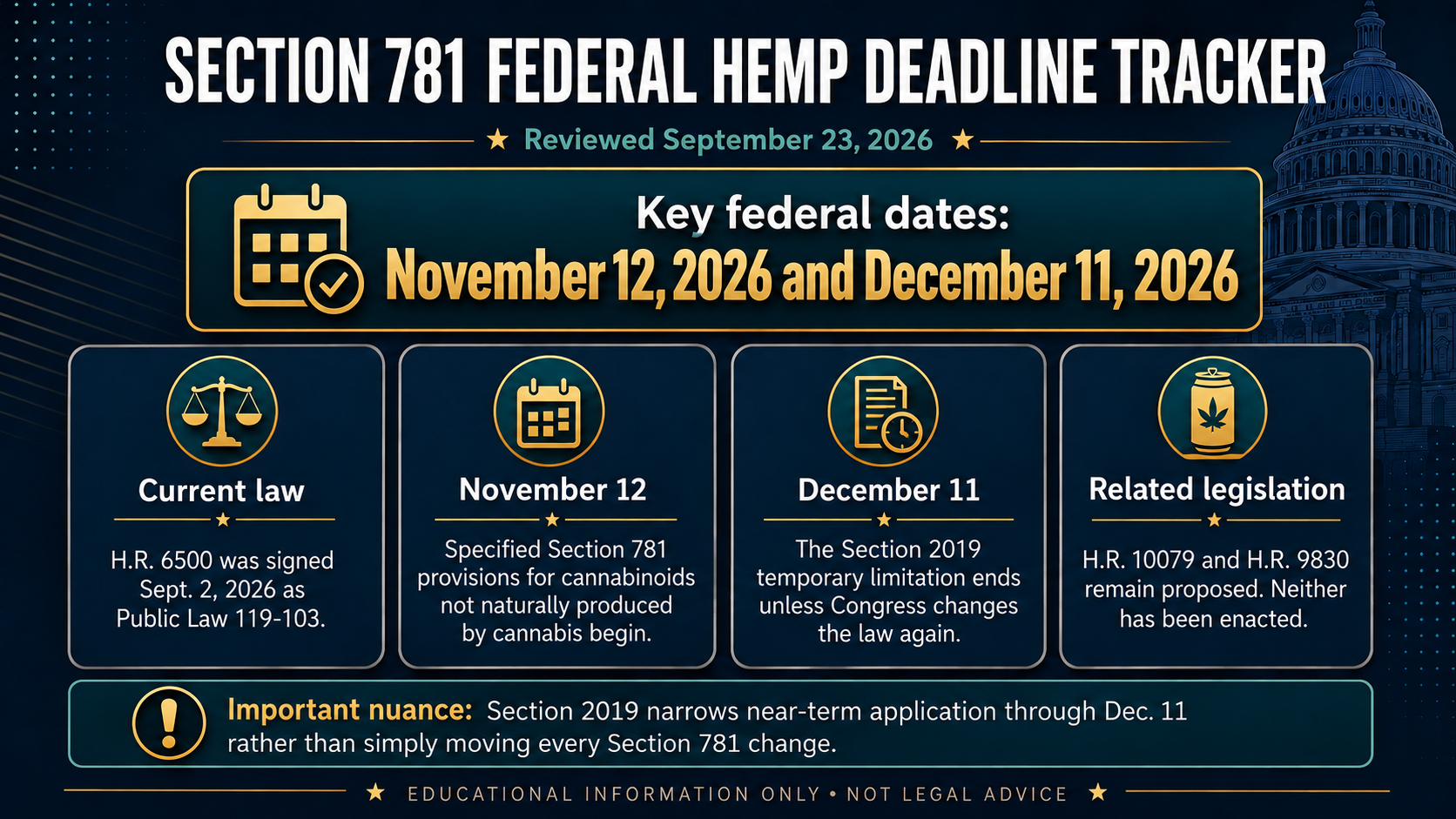
As of August 16, 2026: Section 781 remains enacted law and November 12, 2026 remains the operative federal effective date. No statutory change has yet taken effect.

Senate continuing resolution extension status: The U.S. Senate passed a short-term government funding measure (H.R. 6500) by a 90–6 vote, retaining language that would delay most Section 781 hemp restrictions until December 11, 2026. Senator Ted Budd's effort to remove the delay was turned aside by the Senate. However, the House has not yet approved the Senate version, and the President has not signed it.

Administration position: On August 3, 2026, the Office of Management and Budget (OMB) issued a Statement of Administration Policy (SAP) stating that the Administration supports the Senate Amendment to H.R. 6500 as a whole and that senior advisers would recommend presidential signature if presented in its current form. Important qualification: The OMB SAP supports the Senate amendment as a whole and does not separately address or endorse the hemp extension or Section 2019.

August 10 Beverage Regulatory Parity Act development: H.R. 10079 was introduced by Reps. Beth Van Duyne and Greg Landsman on August 10, 2026, and referred to the House Energy and Commerce and Ways and Means Committees. The proposal would establish a dedicated federal regulatory pathway for qualifying hemp-derived beverages. This is proposed legislation, not enacted law.

Current legal effect: November 12, 2026 remains the operative federal deadline today. Brands should continue tracking House action and presidential signature on the continuing resolution while monitoring the Beverage Regulatory Parity Act as a separate potential long-term framework.

August 8 Development • Senate Rejected Removal Effort

Senator Budd's effort to strip the hemp extension was turned aside

Senator Ted Budd had opposed the temporary hemp delay and sought to remove it from the continuing resolution. That effort did not succeed before Senate passage.

1

Budd opposed the delay

Budd argued that delaying the Section 781 restrictions would prolong risks associated with intoxicating hemp products, especially products marketed in ways that may appeal to children.

2

The Senate kept the extension

The Associated Press reports that Budd tried to strip the hemp delay from the bill, but the Senate turned aside his effort.

3

Final Senate passage was 90–6

The continuing resolution then passed the Senate with broad bipartisan support while retaining the one-month hemp delay.

4

The fight is not fully over

The House still must approve the Senate measure. Changes during House consideration or any later legislative compromise could still affect the final hemp language.

5

Presidential signature still required

Even after House approval, the extension does not change current law until the President signs the final legislation.

6

November 12 remains today's legal date

Until the remaining legislative steps occur, brands should not treat December 11 as legally guaranteed.

Practical implication: the principal Senate-side threat to the one-month extension has been overcome. The next decisive question is whether the House accepts the Senate measure with the hemp delay intact.

Status note: the August 8 passage and the Senate's rejection of Budd's removal effort are confirmed by current Associated Press reporting. The tracker will update again when House action or presidential signature occurs.
Senate-Passed Extension • House Approval Still Required

What the Senate-passed December 11 extension would do

The Senate has now passed the one-month extension as part of its continuing resolution. The extension still requires House approval and presidential signature. The operative details below remain grounded in the Senate Appropriations Committee's August 2 Section 2019 text, which is the public text that describes how the temporary relief works.

Administration position & qualification: On August 3, OMB issued a Statement of Administration Policy supporting the Senate Amendment to H.R. 6500 and stating that senior advisers would recommend presidential signature if the measure is presented in its current form. The statement supports the Senate amendment as a whole and does not separately address the hemp extension or Section 2019.

1

Keep November 12 as a limited synthetic-cannabinoid date

On November 12, the Section 781 exclusions would apply to intermediate and final products containing cannabinoids that cannot be naturally produced by cannabis.

2

Postpone most other changes until December 11

For other covered products, the proposal would delay the broader Section 781 definition change until the CR expires on December 11, 2026.

3

Temporarily defer the 0.4 mg container threshold

The per-container restriction for finished hemp-derived cannabinoid products would not begin applying to the broader product category until December 11 if the proposal is enacted.

4

Temporarily defer the out-of-plant synthesis exclusion

The separate exclusion for cannabinoids capable of natural production but synthesized or manufactured outside the plant would also be postponed for the temporary period.

5

Preserve state and FDA questions

The proposal would not establish FDA authorization, override state restrictions, approve a formulation, or create a complete national regulatory pathway.

6

Expire with the funding measure

The extension would end December 11 unless Congress enacts another delay, replacement framework, or other intervening change.

Practical beverage implication: a conventional hemp-derived delta-9 beverage using a cannabinoid capable of natural production could retain the current federal hemp-definition pathway for approximately one additional month if the Senate language is enacted. Product derivation, FDA requirements, state law, testing, and other rules would still require separate review.

Why the House and Senate versions must be tracked separately

The House previously passed a different continuing resolution that funds the government through December 4 and does not contain the same Section 781 extension. The Senate has now passed its own measure through December 11 with the hemp delay intact. Because the chambers have approved different language, the House must still accept the Senate measure or the differences must otherwise be resolved before the legislation can reach the President.

August 8 Senate result: Senator Ted Budd tried to remove the one-month hemp delay, but the Senate turned aside his effort. The Senate-passed funding measure retains the extension.

Legal-status note: the Senate has passed the extension, but it has not yet been enacted. The House must approve the Senate measure and the President must sign it before current law changes.
New Beverage-Specific Federal Legislation • Introduced August 10, 2026

What the Beverage Regulatory Parity Act would mean for hemp beverages

H.R. 10079, the bipartisan Beverage Regulatory Parity Act, was introduced by Reps. Beth Van Duyne and Greg Landsman on August 10, 2026, and referred to the House Energy and Commerce and Ways and Means Committees. The proposal would create a dedicated federal regulatory pathway for qualifying hemp-derived cannabinoid beverages. It is proposed legislation, not current law.

1

Section 781 beverage carveout

The draft expressly provides that Section 781's per-container intoxicating-cannabinoid limit would not apply to a hemp-derived beverage that complies with the bill's serving requirements.

2

Protected intermediate materials

The draft provides a protected manufacturing pathway for qualifying intermediate hemp-derived cannabinoid materials used to manufacture compliant beverages, subject to specified conditions.

3

5 mg intoxicating THC per serving

The draft defines a qualifying hemp-derived beverage as containing no more than 5 mg of total intoxicating tetrahydrocannabinol content per serving.

4

Separate 5 mg non-THC cannabinoid clause

H.R. 10079 as introduced separately states that the beverage may not contain more than 5 mg of non-tetrahydrocannabinol naturally occurring cannabinoids. In the bill text, the words "per serving" appear with the 5 mg intoxicating-THC limit but are not attached to this separate non-THC cannabinoid clause—a drafting distinction particularly relevant to CBD and CBG formulations.

5

Three-tier distribution & TTB permitting

The proposal includes TTB-related manufacturer and wholesaler permits, a three-tier manufacturer → wholesaler → retailer distribution structure, and federal manufacturing and testing requirements.

6

Age 21 & federal labeling controls

The draft creates nationwide age-21 requirements, federal labeling and advertising standards, and product safety controls.

7

Synthetic cannabinoids & formulation provisions

The draft restricts synthetically derived cannabinoids and includes an adulteration provision addressing added substances (such as alcohol, caffeine, tobacco, nicotine, or melatonin) when, as determined by the Secretary, combined with cannabinoids could interact with or alter/enhance cannabinoid effects in a harmful manner.

8

Proposed $0.08/mg federal excise tax

The proposal imposes a federal excise tax of $0.08 per milligram of intoxicating THC on compliant hemp-derived beverages.

Proposed tax calculation: 5 mg × $0.08 = $0.40 proposed federal excise tax per 5 mg beverage. Make no mistake: this tax is proposed legislation, not current federal law.

Legal-status note: H.R. 10079, the Beverage Regulatory Parity Act, is proposed legislation and has no legal effect unless enacted into law. State laws and local regulations would still require separate compliance review.
July 29 Development • Circulating Draft

What the circulated Comer hemp draft would do

Marijuana Moment reported on July 29 that Rep. James Comer is circulating a seven-page hemp proposal and published the document through DocumentCloud. As of the August 3 review, the draft had not been formally introduced, assigned a bill number, referred to a committee, or publicly confirmed through an official Comer press release. The provisions below describe the published draft, not current law.

1

Delay tied to overdue FDA work

The draft would prevent Section 781 from taking effect until one year after FDA publishes the cannabinoid lists and guidance on the meaning of “container” required by Public Law 119-37. FDA was directed to complete that work within 90 days of enactment.

2

National age-21 rule

Consumable hemp cannabinoid products could not be sold to people under 21.

3

Domestic cultivation and processing

Covered products would have to be derived exclusively from hemp cultivated and processed in the United States.

4

Plant-capable cannabinoids only

Consumable products could contain only cannabinoids capable of being naturally produced by the cannabis plant, narrowing the pathway for synthetic or artificially modified compounds.

5

Manufacturing and testing rules

HHS would be directed to establish uniform manufacturing and testing standards, including independent laboratory testing and good manufacturing practices.

6

Packaging, labels, and QR results

The draft would address child-resistant packaging, youth-oriented or imitation branding, and QR codes linking consumers to laboratory results.

Why the delay mechanism matters: because FDA has not yet completed the required lists and container guidance, tying implementation to that work could move the operative date substantially beyond November 12, 2026 if the proposal were introduced and enacted. The draft does not itself establish a permanent federal milligram limit for beverages.

How it differs from H.R. 9830

H.R. 9830 is a formally introduced, comprehensive replacement framework with FDA, Treasury, and TTB responsibilities, federal beverage taxes, permits, and a three-tier distribution system. The Comer draft is shorter and functions primarily as a delay-and-baseline-regulation proposal. The two should not be described as the same bill or combined into one legislative status.

Source status: the draft was obtained and published by Marijuana Moment through DocumentCloud. NLL has not located an official sponsor release, bill number, Congress.gov record, or committee filing as of August 3, 2026.
Introduced Federal Legislation • H.R. 9830

What the bipartisan Lawful Hemp Protection Act would change

Rep. Andy Barr introduced H.R. 9830 on July 22, 2026, with Rep. Angie Craig as its cosponsor. The bill was referred to the House Committees on Ways and Means, Energy and Commerce, Agriculture, and Transportation and Infrastructure. It remains at the introduced stage. The points below describe what H.R. 9830 would do if enacted; they are not current requirements.

1

Repeal Section 781 and redefine hemp

The bill would expressly repeal Section 781 and define hemp using no more than 1 percent total tetrahydrocannabinol, including THCA, on a dry-weight basis. It would separately protect unfinished hemp-cannabinoid ingredients moving between permitted supply-chain participants.

2

Create an FDA-regulated product pathway

Covered hemp-derived cannabinoid products would be treated as food under the Federal Food, Drug, and Cosmetic Act, with an express category for hemp-derived cannabinoid dietary supplements. HHS would establish cannabinoid limits through notice-and-comment rulemaking within 12 months.

3

Use interim serving limits if rulemaking is late

If federal limits are not established within 12 months, the bill would default to 5 mg total THC per serving for oral products and 50 mg per serving for inhalable and topical products until alternative limits are adopted.

4

Require adult sales and a U.S. supply chain

The proposal would prohibit sale, possession, or consumption by people under 21 and require products entering interstate commerce to come exclusively from hemp cultivated, processed, finished, packaged, and labeled in the United States.

5

Standardize labels, COAs, and final-product testing

Labels would disclose THC per serving and package, warnings, cannabinoid content above a nominal level, and a QR code or web address leading to a COA. Products would be tested in final consumer form by ISO/IEC 17025-accredited laboratories for cannabinoid content, key components, and potential contaminants.

6

Create a federal beverage permit, tax, and distribution system

The bill would establish Treasury and TTB permits for manufacturers and hemp-beverage wholesalers, a manufacturer-wholesaler-retailer distribution structure, a beverage excise tax of 5 cents per milligram of THC, a 5 percent tax on other cannabinoid products, and a separate 5 percent tax on manufacturer sales revenue.

Direct beverage-cost implication: the proposed federal beverage excise tax alone would equal $0.25 on a 5 mg beverage and $0.50 on a 10 mg beverage. That would be in addition to the bill's manufacturer-sales tax and any applicable state or local obligations. The tax and three-tier provisions are likely to be major commercial negotiation points.

State laws would not disappear

H.R. 9830 would allow states, territories, and Tribes to enact and enforce rules that are more stringent than the federal framework. It would protect passage and delivery of federally compliant products through state borders, but it would not create one exclusive national retail rule or erase state licensing, dose, channel, or product restrictions.

Other notable provisions

The introduced text would allow Medicare Advantage plans, subject to federal criteria, to include hemp-derived cannabinoid products as a special supplemental benefit for chronically ill beneficiaries; create impaired-driving standards based on field-sobriety evaluation rather than requiring a per se blood threshold; restrict synthetic and artificially modified cannabinoids; and preserve business-to-business movement of unfinished cannabinoid ingredients among permitted operators.

Current legislative status

H.R. 9830 has an official bill number and four committee referrals, but introduction does not repeal Section 781, guarantee a hearing or markup, establish a final serving-size standard, or guarantee passage. NLL found no action after the July 22 introduction and referral through the August 3 review.

Industry Framework • Not Introduced Legislation

What the Goodness of Hemp Act framework proposes

The Goodness of Hemp Act is an industry-developed federal policy framework receiving coordinated support from hemp organizations and beverage-industry stakeholders. It has a public campaign site and detailed policy pillars, but NLL has not verified a congressional bill number, sponsor, committee referral, or formally introduced text. It should be understood as an advocacy framework, not pending legislation.

1

Separate federal regulatory lanes

The framework would place hemp cultivation under USDA, cannabinoid wellness products and supplements under FDA, and products marketed to impair—including intoxicating hemp beverages—under TTB-style oversight.

2

Low-dose beverage limits

The campaign site describes final-form hemp products at no more than 3.7 mg THC per serving. Beverage-industry reporting describes the proposed beverage standard as 3.7 mg of intoxicating cannabinoids per 8 ounces and 15 mg per container.

3

Plant-derived products and product-form restrictions

The framework would prohibit synthetic compounds, limit conversion technologies, and would not authorize inhalables, raw flower or pre-roll consumer products, or systemic skin-delivery products.

4

Testing, age gating, and state authority

It proposes interim limits, testing, COAs, warnings, child-resistant packaging for oral products, age restrictions, adverse-event reporting, recall authority, and continued state control over in-state sale and retail regulation.

5

Tax and reinvestment structure

Products intended for impairment would be subject to an excise-tax structure, with portions of revenue directed toward road safety, state compliance, farmer assistance, research, supply-chain development, and market promotion.

6

Broader hemp-market goals

The framework also addresses industrial hemp, animal feed, certified seed systems, farmer support, domestic infrastructure, and marketing-order authority beyond the cannabinoid beverage market.

12-ounce beverage calculation: if the reported 3.7 mg-per-8-ounce formula is applied proportionally, a 12-ounce serving would equal approximately 5.55 mg, subject to the separately reported 15 mg-per-container ceiling. A standard single-serving 10 mg can would not fit that reported per-volume limit unless the framework changes or the serving structure is treated differently. This is a calculation based on a proposed framework, not a current legal limit.

Why it belongs on this tracker

The framework is one of the clearest industry-backed alternatives built specifically around USDA, FDA, and TTB jurisdiction and explicit beverage-dose concepts. Its commercial importance does not change its legal status: it is not enacted law, not an introduced bill, and not a substitute for tracking H.R. 9830 or the Comer draft separately.

Enacted law • Future effective

What Section 781 actually says

hemp beverage compliance testing and documentation planning for beverage brands
Section 781 changes the federal hemp definition; product-specific compliance still depends on formulation, derivation, FDA requirements, state law, and other applicable rules.

On November 12, 2025, the Continuing Appropriations, Agriculture, Legislative Branch, Military Construction and Veterans Affairs, and Extensions Act, 2026 was signed into law as Public Law 119-37. Section 781 of Division B amends the federal definition of hemp, effective 365 days after enactment.

1

Total THC enters the statutory definition

The amended definition uses total tetrahydrocannabinols and expressly includes THCA. USDA's separate hemp production rules calculate potential total THC with the formula Total THC = (0.877 × THCA) + delta-9 THC, but Section 781 itself does not prescribe a finished-product conversion formula.

2

A per-container threshold applies

A final hemp-derived cannabinoid product is excluded when it contains more than 0.4 milligrams combined total per container of total tetrahydrocannabinols, including THCA, and other cannabinoids determined to have, or marketed as having similar effects.

3

Production method matters

The amended definition excludes cannabinoids synthesized or manufactured outside the plant. This may include certain converted delta-8 THC and HHC products depending on how they were produced; the exclusion turns on production method, not only the cannabinoid name.

What counts as a container? Section 781 defines it as the innermost wrapping, packaging, or vessel in direct contact with the retail product. For a canned beverage, the can is the container. A 5 mg can exceeds 0.4 mg by 12.5 times.

How does this differ from the current total-THC production formula?

The USDA hemp-production rules in 7 CFR Part 990 use post decarboxylation or similarly reliable testing and account for THCA when determining total THC in hemp production. Section 781 moves a total-tetrahydrocannabinols standard into the statutory definition and applies a separate milligram-per-container test to finished hemp-derived cannabinoid products.

What does falling outside the federal hemp definition mean?

A product that no longer qualifies as hemp loses the protections associated with treatment as hemp under federal law, including federal interstate commerce protections applicable to hemp. The precise Controlled Substances Act and other federal consequences for a specific product after November 12 will depend on its composition and the scheduling, regulatory, and enforcement framework then in effect.

What did Congress direct FDA to publish?

Section 781 directed FDA, in consultation with other relevant federal agencies, to publish within 90 days lists addressing cannabinoids naturally produced by Cannabis sativa L., tetrahydrocannabinol-class cannabinoids, other cannabinoids with similar effects, and container specific information. For the current public search finding, see Current Federal Status.

Introduced Federal Legislation Tracker

Bills that could delay, repeal, modify, or regulate the post-Section 781 landscape

Federal legislation last verified August 16, 2026. H.R. 10079, the Beverage Regulatory Parity Act, was introduced August 10 by Reps. Beth Van Duyne and Greg Landsman and referred to the House Energy and Commerce and Ways and Means Committees. It remains a beverage-specific federal proposal. H.R. 6500 reflects Senate passage of the continuing-resolution package with the one-month hemp extension intact. The House must still approve the Senate measure, and the President must sign it, before the extension changes current law. The circulated Comer draft and Goodness of Hemp industry framework remain tracked separately because they are not enacted legislation.

Scope note: H.R. 6500 is listed first because it is the Senate-passed continuing-resolution vehicle carrying the one-month hemp extension. The Senate Appropriations Committee's August 2 Section 2019 text remains the public source used here to explain the extension's mechanics. H.R. 9770 remains the earlier House-passed FY2027 continuing-resolution proposal, and H.R. 9830 remains the newest comprehensive standalone replacement bill. H.R. 7010 and H.R. 7024 are separate House delay proposals, while H.R. 7212 and S. 4315 address other parts of the post-Section 781 regulatory landscape.

Bill Relationship to Section 781 Introduced Latest verified action
H.R. 10079: Beverage Regulatory Parity Act
Reps. Beth Van Duyne and Greg Landsman
Proposed beverage-specific federal framework. Would exempt compliant beverages from Section 781's per-container limit, protect intermediate manufacturing materials, limit total intoxicating THC to 5 mg per serving, set a separate 5 mg non-THC naturally occurring cannabinoid clause, establish TTB permitting, a three-tier distribution structure, testing and labeling rules, age-21 requirements, and a $0.08/mg proposed excise tax. August 10, 2026 Introduced
Referred to the House Energy and Commerce and Ways and Means Committees. Proposed legislation, not current law.
H.R. 6500: Senate CR legislative vehicle
Originally the AGOA Extension Act
The Senate used H.R. 6500 as the legislative vehicle for its continuing resolution. The Senate-passed measure retains the one-month Section 781 hemp delay and funds the government through December 11. The detailed hemp-extension mechanics remain described in the Senate Appropriations Committee's August 2 Section 2019 text. House passed original bill January 12, 2026; Senate CR passage August 8, 2026 Passed Senate as CR Vehicle
Senate passed the short-term funding measure 90–6 with the hemp delay intact. Senator Ted Budd tried to strip the delay, but the Senate turned aside his effort. House approval of the Senate measure and presidential signature are still required.
H.R. 9770: Continuing Appropriations Act, 2027
House-passed CR proposal
The House-passed version funds the government through December 4 and contains no hemp extension. It remains relevant because the House must ultimately approve matching funding language or resolve differences with the Senate. July 21, 2026 Passed House
Passed 220–205. The Senate is currently using H.R. 6500, rather than H.R. 9770, as its CR vehicle.
H.R. 9830: Lawful Hemp Protection Act
Rep. Andy Barr; cosponsor Rep. Angie Craig
Would repeal Section 781, define hemp at no more than 1 percent total THC including THCA on a dry-weight basis, create FDA and TTB oversight, establish a 21+ standard, require U.S.-only sourcing and final-product testing, and create a federal tax and distribution system for hemp beverages. July 22, 2026 Introduced
Referred to House Ways and Means, Energy and Commerce, Agriculture, and Transportation and Infrastructure. No later action verified through August 11.
H.R. 7010: Section 781 implementation delay
Rep. Jim Baird
Would replace Section 781's 365-day implementation period with three years, moving the effective date to November 12, 2028. January 12, 2026 Introduced
Referred to the House Committee on Agriculture.
H.R. 7024: Hemp Planting Predictability Act
Rep. Jim Baird
Parallel House proposal that would replace the 365-day implementation period with three years, moving the effective date to November 12, 2028. January 13, 2026 Introduced
Referred to the House Committee on Agriculture.
S. 3686: Hemp Planting Predictability Act
Sen. Amy Klobuchar
Senate proposal with the same three-year implementation change. January 15, 2026 Introduced
Read twice and referred to the Senate Committee on Agriculture, Nutrition, and Forestry.
H.R. 6209: American Hemp Protection Act of 2025
Rep. Nancy Mace
Would repeal Section 781, with the bill text making the repeal effective November 12, 2025. November 20, 2025 Introduced
Referred to the House Committee on Agriculture.
S. 3474: Cannabinoid Safety and Regulation Act
Sen. Ron Wyden
Would establish a federal cannabinoid regulatory framework. It authorizes standards that may include, for drinkable products in states without their own serving-size law, 5 mg THC per serving and 10 mg per container, and would prohibit sales to people under 21. December 15, 2025 Introduced
Read twice and referred to the Senate Committee on Health, Education, Labor, and Pensions.
H.R. 7212: Hemp Enforcement, Modernization, and Protection Act
Rep. Morgan Griffith
Would create an FDA regulatory framework for cannabinoid hemp products, including oral products and beverages, with labeling, testing, registration, packaging, minimum-age, and future cannabinoid-content standards. It does not directly postpone Section 781's effective date. January 22, 2026 Introduced
Referred to the House Committee on Energy and Commerce.
S. 4315: Hemp Safety Enforcement Act
Sen. Rand Paul
Would amend the Section 781 framework to allow qualifying states and Indian tribes to use their own hemp and hemp-derived cannabinoid definitions and exercise primary regulatory authority, subject to specified conditions including a minimum purchase age. It would take effect when Section 781 takes effect. April 16, 2026 Introduced
Read twice and referred to the Senate Committee on Agriculture, Nutrition, and Forestry.
Planning implications

What Section 781 means for hemp beverage brands

Current law still points to November 12, but the Senate has now passed the one-month extension. The Senate's 90–6 vote makes a December 11 extension substantially more likely than it was earlier this week. The Senate also turned aside Senator Ted Budd's effort to remove the delay. However, the House still must approve the Senate measure and the President must sign it. Brands should therefore treat December 11 as a strong pending scenario—not yet secured time.

What brands should be doing now

  1. Track House action and presidential signature on the Senate extension. The Senate has passed H.R. 6500 with the one-month hemp extension intact. The next decisive steps are House approval and presidential signature.
  2. Track the Beverage Regulatory Parity Act as a separate potential long-term pathway. Monitor Rep. Van Duyne's August 10 bipartisan proposal as a dedicated federal framework for hemp beverages.
  3. Continue planning around November 12 as current law. November 12, 2026 remains the operative enacted date until a statutory change is enacted.
  4. Evaluate commercial effects of a 5 mg/serving framework and proposed excise tax. Assess the commercial implications of a 5 mg intoxicating THC per serving limit, the separate non-THC cannabinoid drafting language, and a proposed $0.08/mg excise tax ($0.40 per 5 mg beverage) without assuming any proposal will pass unchanged.
  5. Continue state-law review separately. Federal proposals do not override existing state-level licensing, dose limits, or retail distribution requirements.
  6. Maintain documentation, testing, derivation, and inventory scenario planning. Keep batch COAs, derivation records, and inventory scenario plans current for both November 12 and December 11 effective dates.

For the state layer, use the Next Level Leaf state resources. For the broader federal and manufacturing framework, explore compliance resources and beverage manufacturing.

We are not attorneys, and this page is not legal advice. It is designed to help operators understand the verified federal record and plan manufacturing scenarios. Product specific legal conclusions, contracts, and market-entry decisions should be reviewed with qualified counsel.

Frequently asked questions

Yes. Section 781 was enacted on November 12, 2025, and is currently scheduled to take effect November 12, 2026. The Senate has now passed a one-month extension, but the extension itself is not law until the House approves the Senate measure and the President signs it.
Not yet. The Senate passed the continuing resolution 90–6 with the one-month hemp extension intact. The House has not yet approved the Senate measure, so Congress as a whole has not completed passage and the extension has not been signed into law.
The Senate passed the short-term government funding measure by a 90–6 vote. The Senate-passed bill funds the government through December 11 and retains language delaying most Section 781 hemp restrictions for approximately one month.
No. Senator Ted Budd tried to strip the hemp delay from the funding bill, but the Senate turned aside his effort. The final Senate-passed measure retained the one-month extension.
Because the Senate has now approved a measure that would do that if it becomes law. The description is accurate as a Senate-passed outcome, but the legal effective date has not changed yet because House approval and presidential signature are still required.
Based on the Senate Appropriations Committee's August 2 Section 2019 text, the Section 781 exclusions for intermediate and final products containing cannabinoids that are not capable of being naturally produced by Cannabis sativa L. would begin on November 12. Most other Section 781 changes would be postponed until December 11 if the measure is enacted.
Under the Senate-passed extension as described by the August 2 Section 2019 text, broader application of the 0.4 milligram per-container threshold would be postponed until December 11, 2026. The delay is not yet law because House approval and presidential signature are still required.
The House must approve the Senate continuing-resolution measure or otherwise resolve the differences between the House and Senate versions. The final measure must then be signed by the President. Only then would the one-month Section 781 extension change current law.
H.R. 10079 is a beverage-specific federal proposal introduced August 10, 2026, by Reps. Beth Van Duyne and Greg Landsman and referred to the House Energy and Commerce and Ways and Means Committees. The bill would create a regulated federal pathway for qualifying hemp-derived beverages, including TTB permitting, a three-tier distribution structure, testing and labeling requirements, age-21 rules, cannabinoid limits, and a federal excise tax. It is proposed legislation, not current law.
H.R. 10079 as introduced says Section 781's per-container intoxicating-cannabinoid limit would not apply to a hemp-derived beverage manufactured, distributed, labeled, advertised, and sold in accordance with the bill's serving requirements. That provision is proposed and would have no legal effect unless enacted.
H.R. 10079 as introduced limits total intoxicating THC to 5 mg per serving. It separately states that a qualifying beverage may not contain more than 5 mg of non-THC naturally occurring cannabinoids. The words "per serving" are attached to the THC limit but not to the separate non-THC cannabinoid clause in the bill text reviewed by NLL. That drafting distinction should not be treated as a final agency or judicial interpretation.
The draft proposes an excise tax of $0.08 per milligram of intoxicating THC. At 5 mg, that would equal $0.40 per beverage. This is a proposed tax, not a current federal tax on hemp beverages.
H.R. 9830 is a bipartisan House bill introduced July 22, 2026. It would repeal Section 781 and create a broader federal regulatory, testing, labeling, age, tax, permitting, and beverage-distribution framework. It remains separate from the temporary one-month continuing-resolution extension.
A 5 mg or 10 mg hemp-derived beverage may fit within the current federal hemp definition before the operative Section 781 date, depending on formulation and derivation. That does not establish compliance with FDA requirements, state law, or every other applicable rule.
Yes, with scenario planning. Brands should continue to plan around November 12 as current law while preparing for a possible December 11 extension if the Senate measure is approved by the House and signed by the President.

Launching or reformulating a hemp beverage while the federal extension moves through Congress?

Next Level Leaf helps brands plan around the current November 12 date and the Senate-passed December 11 extension scenario through product scoping, formulation planning, testing documentation, low-MOQ production options, and state-by-state regulatory information.

Public Update Log

Verified tracker updates

  • August 16, 2026 — Verification update. Verified through the official GovInfo bill record that the Beverage Regulatory Parity Act is H.R. 10079, introduced August 10, 2026, by Reps. Beth Van Duyne and Greg Landsman and referred to the House Energy and Commerce and Ways and Means Committees. The bill remains proposed legislation, not enacted law.
  • August 11, 2026 — Material update. Added the August 10 Beverage Regulatory Parity Act bipartisan proposal (Rep. Beth Van Duyne / Rep. Greg Landsman) establishing a proposed Section 781 beverage carveout, protected intermediate materials pathway, 5 mg intoxicating THC per serving limit, separate 5 mg non-THC cannabinoid clause, TTB permitting, three-tier distribution structure, and $0.08/mg proposed federal excise tax ($0.40 per 5 mg beverage). Added OMB's August 3 Statement of Administration Policy supporting the Senate Amendment to H.R. 6500 as a whole, with the qualification that the SAP does not separately address hemp. Reconfirmed November 12 remains operative current law. Updated metadata, current-status section, legislation table, planning guidance, FAQs/schema, and primary sources.
  • August 8, 2026 — morning ET Material update. Confirmed Senate passage of the short-term continuing resolution by a 90–6 vote with the one-month Section 781 hemp delay intact. Updated the tracker to reflect that Senator Ted Budd tried to strip the hemp delay but the Senate turned aside his effort. Clarified that the extension has passed the Senate but is not yet law because the House must approve the Senate measure and the President must sign it. Updated the hero, current-status section, Budd section, legislation table, planning guidance, FAQs, structured data, metadata, and sources. November 12 remains the operative legal date until enactment.
  • August 5, 2026 — afternoon ET Material update. Confirmed that the Senate is using H.R. 6500 as the continuing-resolution vehicle, the motion to proceed was agreed to by voice vote, and cloture was filed on Collins substitute amendment 6732 and on H.R. 6500. Clarified that the Senate advanced the vehicle—not the hemp extension as a confirmed final provision—and that this is procedural movement rather than passage or enactment. Because the official text of amendment 6732 was not yet publicly available in the records reviewed, the August 2 Senate extensions document remains the public source for proposed Section 2019. Updated the current-status summary, Budd opposition section, legislation table, FAQs, structured data, planning guidance, and source notes.
  • August 3, 2026 — 4:17 p.m. ET Material update. Added the U.S. Hemp Roundtable report that Senator Ted Budd intends to offer an amendment removing the temporary hemp extension from the Senate continuing resolution. Added a dedicated status section, updated the current-status summary, H.R. 9770 entry, planning guidance, FAQs, structured data, metadata, and source notes. NLL had not verified filed amendment text, an amendment number, an official sponsor release, or Senate action at the time of publication.
  • August 3, 2026 — earlier update Added the August 2 Senate continuing-resolution proposal and official Section 2019 text, explained the proposed temporary extension to December 11, distinguished the narrow non-naturally-producible cannabinoid provisions that would still apply November 12, added H.R. 9770 as the active funding vehicle, compared the House and Senate versions, and reconfirmed that November 12 remains the operative date unless the proposal is enacted.
  • July 30, 2026 Material update. Confirmed that the Lawful Hemp Protection Act is formally filed as H.R. 9830 and referred to four House committees. Added the July 29 seven-page draft attributed to Rep. James Comer as a separately labeled circulating draft, added the Goodness of Hemp Act as a separately labeled industry framework, updated the current-status summary, bill table, FAQs, structured data, and source record, and reconfirmed that Section 781 remains scheduled for November 12, 2026.
  • July 22, 2026 Material update. Reps. Andy Barr and Angie Craig introduced the bipartisan standalone Lawful Hemp Protection Act. NLL reviewed the released 60-page text, added the proposal to the federal tracker, and summarized its hemp definition, serving-limit, labeling, testing, permitting, tax, beverage-distribution, state-authority, Medicare, and impaired-driving provisions.
  • July 20, 2026 Weekly verification completed. No enacted delay, repeal, replacement, or other change to the November 12 operative date was identified. The tracker was expanded from four to seven federal bills, the H.R. 8646 amendment record was rechecked, and FDA's public-site publication status was reviewed.
  • July 11, 2026 Page launched. Public Law 119-37, the initial four Congress.gov bill records, FDA public-site search findings, and the June 24 White House/OMB request were reviewed for the initial publication.
Primary and supporting records

Official and public source documents

Government records are used for enacted law and formally introduced legislation. Published drafts, advocacy frameworks, and reporting are separately identified so readers can distinguish official legal status from active policy proposals.

The official GovInfo record for H.R. 10079 was reviewed August 16, 2026. The Senate continuing-resolution process, the one-month Section 781 extension, Senator Budd's effort to remove the delay, OMB's Statement of Administration Policy, H.R. 6500, the August 2 Section 2019 text, H.R. 9830, the Comer draft, the Goodness of Hemp framework, and FDA public-site publication status were previously reviewed August 11, 2026. November 12 remains the operative legal date under enacted law.

Related Next Level Leaf resources